Timing the Stock Market: Debunking the Myth

By Dale Gillham
Accepting the mantra that time in the stock market is more important than timing the stock market is probably the single greatest downfall of any investor wanting to beat the market average. The public is often cautioned through advertising slogans about the perils of market timing, but time in the stock market is probably the most perpetuated myth in the financial services industry.
Each week, I predict where the Australian market will be over the short, medium and long term, which is published in local and national publications both in Australia and overseas, and in my weekly market report. Just because a prediction does not unfold once or twice does not mean that timing the stock market is not an effective strategy.
I will be the first to acknowledge that while forecasts about timing the stock market have an incredibly high reliability, they don’t work 100 percent of the time. That said, having the knowledge will allow you to make decisions in preparation for the market’s next move, which is why my intention in writing this article is to debunk the myth around timing the stock market.
Timing the stock market - what is it all about?
Put simply, it is about managing your investment risk, no more, no less. If the risk of holding an asset becomes too high, it should be liquidated. Just as importantly, if the risk of holding an asset decreases, it should be held, provided it supports the investor’s objectives.
But instead of timing the stock market, investors are told to buy and hold or it is time in the stock market that yields returns. Indeed, the majority in the industry promote the idea that individuals should leave their funds fully invested over five to 10 years or more. The reason we hear this is because the industry cannot time the market, as the funds are simply too large to manoeuvre with any speed.
Instead, they ride out the inevitable peaks and troughs in the market in the hope that the compounding effect will increase over the longer term. Meanwhile, your portfolio erodes and you continue to pay annual fees to achieve, at best, average returns.
A common misconception presented by some in the financial industry to get you to believe that time in the market is more important than timing the market is that ‘market timers’ sell when the market is low and are out of the market when the inevitable rally occurs. They assert that you run the risk of being out of the market at the trough of a decline, when sentiment is at its most negative and potential returns are at their greatest.
They attempt to substantiate this argument by suggesting that if you are out of the market on the 20 biggest days that the market is rising over a 10-year period, your return will fall substantially. However, the inverse of that argument is that if you are out of the market on the 20 biggest days that the market is falling, it stands to reason that your returns would surpass the market average over any 10-year period. After all, markets don’t crash up, they crash down.
Even Warren Buffett times the market! At the bottom of the bear market in October 1974 Forbes magazine interviewed Buffett and when asked how do you feel, he responded by saying: “Like an oversexed guy in a whorehouse. Now is the time to invest and get rich.” As Buffett so aptly states, most people get interested in stocks when everyone else is but the time to get interested is when no one else is.
Why should investors consider timing the stock market?
Interestingly, an important fact that is ignored by many in the industry is that if an investment falls in value by 30 percent, it has to rise by 43 percent just to break even and if it falls by 50 percent, it needs to rise 100 percent just to break even. How many of you are aware that the average market recovery following a major bear market correction, like we experienced with the Global Financial Crisis (GFC), is around 30 percent in the first year, which means it takes over three years for investors to get back to square one?
Unfortunately, many hard working individuals who were caught up in the mantra of buy and hold during the GFC, who intended retiring from the workforce, were faced with having to put off retirement until the market recovered. But if timing the stock market had been used to protect the client’s capital, they would have been able to achieve their goals.
Some in the financial industry also believe that timing the stock market provides investors with a false sense of security. But I am sure my clients, who were out of the market when it fell significantly during the GFC, would argue otherwise. Indeed, they understood the importance of risk management. In fact, they summed up the concept of timing the stock market very nicely during the GFC when they stated: It’s not the 15 percent stop loss that we should worry about but the protection of the other 85 percent of our capital.
I believe many investors would much rather recover 15 percent from using a stop loss than be faced with the significant losses experienced during a major market correction. While no one can accurately predict the stock market 100 percent of the time, to ignore that all share markets suffer falls of 20 percent plus every four to five years or by around 50 percent every 20 years is like sticking your head in the sand when a tsunami is coming.
Remember, timing the stock market is about preservation of capital. In other words, it is about selling assets that are falling in value so as to protect your capital. In the end, it is up to investors to vote on what is best for them when it comes to protecting their hard earned capital, which many are doing by deciding to invest directly in the stock market. Indeed, many are taking a proactive approach to learning how to protect their portfolio from a stock market correction, so they are more profitable and experience less stress.
The advantages of timing the stock market
For those in the know, timing the stock market is everything. Timing the stock market is about buying low and selling high, which is where the small investor has a huge advantage over fund managers. Getting it right will alleviate the problems associated with having your capital tied up for years in unproductive investments. Unlike fund managers, who must invest your capital when they receive it irrespective of whether the market is rising or falling, you have the flexibility to diversify the timing of your entry to ensure you only invest when the market is rising.
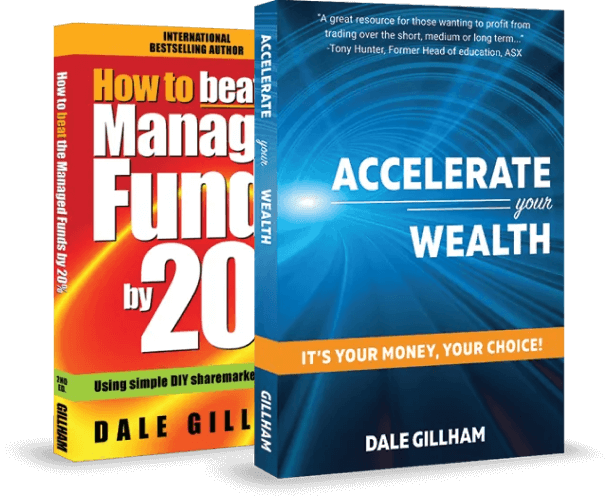
The flexibility to move smaller amounts of equity between stocks and to only be in the stock market when it is rising will result in creating a portfolio that outperforms institutional returns by a significant margin as I outline in my latest book Accelerate Your Wealth - It's Your Money, Your Choice. Selling stocks when the market is falling or moving sideways will enable you to compound your returns by selling shares at a higher price and buying more at a lower price. It will require you to be a little more proactive than an investor with a buy and hold strategy, but the outcome is worth it.
Timing the stock market is about protecting your capital
As I mentioned previously, timing the stock market is about risk management. However, a common misconception held by many who trade the share market is that they only need to be armed with the knowledge of how to pick stocks to invest in, but this ignores the importance of knowing when to exit. One of the most important aspects to successfully trading the stock market is to protect your capital. In the event that you are wrong and the stock price moves against you, it is imperative that you apply a stop loss before entering a trade. A stop loss is simply a price point where you sell a stock to preserve capital if the trade turns against you.
Remember, successfully trading the stock market is about cutting your losses short and letting your profits run. So it’s distressing to see many individuals taking on large losses and cutting profits. Recently, I was reading an interesting article on Forex traders that proves my point.
Rodriguez and Shea stated that traders are generally right more than 50 percent of the time; in fact, the ratio is around 59 percent profitable trades versus 41 percent losing trades. While on the surface this appears to be good news, when I delved deeper, I discovered that the average loss on a trade was much higher than the profit and in some cases the losses were more than double the average profit.
Why does this occur? More often than not, individuals become emotionally entangled once a trade is triggered and, in the face of a loss, default to the “hold and pray” mentality in the hope of a recovery.
In reality, when it comes to trading and protecting your capital, a stop loss is your best course of action, as it will minimise your losses and it has the potential to maximise your profits. Indeed, the better you get at selling, the more money you will make.
Others who read this article also enjoyed reading:
If you want to learn how timing the stock market can assist you to trade more confidently and profitably, view our trading courses. You can also check our what our clients have to say by viewing their reviews and testimonials.