Quick Links


BRW Fast 100


Nationally Recognised Training Logo
Diploma of Share Trading and Investment

Course Code: 69863

Even perfection comes at a price

Published in The Australian, March 2008

by Peter Switzer

ONE of the most perplexing aspects of equity market commentary is the surprising self-confidence of "experts" who completely missed this massive sell-off and now heroically telling us how low the market will go.

In fact, their predictive records make me ask the question: is the goal to invest to perfection too costly?

Tempering my attitude to asset markets, which are overwhelmingly driven by economics, are two pieces of advice from the legendary economist JK Galbraith.

The first hit me when I was teaching economics at the University of NSW in the late 80s and I was moonlighting as the business and political editor for the Triple M network.

The market had crashed in October 1987 and I put a call through to Galbraith's holiday residence in Switzerland.

I asked him what he thought would happen. Some "experts" were pulling out the D-word, invoking images of a rerun of the Great Depression.

"There are those out there who admit that they don't know what is going to happen," he said to me.

"And then there are those poor fellows who don't know that they don't know."

Many of today's market tipsters on how low the stock market will go fall in this latter category.

Around the same time I came across another Galbraith observation, which I pull out when I have the audacity to challenge the consensus view.

"In economics, the majority is always wrong," he boldy pontificated in America's famous Saturday Evening Post magazine 40 years ago.

Of course, we can get small matters such as "the Reserve Bank will raise interest rates" right, but the majority generally miss the really big and important calls.

It says something about the calibre of our early-warning systems, our experts, our newsletters and the broking houses with their analysts.

Despite the facts that tell us how hard it is to invest perfectly, many of us strive for perfection trying to guess market turning points.

We try to get on to cheap stocks before they go sky high and we invest in tips.

But even if you get your market timing right, there is often a hidden cost of success for many of us that raises doubts over the wisdom of even trying to get it right. That's called capital gains tax.

Let's imagine you saw the signs on the wall -- call it Wall Street -- and you wisely opted out of the stock market, turning your portfolio to cash before the November 1 high of the All Ords at 6853.

This action meant you missed the March 18 low of 5163 and saved yourself say a 20 per cent loss on your shares.

Further, assume your portfolio started with $200,000 and you made 20 per cent a year for four years, which took your portfolio to $414,720.

The gross gain was $214,720 with a taxable gain of $107,360 delivering a capital gains tax bill of $49,992.

Now given you have saved yourself $82,944 by picking the market perfectly, your post-tax gain would be $33,022.

By the way, the return could be higher if you wisely got 8 per cent interest on a term deposit for the time the money is out of the stock market.

It's a nice pay-off for perfection but how many of us actually did this? And while that's what we all dream of, most of us did not get 20 per cent per annum for four years, despite the fact that the stock market did better than that.

Furthermore, most of us missed the November 1 "get out" opportunity and were locked into fear and loathing as our portfolio was trashed by sub-prime, panic-stricken investors and the bears that had a picnic off the sell-off in the first three months of 2008.

Perfection is a nice pay-off but it is easier said than done. And even if you get it right, there is a tax slug.

The financial-planning community lives by the mantra that it is time in the market not timing the market that works. And a few weeks ago I showed that by being fully invested between 1979 and 2006, the return would have been about 11.4 per cent.

On the other hand, if you were in and out but missed 20 of the best days on the stock market your average return would have dropped to 7.6 per cent.

That said, not everyone thinks time in the market should be investment law.

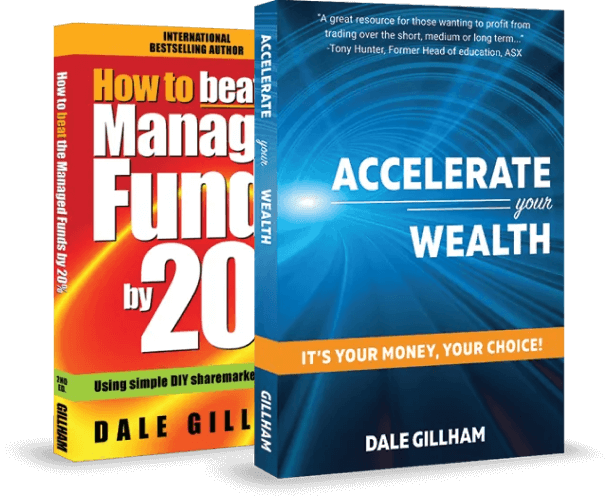
"Accepting the mantra that time in the market is more important than timing the market is probably the single greatest downfall of any investor wanting to beat the market average," argues Dale Gillham, chief analyst and director of Wealth Within.

"The public is often cautioned through advertising slogans about the perils of market timing, but time in the market is probably the most perpetuated myth in the financial planning and managed fund industry."

Gillham says this is because the industry cannot time the market and the funds are simply too large to manoeuvre with any speed.

The financial industry warns "market timers" to sell when the market is low and are out of the market when the inevitable rally occurs.

Gillham takes the alternative track and says if you are out of the market on the 20 biggest days that the market is falling, it stands to reason that your returns would surpass the market average over any 10-year period.

While Gillham is not a buy-and-hold type, he has shown that taking the top 20 stocks and creating two funds based on odds and evens you could outperform the industry averages and not pay a fund manager fee.

Personally, I think timing is often hard and so I like time in the market, but I prefer to do timing and time in the market. And the time must be close to start getting in.

Buying great quality shares inside a self-managed super fund and hanging on to them until you are 60 and retired, when no tax applies, has to be the go.

It might not be the perfect investment strategy, but in a challenging stock market world it sure is a very tax-effective one.