
Trading Courses
Master the Strategies to Achieve
Consistently Profitable Returns
Plenty of trading educators make bold claims. At Wealth Within, we make just one: by studying our share trading courses, you’ll receive a quality education that delivers consistent, proven results. As the only government-accredited educator in Australia teaching technical and fundamental analysis through the Diploma of Share Trading and Investment (11398NAT), we design our courses to ensure you can trade more confidently and profitably.





Rated
Trade with More Certainty than over 95% of all Traders
This isn’t just about learning to trade, it’s about building a skillset that becomes one of the most valuable investments you’ll ever make.
Learn Profitable Skills
The difference between those who struggle and those who thrive isn’t luck, it’s certainty. Certainty in your trading strategy, execution, and consistent profitability in all market conditions.
At Wealth Within, we don’t just teach trading, we teach you how to trade profitably by minimising risk and maximising profits. Our structured, competency-based trading courses ensure you’re not just successful today, but in ten, twenty, even thirty years from now.
If you want to trade with more certainty than 95% of all traders, it starts with a proven, repeatable trading strategy that removes guesswork and gives you the skills to win.
Completing the Diploma has given me the confidence to be making 30% plus returns on my trades with some returning over 100%...
Clayton Mizzi
Build Long-Term Trading Success
Success in the markets isn’t about chasing stock tips or using one-size-fits-all systems, it’s about having a repeatable, structured process that ensures profitability, no matter the market direction.
Markets shift. Conditions change. And without the right skills, traders leave their results to chance.
That’s why Wealth Within teach a competency-based approach, so you can take control of your financial future and generate consistent profits because in a market full of opportunity, the person with the greatest trading skills always wins.
Since completing the course my medium to long-term portfolio is up over 60% while my short-term trades are achieving returns of up to 200%...
Garry Cooke
Enrol Now, Pay Later Interest Free*
To get more information including course fees, download our Course Handbook today. (*conditions apply)
Learn More About our Trading Courses
With a no sales hype approach, and consistently high student satisfaction, it’s no wonder Wealth Within is Australia’s most trusted name in trading education.
 Trading Mentor Course
- Beginner friendly
- Best suited to those who are new to the stock market
- Learn profitable foundations
 Short Course in Share Trading
- Ideal for those wanting to achieve consistent profitability
- Self-contained with mentoring support
- Cut through the noise with proven techniques and strategies
 Diploma of Share Trading and Investment (11398NAT)
- Trade markets with a higher level of sophistication
- Discover how much money you can make before you trade
- Written by industry professionals with over 80 years’ combined experience
5 Stars
Years in business delivering high-quality education
of students rate the quality of education as excellent or very good
of students recommend Wealth Within
It’s not just a course, the support provided by the Wealth Within team accelerates your learning and your overall success as a trader…
Ryan Capra
If you are serious about trading either short term or long term, I highly recommend getting a quality education with Wealth Within…
Vince Bucello
Having completed the Diploma, Fred is now looking forward to having more freedom to do what he enjoys rather than just working.
Frederic Capitan
I had 10 wins out of 10 trades and I am extremely happy as I have consistently had more wins than losses, which means I am well in front…
Peter Simpson
Why Study With Wealth Within?
Real People, Real Results
It’s our attitude of 'customer first' in everything we do that has seen our customers benefit by becoming more empowered to take control and achieve their financial goals with our stock market trading courses that deliver real results.
You wouldn't step on a plane flown by a pilot with zero flying time. Likewise, when you're learning how to trade the stock market, you must learn from those who 'walk-the-talk'.
I am currently trading at a 65% success rate and I am way up on my trading from where I would be if I hadn't completed the Diploma…
Theo Perifanos
Unmatched industry experience & expertise
The nationally accredited Diploma of Share Trading and Investment offers the highest quality, internationally recognised education to ensure clients are given the greatest advantage in achieving their financial goals. If you’re serious about your success in the stock market, there's no room for compromise.
Dominic's advice to anyone who listens is to just do the course because education is the key to your success in the stock market.
Dominic Sasso
Your Journey to Wealth Starts Here
If you're new to trading or you're already trading but want to increase your profitability and trade with more certainty, our stock market trading courses will give you the skills, strategy, and confidence to trade in all market conditions.
With the right education and guidance, you can stop second-guessing and start trading like a pro, so why wait?
After completing the Diploma I was able to bring forward my retirement by over a decade to spend quality time with my family and to enjoy life to the fullest…
Darrell Murray
Enrol Now, Pay Later Interest Free*
To get more information including course fees, download our Course Handbook today. (*conditions apply)
Frequently Asked Questions


Competency Based: This provides evidence that on completion of the course, you will be competent and confident in the applying the techniques and strategies being taught.
ASIC Training Register: Gain peace of mind knowing that the Diploma of Share Trading and Investment is an ASIC-approved training course providing knowledge and skills in securities.
Pathways: On completion of the Diploma, students may also be eligible for credit towards the Bachelor of Business (Finance) at institutions both locally and offshore, subject to meeting the university's entry requirements.
Continuous Professional Development: Our trading courses are recognised by the Financial Planning Association (FPA) for Continuing Professional Development (CPD), with the Short Course in Share Trading earning 45.25 CPD points and the Diploma of Share Trading and Investment earning 75 CPD points. Additionally, CPA Australia acknowledges our courses for ongoing professional development, with each hour of learning counting as one hour of Continuing Professional Education (CPE).
No Marketing Hype: We also won't give you any sales and marketing hype or make any false claims. Every trading course offered must pass our rigorous standards for content and student support because your ongoing success comes first.
Client Satisfaction: As testament to the quality and outcomes of our trading courses we offer, our students have continually rated them highly because we deliver on what we say.
Our trading courses utilise a flipped classroom model that emphasises student engagement through an interactive online learning environment, maximising quality, flexibility, and accessibility.
This learner-centred approach allows personalised interaction with our team to meet the individual needs as students progress through each course. It creates a responsive environment, motivating students to confidently complete their studies and assessments with interactivity and feedback loops to achieve their goals.
The benefit to you is that you can study anytime, anywhere without being constrained by a classroom environment, but you can still interact with other students via our student forum.
Key Features:
- Comprehensive learning and assessment materials
- Instructional, interactive webinars to reinforce learning
- Self-assessment and skills practice activities
- Suitable for professionals, self-managed super funds, beginners, or more experienced traders who are not yet profitable or want to take more profits from the market
- Interactive support services including email and phone
- Weekly reports and expert guidance in applying the techniques in the real world of trading (applies to Diploma on commencement of Module 4).
- Educational forums every month
Course fees vary depending on the course you enrol in, starting from $1,997. The Short Course in Share Trading and the Diploma of Share Trading and Investment also qualify for an interest-free payment plan over 12 or 18 months.
Our courses are ideal for individuals looking to increase their cash flow and improve their lifestyle, whether for themselves or their families or those aiming to grow their capital to enjoy a more comfortable retirement. They're also highly valuable for financial planners and accountants who want a deeper understanding of the stock market to better advise their clients. Given this, our trading courses are suitable for anyone:
- New to the stock market, wanting to learn proven techniques and strategies
- A private share trader seeking specialist advanced trading strategies
- Working in areas such as stock broking and financial advisory roles
- Seeking a career change and aspiring to work in the finance and investment industry
- A professional servicing the finance and investment industry
- Seeking an internationally recognised industry qualification
| Wealth Within | Other Programs |
|---|---|
| One-on-one Mentoring | Group sessions or seminars |
| Personal relationship with a highly experienced trading mentor (during training) | Limited to no support |
| Personal relationship with highly experienced trading experts (when trading) | Almost no interactions with the actual experts |
| Detailed structured training and mentoring to become a profitable share trader | Mostly slides or PDFs with limited strategies and no structured training |
| Weekly reports with the analysis taught in the course applied to the real world of trading (on commencement of Module 4) | No analysis applied in the real world of trading |
| Direct feedback on any stocks before you enter a trade or while managing a trade (on commencement of Module 4) | No support on personal trades |
| Access to even more knowledge and important to the real world when you are independent. We'll never take commissions from any brokers when you trade | Almost no interaction with other students or mentors. Conflict of interest, as they make money each time you trade, regardless of whether you actually make money |
Why is this important to you?
Before investing money in a stock trading course, you need to know that the education you receive delivers results and supports you in achieving your financial goals.
One of the many benefits of what we teach with our share trading courses is that students can prove to themselves how much money they can make from the market before they invest.
You see, our goal is simple - we want to give you everything you need to know when it comes to how the market works so you can profitably trade in any market condition to achieve your financial goals or those of your clients.
Every week, we share new videos on our YouTube channel, ranging from Hot Stock Tips to episodes of the Australian Stock Market Show.
We also release weekly educational content through our Talking Wealth podcast, which receives over 100,000 downloads each month and has been recognised by Feedspot as one of the top 100 podcasts globally.
Because we are serious about your success in the market! In fact, the success of our students has drawn considerable attention from the Australian media with clients profiled in TV appearances on Channel 10, Channel 9 and A Current Affair. Students have also been profiled in media interviews including the Herald Sun, Your Trading Edge and the Courier Mail, to name a few.
In a nutshell, the knowledge and practical hands-on skill you gain by completing a trading course with Wealth Within will enable you to confidently formulate share trading strategies based on the specialist techniques taught, so you can safely and profitably trade the market.
While expertise takes time to acquire, studying with Wealth Within means you will develop the right skills and knowledge in a supportive environment whilst working with experts in their field.
If you still have more questions related to our trading courses, read our FAQs. Alternatively, download the Course Handbook to learn more about our trading courses.
Making A Difference
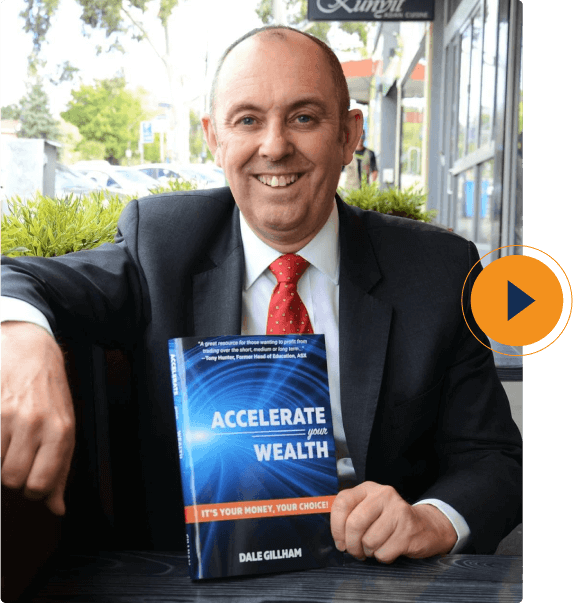
Wealth Within was co-founded in 2002 by Dale Gillham to provide a range of solutions to support our clients achieve their financial goals.
Our mission has always been "customer first in everything we do" – which means breaking down a lot of the myths in the market that hold individuals back from achieving their financial goals.
