Iran War Just Escalated: 3 ASX Metals Stocks Running Hot

By Fil Tortevski and Pedro Banales
Reading Time: 13 minutes
General Advice Disclaimer
This article is for general educational purposes only and does not take into account your personal financial circumstances, objectives or needs. Before making any investment decisions, consider your individual circumstances and seek independent financial advice if necessary.
The Iran conflict has taken another significant step forward, and in the same moment, a piece of critical information hit the market that sent three ASX-listed rare earth stocks sharply higher. In the latest episode of the Hot Stock Tips Show, Wealth Within's senior analyst Filip Tortevski was joined by senior analyst Pedro Banales to break down the macro forces driving the rare earth sector and to analyse the charts of three stocks that could deliver massive gains if the trend continues.
The discussion covered everything from the US Pentagon's strategic deal with Lynas Rare Earths to the emerging opportunities in smaller players like Iluka Resources and Arafura Resources, all set against the backdrop of a rapidly evolving geopolitical landscape.
For those who are just getting started in the markets and want to understand the basics of how stocks move and how to read the signals, Wealth Within's comprehensive guide on the stock market for beginners is an excellent place to build your foundation before acting on opportunities like these.
The Macro Backdrop: Why Rare Earths Are Centre Stage
The Iran war is escalating, with the United States now targeting the Strait of Hormuz and countries around the world scrambling to secure energy and resource supply chains. Filip set the scene by explaining that the conflict is accelerating a trend that was already well underway, which is the push by Western nations to reduce their dependence on Chinese rare earth materials. These materials are essential to the evolving modern world, underpinning everything from artificial intelligence and advanced technology to military hardware and national defence systems.
Pedro expanded on this, framing it as a mega trend centred around energy security and the digitisation of the global economy. The majority of rare earth supply has historically come out of China, and the world has already seen instances where China has restricted exports to countries like Japan and the United States.
This has created an urgent need for alternative Western supply chains, and Australia, with its expertise, established players, and significant deposits, is uniquely positioned to benefit. Both analysts noted that what makes this moment particularly interesting is that Australian companies are not just digging rare earths out of the ground anymore. Instead, they are moving up the value chain into processing and refining, which is the segment that China has historically dominated.
Lynas Rare Earths: The Canary in the Coal Mine
The first stock analysed was Lynas Rare Earths, which had just announced a landmark deal with the US Pentagon guaranteeing a minimum price of approximately US$110 per kilogram for key rare earth materials. The agreement also commits the United States to purchasing roughly $96 million worth of supply over four years, providing Lynas with significant revenue certainty and further cementing its role in Western supply chain security.
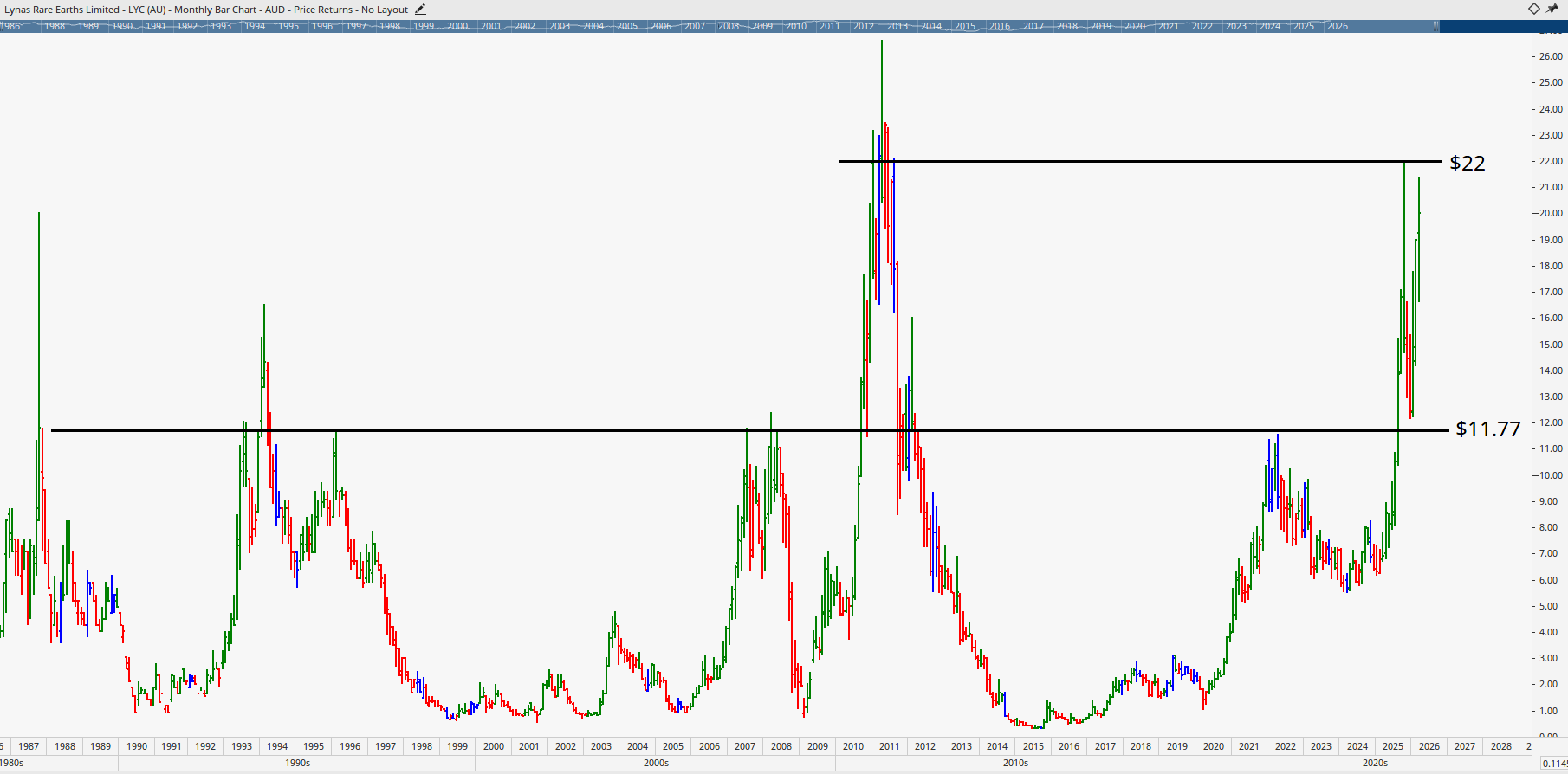
Filip walked through the chart, reminding viewers that Wealth Within had first flagged the technical setup on Lynas when the stock was trading around $7. Since then, the stock has broken out beautifully, with many of Wealth Within's students and clients capturing substantial gains along the way.
The key level Filip identified was $11.77, which had served as massive resistance since the stock's inception. When the stock pulled back to test this level in January 2026, it bounced perfectly which is a textbook demonstration of former resistance turning into support.
Looking ahead, Filip identified the $22 level as the immediate target, noting that the stock appeared poised to break through it in the short term. Beyond that, $23 to $24 represented the next significant resistance zone, mirroring where the stock topped out during its last major vertical run in 2010 and 2011. Filip cautioned that when stocks become this vertical, a healthy pullback is normal and even desirable.
If the stock can pull back and then base higher before making its next move, that would be the strongest signal that new all-time highs are on the table. However, if it spikes to the highs and then collapses back without a constructive pullback, that could mark the peak of what buyers are willing to pay in the short to medium term.
Pedro added an important perspective, describing Lynas as a canary in the coal mine for the broader rare earth sector. He noted that the stock's personality had changed significantly in recent months, with the monthly bars becoming longer and more volatile. This means the stock may be challenging for less experienced traders to ride out emotionally, with fear and greed amplified by the larger price swings. He emphasised that Lynas is cyclical by nature as it is not a stock you simply buy and hold forever. Active management and knowing when to take profits are essential.
Iluka Resources: A Range-Bound Setup Ready to Spring
The second stock was IIluka Resources, another company doubling down on the rare earth story. Pedro explained that Iluka has a separate mineral sands segment of its business that has been underperforming, which the company has effectively put on pause. What the market was digesting through January and February was the weaker performance from that division. However, the important strategic move is that Iluka is redeploying its capital into its rare earth operations, including the development of a rare earth refinery in Perth that is expected to come online later this year or early next year.
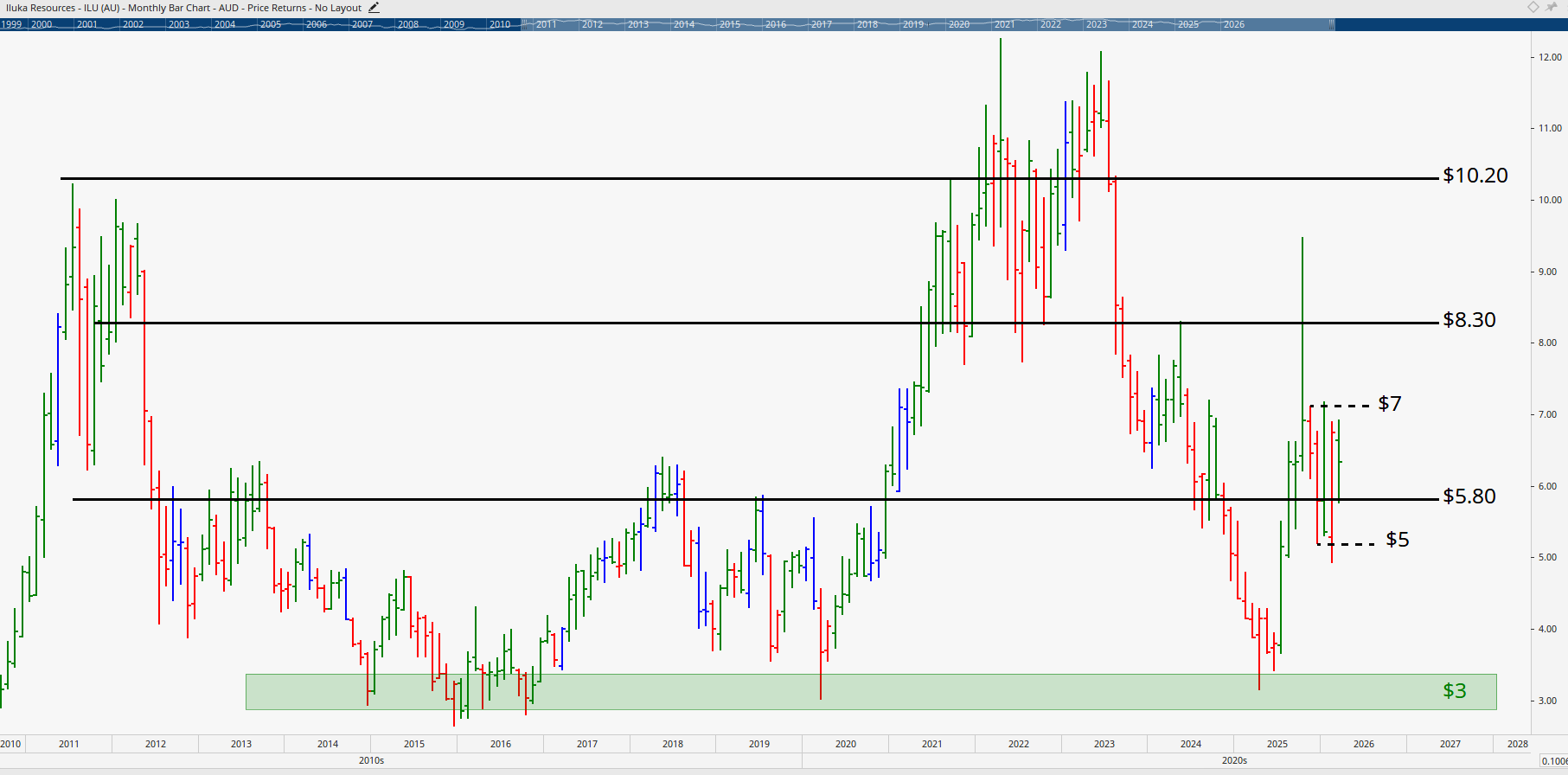
On the chart, Pedro identified a clear range-bound pattern on the weekly timeframe, with the stock oscillating between approximately $5 and $7. The stock had been bought and sold repeatedly within this range, with clear agreement between buyers and sellers at these levels. Pedro explained that the key moment will come when the stock breaks decisively out of one of these two boundaries. A break above $7 would likely trigger a sharp move higher, consistent with how the stock has behaved historically during previous consolidation-to-expansion transitions.
Filip reinforced the importance of long-term price history for Iluka, pointing out that the $3 level has been a zone of massive support going all the way back to 2014, a span of twelve years during which the stock has repeatedly bounced from this area and gone on to deliver significant runs. More recently, the $5.80 level had acted as strong resistance for an extended period, and the stock was now finding support at that same level.
Filip's view was that if Iluka breaks above $7.10, the initial targets would be around $8.20 to $8.30, with a potential run back up to $10.20 mirroring the stock's previous major move in 2022. Pedro's broader target was even more ambitious, suggesting the stock could reach $10 to $12 once the expansion phase takes hold. For traders looking to deepen their understanding of how to identify these consolidation-to-expansion setups and time their entries more effectively, the Short Course in Share Trading covers the foundational techniques for trend analysis, volume interpretation, and proven entry and exit strategies.
Arafura Resource: The Highest Potential But Highest Risk
The third and final stock was Arafura Resources, a smaller company developing the Nolans project in the Northern Territory. What makes Arafura particularly interesting is that it is focused on neodymium and praseodymium which are the exact same magnet metals that Lynas supplies. Filip explained that the logic is straightforward: if Lynas is attracting attention as a key Western alternative to Chinese rare earth supply, then smaller companies producing the same materials should also benefit as the sector heats up.
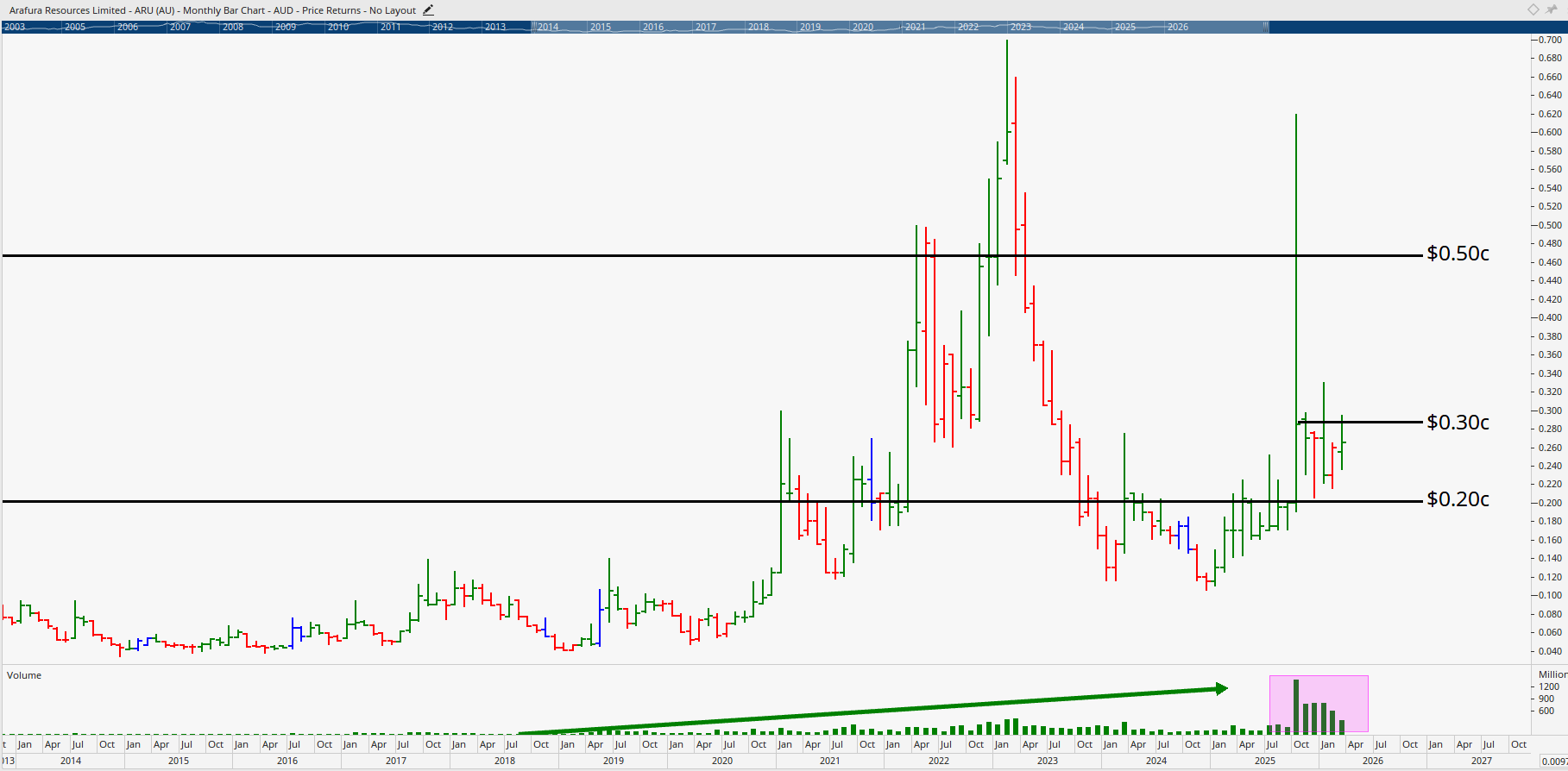
At around 30 cents, Arafura is a much smaller and more volatile stock than the other two, and Filip was clear that it is not for the faint-hearted. However, the chart told a compelling story. The stock had formed a significant basing pattern, with buyers coming in at key levels and, crucially, the subsequent selloffs holding above the initial base rather than collapsing back to prior lows.
This is an important distinction because when a stock spikes and then sells off all the way back to where it started, it suggests the initial buying was speculative rather than genuine accumulation. The fact that Arafura was basing higher suggested real buying interest building beneath the surface.
The most striking feature on the chart was the volume. Filip pointed out that the stock had just recorded the highest volume in its entire trading history, and that volume came in on the biggest uptick the stock had seen in recent times. Pedro confirmed this observation, adding that what made it even more significant was that the volume was sustained rather than being a single-day spike. In illiquid stocks, you often see a sharp burst of volume that immediately dissipates, but Arafura's volume had increased and been maintained, indicating genuine institutional-level interest.
Pedro placed the stock in a range-bound zone between approximately 20 cents and 30 cents, noting that if it could break above 32 to 33 cents, the next run could target the 48 to 50 cent level, representing roughly 70 percent upside. If the stock truly turned the corner and entered a sustained expansion phase, there was potential for it to challenge the 60 to 70 cent area, which would represent approximately 120 percent upside from the 30-cent entry.
Pedro was also keen to point out that Arafura had received $533 million in USD debt funding from the Australian government for its processing plant, demonstrating significant government backing and further validating the company's role in the broader rare earth reshoring strategy.
Both analysts agreed that Arafura carried the most potential upside of the three stocks but also the most risk. It requires traders who understand volatility, have clear rules, and accept the nature of smaller-cap stocks. Filip summarised by saying that as long as the stock held above its momentum levels and broke through the 33 to 34 cent resistance, it could be the start of the next significant run but if it broke through support, that would be a signal to step aside and wait for further developments.
Why Technical Analysis Leads the Fundamentals
A recurring theme throughout the episode was the power of technical analysis to anticipate major moves before the fundamental story becomes mainstream. Pedro made this point explicitly with Lynas, noting that the technical setup was visible on the chart when the stock was trading at $7, well before the Pentagon deal was announced and before the Iran war escalated to its current level. The chart was signalling accumulation and a potential breakout long before the headlines caught up.
Filip reinforced this by demonstrating how historical price levels from years and even decades ago continue to influence how stocks trade today. With Iluka, the $3 support level dating back to 2014 proved relevant in 2025. With Lynas, the $11.77 resistance level from early in the stock's life became the exact level where the stock bounced during its recent pullback. These are not coincidences; they reflect the collective memory of the market and the behaviour of institutional participants who track these levels closely.
For both analysts, the message was consistent: while understanding the macro story and fundamental drivers is valuable for context, it is the technical analysis that tells you when to act. The fundamentals tell you what might happen; the technicals tell you what is actually happening in terms of supply, demand, and price. You can watch the full analysis of these stocks and many more in the Stock Market Show.
The Critical Minerals Mega Trend and What It Means for Australian Investors
Stepping back from individual stocks, the broader takeaway from this episode is that the critical minerals mega trend is accelerating faster than many anticipated. The convergence of the Iran conflict, US-China tensions, the global push toward AI and advanced technology, and the strategic imperative of national security has created a perfect storm for companies that can supply and refine rare earth materials outside of China's influence.
Australia is at the centre of this shift. With world-class deposits, established companies like Lynas already producing and exporting, and emerging players like Iluka and Arafura building processing and refining capacity domestically, the Australian rare earth sector is positioned to benefit from what could be a multi-year tailwind.
Pedro described it as a story about energy in the broadest sense and Australian companies are moving up the value chain from simply digging materials out of the ground to processing and refining them, which is where the real value lies.
Managing Risk in Fast-Moving Stocks
Both Filip and Pedro repeatedly emphasised the importance of risk management when trading stocks in rapidly moving sectors. With Lynas becoming increasingly vertical, Filip noted that the risk-reward profile has changed compared to when the stock was sitting at $7 in a consolidation. Riding a trending stock requires different strategies than entering one at the beginning of a breakout, and getting your stops right becomes critically important when price action accelerates.
Pedro highlighted the emotional challenges that come with volatile stocks, particularly the fear and greed cycle that can trap inexperienced traders. He pointed out that many people would have missed the initial spike in Arafura because it moved so fast, while others may have bought near the top of that spike and then watched the stock pull back, a painful experience that can be avoided with proper technical knowledge.
His advice was clear: do not chase spikes, and do not buy at the top of a vertical move. Instead, study the stock during its consolidation phase, understand its personality, and position yourself before the next breakout occurs.
The discussion also touched on the danger of turning a winning trade into a losing trade, something both analysts said they see constantly with traders who come to Wealth Within for help. A stock goes up, the trader feels good, and instead of following their exit rules, they hold on hoping for more. Then the stock reverses, the profit evaporates, and suddenly they have become a reluctant long-term shareholder in a stock they only intended to hold for a short-term trade.
The solution, as both analysts agreed, is having clear rules and the discipline to follow them regardless of how you feel in the moment. The Diploma of Share Trading and Investment is specifically designed to teach this proven five-step approach, giving you the techniques and the structured process to trade with confidence in any market condition.
Ride the Rare Earth Wave With the Right Skills Behind You
This episode underscored a powerful reality: the rare earth and critical minerals sector is one of the most exciting areas of the ASX right now, driven by forces that are unlikely to dissipate anytime soon. Lynas Rare Earths is leading the charge with its Pentagon deal and strong technical breakout, targeting the $23 to $24 level in the short term with the potential for new all-time highs if it can produce a healthy pullback and base higher.
Iluka Resources is consolidating between $5 and $7 with a rare earth refinery on the way, and a breakout above $7.10 could see it run toward $10 to $12. Arafura Resources carries the most potential upside of the three, with a possible move from 30 cents to the 50 to 70 cent range, backed by record volume and significant government funding, but it also demands the most experience and risk tolerance from traders.
The common thread across all three stocks is the importance of knowing when to buy, when to sell, and how to manage your position while the trade is active. The macro story is compelling, but as Filip and Pedro demonstrated throughout the episode, it is the technical analysis that provides the actionable signals.
At Wealth Within, our team of investment professionals with over 80 years of combined experience has helped thousands of clients learn to trade shares with confidence and consistency. If you are ready to stop guessing, stop chasing headlines, and start trading with a structured process that turns opportunities like these into real profits, get in touch today and discover how our courses can help you take control of your financial future.