How the Stock Market Works: What Investors Need to Know

By Dale Gillham
Reading Time: 12 minutes
General Advice Disclaimer
This article is for general educational purposes only and does not take into account your personal financial circumstances, objectives or needs. Before making any investment decisions, consider your individual circumstances and seek independent financial advice if necessary.
You don't have to be an investor to hear about what's happening in the stock market. Whether shares are hitting record highs or the market is falling sharply, these stories regularly make the news.
But how does the stock market work, and why do share prices change?

The stock market isn't as complicated as many people think. At its simplest, it's a place where people can buy and sell shares in publicly listed companies.
But a lot more influences what those shares are worth.
To understand how it all works, we need to start with what a share is, why companies issue them, and what happens when shares are traded on the stock exchange.
What is a share?
A share represents part ownership of a company. When you buy shares, you become a shareholder, meaning you own a portion of the business.
Let's say a company has issued 10,000 shares and you own 1,000 of them. You own 10% of the company's shares.
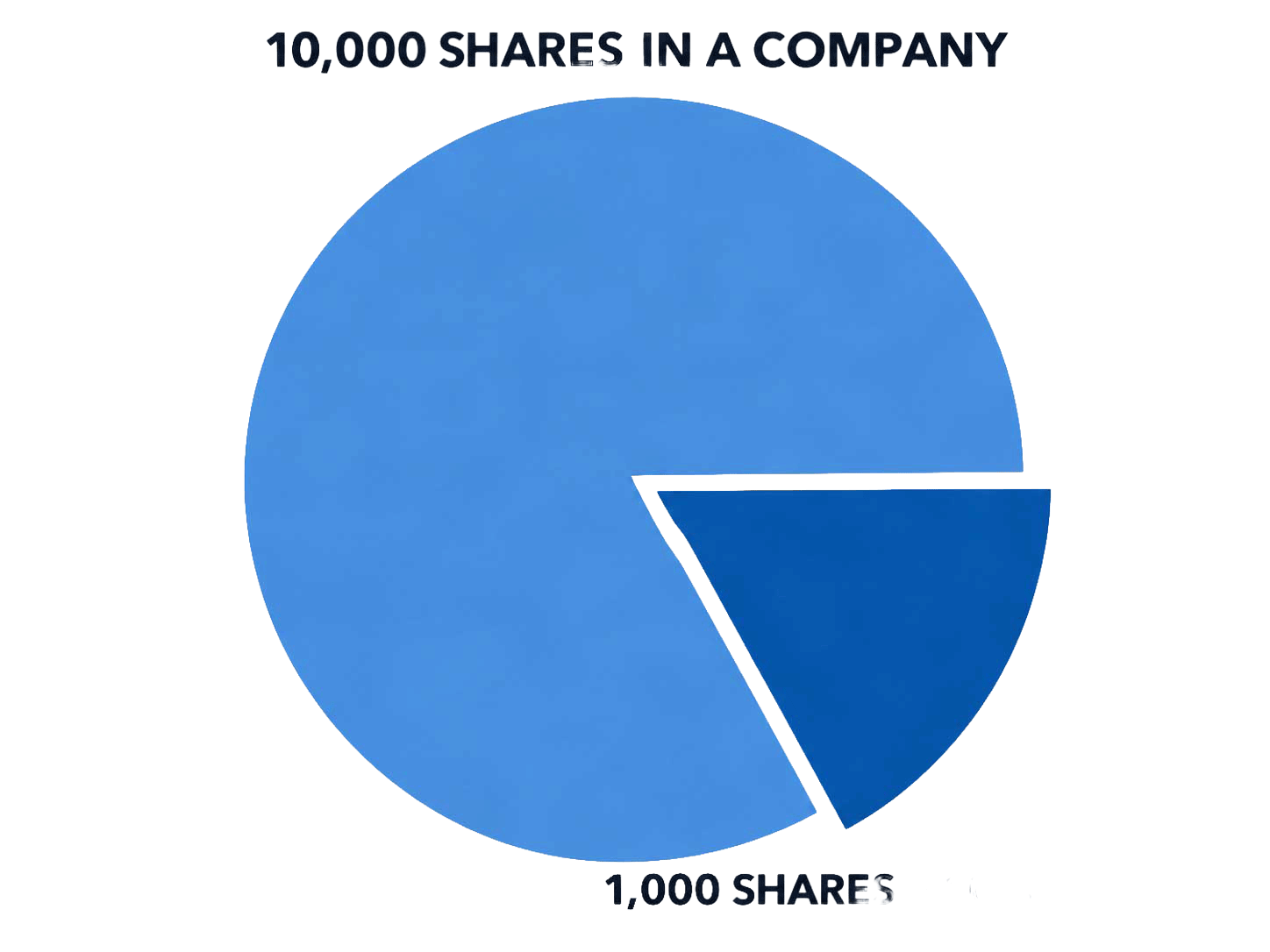
Of course, when you're buying shares in a large company like BHP or National Australia Bank, you're generally purchasing a much smaller percentage of the business because these companies can have hundreds of millions of shares on issue.
As a shareholder, you may benefit in two ways. First, if the share price rises, your investment becomes more valuable, and you may make a profit when you sell. Second, some companies pay dividends, which are payments made to shareholders from company profits.
Depending on the shares you own, you may also have voting rights, which allow you to have a say in certain company matters.
However, owning shares doesn't guarantee you'll make money.
If the share price falls, your investment loses value, and you may realise a loss if you sell your shares for less than you paid. There's also no guarantee that a company will continue paying dividends.
Why do companies issue shares?
You might wonder why a successful business would want to sell part of its ownership to other people.
One main reason is to raise money.
For example, a company might want to expand its operations, develop new products, purchase equipment or move into new markets. All these activities require capital.
Rather than borrowing money, the company may raise funds by issuing its shares to the public via an initial public offering, commonly called an IPO.
An IPO allows a company to raise capital by offering its shares to investors for the first time. Investors then become shareholders.
In Australia, many well-known businesses, including BHP, Coles and National Australia Bank, are listed on the Australian Securities Exchange (ASX).
What happens after a company is listed?
Once the company completes the capital raising and its shares are admitted to trading on the stock exchange, investors can buy or sell them to other investors.
This distinction matters because the company doesn't receive money every time its shares are traded.
When a company issues new shares to raise capital, it is participating in what is known as the primary market.
When investors buy and sell existing shares to one another, those transactions occur in the secondary market.
In other words, the primary market helps companies raise capital, while the secondary market allows shareholders to buy and sell their investments.
| Primary market | Secondary market | |
|---|---|---|
| What happens? | A company issues new shares to investors. | Investors trade existing shares with one another. |
| Who receives the money? | The company | The investor selling the shares |
| Why does it happen? | To raise capital | To allow investors to trade their shares |
| Example | A company issues new shares through an IPO. | An investor buys existing BHP shares on the ASX. |
How does the stock market work?
The easiest way to understand how the stock market works is to think of it as an auction.
In an auction, buyers decide how much they're prepared to pay for something, while sellers decide how much they're willing to accept.
The stock market works much the same way, except that buying and selling take place electronically.
In Australia, the ASX operates a market where investors can trade shares in listed companies. Buyers and sellers generally place their orders through stockbrokers, and the exchange's electronic trading system matches compatible orders.
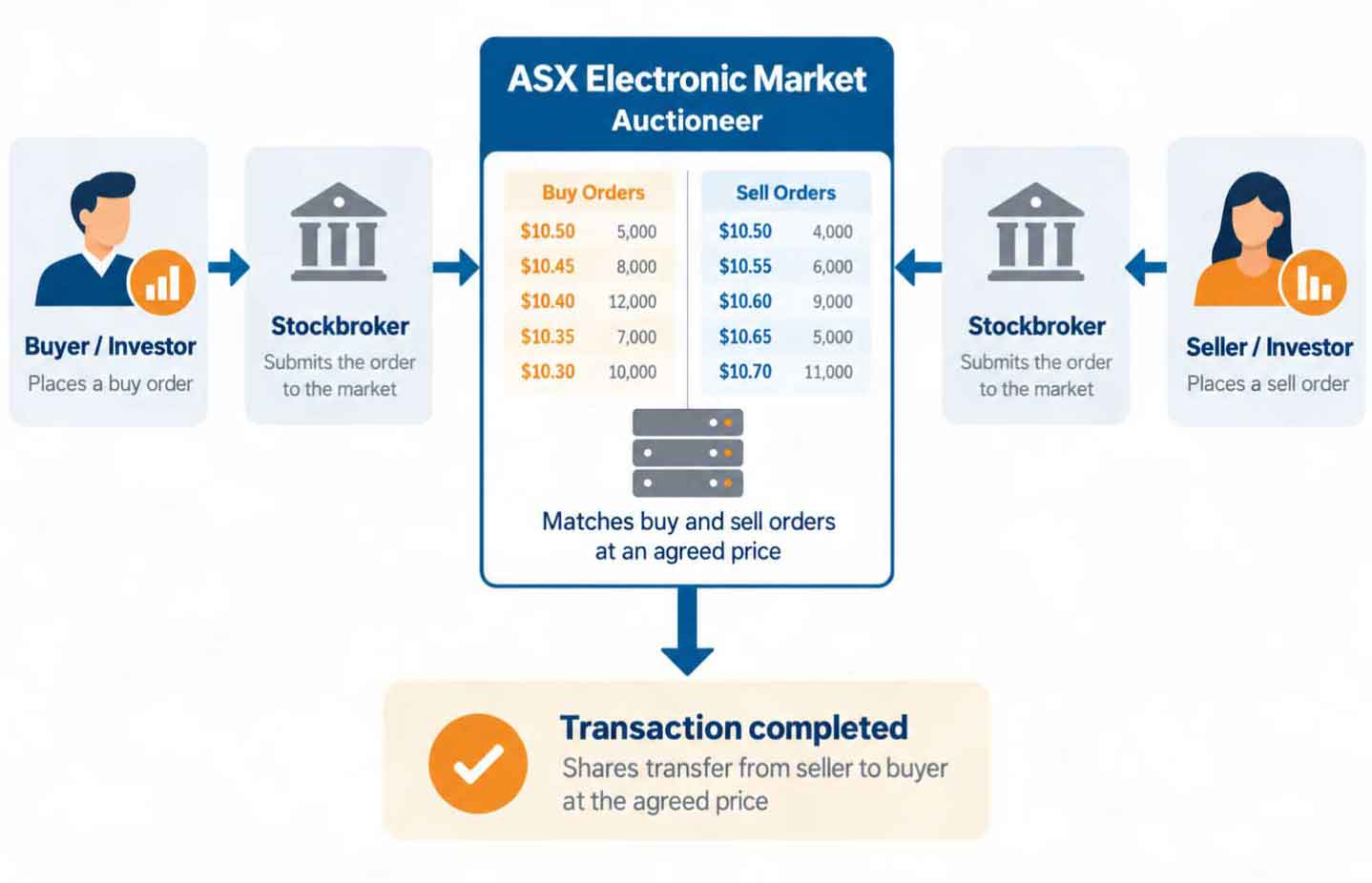
When a buyer and seller agree on a price, a transaction occurs, and the shares transfer from the seller to the buyer through the settlement process.
Let's look at a simple example.
Suppose you own 1,000 shares in a company and want to sell them for $10 each. This is also known as the 'ask price'.
If someone is prepared to buy those shares at $10, a trade can take place.
However, if buyers are only prepared to pay $9.90, you have a decision to make. You can accept the lower price, or you can wait and see whether someone is prepared to pay $10.
Of course, there's no guarantee that someone will pay your asking price.
Now imagine thousands of investors buying and selling shares in the same company throughout the day. Each transaction contributes to the trading activity you see on a price chart.
That's how the market operates. Buyers and sellers continually decide what they're willing to pay or accept, and those decisions determine the prices at which shares change hands.
Once you understand how the stock market operates, the next step is learning how to buy shares through a stockbroker. My guide on how to invest in shares for beginners explains the process.
What determines the price of shares?
The price of a share is determined by supply and demand. In other words, it depends on how many shares people want to buy or sell and the prices they're willing to accept.
Think about a company like BHP. If many investors want to buy its shares but sellers aren't willing to sell at the current price, buyers may have to offer more to get the shares they want, which can push the share price higher.
Now turn that around. If more investors want to sell and buyers aren't prepared to pay the current price, sellers may need to accept less.
But what makes investors change their minds about what they're prepared to pay?
Company profits, economic conditions, company news, interest rates and expectations about future growth can all influence their decisions.
And sometimes it only takes one announcement to change how investors view a company.
How does company news affect share prices?
A recent example is Australian data centre operator NextDC.
On 21 October 2026, NextDC announced a significant reduction in its revenue and earnings forecasts following delays to electricity infrastructure needed for one of its Melbourne data centres.
The announcement raised concerns about the company's future earnings, and its share price fell 41.7% that day.
Investors were reassessing what they believed the business was worth considering the new information.
A day later, furniture retailer Nick Scali saw a similar reaction. Its shares fell more than 15% following an announcement about expected profits for the first half of the financial year.
These examples show how quickly investors can change their expectations about a company's future, and how that can affect the price they're prepared to pay for its shares.
How does investor sentiment influence prices?
Share prices don't always move because a company has announced something new.
Sometimes investors become enthusiastic about a particular company or industry because they believe it will perform strongly in the future.
Artificial intelligence and data centres provide a good example. Investors have been attracted to companies in developing the infrastructure needed to support growing demand for AI.
But expectations can change, particularly when investors begin questioning whether companies can deliver the growth and profits they are anticipating.
This is why it's important not to get caught up in the excitement surrounding a particular company or industry.
Just because everyone else is buying doesn't mean you should follow. It's always better to do your own research before deciding to invest.
A share rising strongly doesn't necessarily mean it will keep rising. Investors can become overly enthusiastic about a company, just as they can become overly pessimistic when prices are falling.
Why does the stock market rise and fall?
When people say the stock market has risen or fallen, they're generally referring to the movement of a share market index.
In Australia, the S&P/ASX 200 and All Ordinaries are commonly used to measure the broader market's performance.
An index tracks the performance of a group of shares, giving investors an indication of how that part of the market is performing.
However, just because the index rises doesn't mean every share listed on the exchange has increased in value.
Take 21 October 2026, when NextDC fell more than 41%. Despite that significant decline, the S&P/ASX 200 finished the day 0.16% higher.
So how can one company lose so much value while the broader market rises?
Because an index reflects the combined performance of many companies. While NextDC was falling, gains in other stocks helped lift the overall index.
A company's size within an index also matters, as larger companies generally have more influence on its movements.
This is why you can look at your portfolio and see some shares rising while others are falling, even when the overall market is moving strongly in one direction.
The broader market is also affected by risks such as inflation, interest rates, political events, commodity prices and currency movements, which can affect investor confidence and expectations about company earnings.
Who participates in the stock market?
Individual investors are only one part of the stock market.
Superannuation funds, managed funds, hedge funds, and other financial institutions also control substantial amounts of money.
| Market participant | What they do |
|---|---|
| Individual investors | Buy and sell shares using their own money, generally to build wealth or generate income. |
| Superannuation funds | Invest savings on behalf of their members, including in Australian and international shares. |
| Managed funds | Pool investors' money and invest it according to the fund's investment strategy. |
| Hedge funds | Use a range of investment and trading strategies, which may include short selling, to pursue returns. |
Because these institutions manage large amounts of capital, their buying and selling can influence share prices far more than an individual buying a few hundred shares.
For example, a superannuation fund may need to purchase shares when more money is invested in the fund. A managed fund may need to sell shares when investors withdraw their money.
Large institutions also have access to specialist trading desks and sophisticated trading systems that allow them to handle transactions differently from individual investors.
By learning to analyse price charts, you can see the effect of buying and selling activity, including large institutional activity.
How do ETFs influence the stock market?
Exchange-traded funds, or ETFs, have become another important part of the market.
Many ETFs track an index, which means they invest in the companies included in that index.
For example, an ETF tracking the S&P/ASX 200 provides exposure to shares in the companies making up that index.
As money moves into or out of these funds, it can create buying and selling activity in the underlying shares.
In my experience, this activity can benefit individual traders because it adds liquidity to larger companies.
What are trading volume and liquidity?
Two things I regularly look at when assessing shares are trading volume and liquidity.
Trading volume tells you how many shares have changed hands over a particular period (i.e. a day, a week or a month, for example).
Liquidity, on the other hand, refers to how easily you can buy or sell shares without significantly affecting their price.
Generally, larger companies attract more trading activity because individual and institutional investors trade them more widely.
Smaller companies may have far fewer buyers and sellers, which can make them illiquid and their share prices more volatile.
A simple analogy I use to explain this: Think about dropping something into a pond. Even a small object can create ripples across the water.
The same can happen with shares that have very little trading activity. A relatively small transaction can noticeably affect the share price.
In a heavily traded share, more buyers and sellers generally participate, so an individual transaction may have less impact.
This is one reason why I generally prefer larger, more liquid companies when selecting shares.
Can people make money when the stock market falls?
Most people understand that individuals can make money when share prices rise. However, some market participants also seek to profit when prices fall.
This is known as short selling.
Short selling involves borrowing shares from another investor, selling those shares in the market and attempting to buy them back later at a lower price.
If the share price falls, the short seller may make a profit. If the price rises instead, the short seller can incur a loss.
Large institutions, including hedge funds, may use short selling as part of their trading activities.
Short selling can add selling pressure to the market, especially when large institutions are involved.
It also carries greater risks than simply buying shares, where your maximum loss is limited to the amount invested. Losses from short selling, however, can theoretically be unlimited.
For this reason, it's a strategy best left to experienced traders who understand how to manage these risks.
For someone learning how the stock market works, the key thing to understand is that not everyone trading shares expects prices to rise.
Why is it important to understand how the stock market works?
One of the biggest mistakes people make is assuming that because buying shares is easy, making money from the stock market must be easy as well.
But being able to place a trade through a stockbroker's platform doesn't mean you understand how the market works or why share prices move.
You don't need to understand every transaction large institutions make or follow every piece of financial information.
You do need to understand the market you're participating in, why prices rise and fall, and the risks involved.
The stock market has provided opportunities for people to build wealth over many years, but it also carries risks. Share prices can move quickly, companies can underperform, and investors can lose money.
Learning how the stock market works gives you a starting point for understanding why share prices change, recognising certain risks, and making more informed decisions.
If you're ready to take the next step but wondering how much money you need to get started, my guide on how to invest in shares with little money explains what you need to consider before you begin.
If you want to learn how to select shares, manage risk and make more informed investment decisions? Dale Gillham's bestselling book, How to Beat the Managed Funds by 20%, is a great place to start.