How to Choose a Stockbroker: A Complete Guide for Traders and Investors

By Dale Gillham
One of the most common questions I get asked, whether I'm speaking with a brand-new investor or a seasoned trader, is simply: "How do I choose the right stockbroker?"
It's an important question, and one that deserves a thoughtful answer because the broker you choose will sit at the heart of your wealth-building process for years to come.
The good news is that no matter where you live in the world, the principles of choosing a broker are remarkably similar.
I often use the analogy of driving a car.
Whether you're in Australia, the US, the UK, Hong Kong or Singapore, the road rules might differ slightly (and the steering wheel might be on the other side), but the way you actually drive a car is the same everywhere.
Stockbroking works exactly the same way; once you understand the fundamentals, you can apply them to any market in the world.
Let me walk you through everything you need to know.
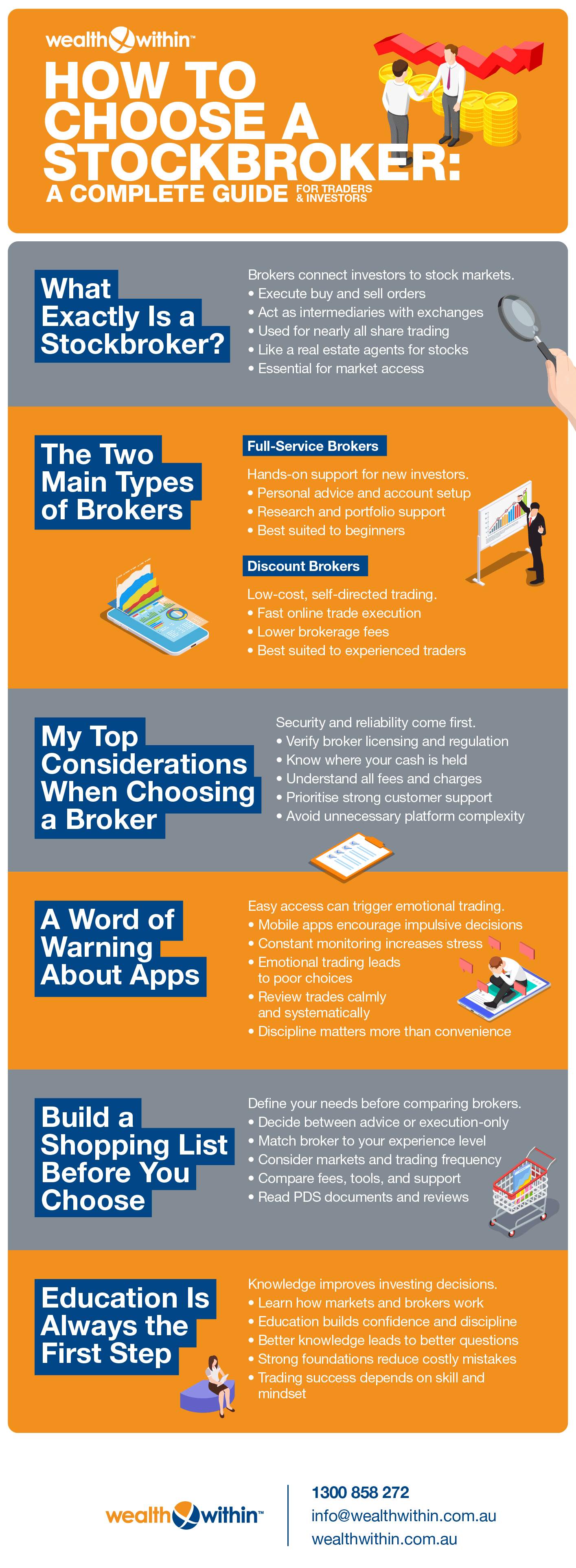
What Exactly is a Stockbroker?
Before you can choose the right broker, you need to understand what one actually does.
At its simplest, a broker is an intermediary that sits between you and the stock exchange, whether that's the ASX in Australia, the NYSE or Nasdaq in the US, the FTSE in London, or the Hang Seng in Hong Kong.
Their core job is to execute your buy and sell orders on the exchange.
A great way to think about it is to compare a stockbroker to a real estate agent.
When you want to buy a house, you don't usually deal directly with the seller, you go through the agent who matches buyers with sellers and brokers the deal.
Stockbrokers do exactly the same thing, just for shares.
Now, can you buy and sell shares without a broker?
Technically, yes, through what's called an off-market transfer using a registrar like Computershare or Link. But realistically, in 99.9% of cases, you'll need a broker.
So rather than trying to avoid one, your focus should be on choosing the right one.
The Two Main Types of Brokers
Brokers generally fall into two camps: full-service brokers and discount brokers.
Full-service brokers do exactly what their name suggests. They'll help you set up your account, conduct a fact-find on your goals and risk profile, provide research, talk you through specific stocks, and answer questions when you call.
Some will even charge a portfolio management fee (often around 0.5% to 1% of your portfolio) to help you actively manage your investments.
If you're new to the share market and have never bought a share in your life, I strongly suggest going with a full-service broker.
A good one will more than pay for themselves.
Discount brokers, on the other hand, range from bare-bones platforms that simply let you place trades, through to more sophisticated offerings (like CommSec in Australia or E*TRADE in the US) that give you research tools, charts, EPS data, dividend yields, and even suggested portfolios.
The more bells and whistles, the more you'll generally pay in brokerage. In Australia, discount brokers typically charge around $20 or under per trade; in the US it's even cheaper.
My Top Considerations When Choosing a Broker
Over my 35+ years in the industry, I've narrowed down my checklist to a few non-negotiables. Here's what I look for:
1. Are They Properly Licensed?
This is absolutely the first box that must be ticked. In Australia, brokers must be licensed by ASIC (the Australian Securities and Investments Commission). In the US, it's the SEC (Securities and Exchange Commission). Every legitimate market has its own regulator. If a so-called "broker" can't show you a valid licence from the local authority, run the other way, fast.
I see this issue a lot with over-the-counter (OTC) products like FX, binary options, and crypto-related platforms. These websites often plaster a flashy London or New York address on their site, but when you dig deeper you discover it's a serviced office and they're not licensed in any reputable jurisdiction. If something goes wrong, you'll have little to no recourse, because regulators in your home country can't chase a foreign, unlicensed entity on your behalf.
2. Where Is Your Money Held?
This is one most beginners overlook, and it's crucial. Some brokers hold all client funds in one big "bucket" account in the broker's name. If that broker goes belly-up (and we've seen brokers fail during the GFC, the COVID crash, and the 1987 crash), you can be tied up in liquidation processes for years, and you may not get 100% of your money back.
This is why I personally use a bank-owned broker here in Australia. My money sits in my bank account, and the broker simply draws from it when I buy and deposits into it when I sell. If the broker goes down, my cash is safe in my own account. When I have to use a non-bank broker, I only ever fund the account with the bare minimum needed to place a trade and pull surplus funds out as soon as they appear.
3. Fees, Commissions and Hidden Charges
Always understand exactly how your broker makes money. Compare brokerage fees, but please, don't choose the cheapest just because it's the cheapest. Cheapest rarely means best.
Watch out for extra charges too, things like live data feeds (often around $40 per month), platform subscriptions, inactivity fees, and minimum monthly trade requirements. I never subscribe to live data feeds because, unless you're an intraday trader, you simply don't need them. Worse, those minimum-trade incentives can compulsively push you into trading more than you should, just to avoid the fee.
4. Customer Service
For me, customer service is king. I want to know that if something goes wrong, I can pick up the phone and get an answer immediately. Time wasted chasing problems is money lost. I'd happily pay slightly more in brokerage for the peace of mind that comes with knowing real humans are on the other end of the line.
5. Beware the Bells and Whistles
I'll never forget a meeting with one of the world's top-five international brokers, who came into my office to demo their platform. After ten minutes of feature-rattling, I asked, "Can I just buy and sell on it?" When he said yes, I told him that's all I needed to know.
Fancy charts, complex tools and shiny dashboards are designed to give you the illusion of being informed. As I tell my students, it's nice to have a souped-up V8, but if you can't drive it safely, why have it in the first place? All you really need is a platform that's simple, user-friendly, and gives you exactly what you need, no more.
A Word of Warning About Apps
Today, the vast majority of trading happens through online portals and mobile apps.
That convenience is wonderful, but it comes with a cost. I deliberately do not have a broker app on my phone. Why?
Because phones suck you in.
They make you emotional.
They tempt you to react to every little wiggle in the market.
I review my portfolio at the end of each day, in the cold, hard light of day, where my rules can run the show, not my emotions.
Compare that to the old days, when every trade meant picking up the phone and talking to a human being.
That accountability changed your decision-making for the better.
The less friction there is between you and the buy/sell button, the more disciplined you have to be on your own.
Build a Shopping List Before You Choose
Before you start signing up to anything, write down what you actually want from a broker.
Ask yourself:
Do I want full advice or just execution?
- Am I a beginner who needs hand-holding, or an experienced trader?
- How important is customer service to me?
- Where will my money be held?
- What markets do I want to access?
- What's my realistic trade frequency?
Then, and only then, start interviewing brokers against that list.
Pick up the phone, ask questions, read the PDS (Product Disclosure Statement), check reviews, and look at the parent company's reputation.
Most exchanges, including the ASX here in Australia, have excellent free resources on their websites that explain how brokers work and what they're required to do.
Education Is Always the First Step
The most important rule before you start investing or trading is this: educate yourself first.
And I don't just mean education on how to buy and sell a stock, I mean education on how the entire system works so you can ask better questions and make better decisions.
If you want to take that next step seriously, I'd encourage you to explore our share trading courses, which are designed for traders and investors at every level.
For those committed to building genuine, long-term competence, our flagship Diploma of Share Trading and Investment is Australia's only government-accredited diploma in share trading. It will give you the proven techniques, strategies and confidence you need to trade profitably in any market condition.
Choosing the right broker is just one piece of the puzzle.
Combine it with the right education, the right rules and the right mindset, and you'll be well on your way to building genuine wealth from the share market.
Because, as we always say at Wealth Within, lifestyle matters.