Investing in Shares for Beginners: A Complete Guide

By Dale Gillham
Reading Time: 18 minutes
General Advice Disclaimer
This article is for general educational purposes only and does not take into account your personal financial circumstances, objectives or needs. Before making any investment decisions, consider your individual circumstances and seek independent financial advice if necessary.
If you’ve realised that investing in shares provides a long-term solution to building wealth, you’re in the right place.

With easy access to technology and information, individuals worldwide have taken the bull by the horns and invested directly in the stock market.
However, for beginners, initial interest in investing in shares often comes from a hot tip or friends talking up how much money they could make in the stock market.
Unfortunately, many who invest this way end up disappointed because they lose some or all of their capital, since they lack the knowledge to stay in the stock market long term.
But this needn’t be the case if you educate yourself with some simple rules, which I outline in this comprehensive guide. I also provide a roadmap to help you get started.
Building your investing knowledge is crucial to making informed decisions and developing confidence in your investment journey.
Understanding the basics of share investing
Before we explore how to make money by investing in shares, also known as stocks, it’s essential to understand what a share is.
Simply put, a share represents ownership in a company. As such, when you invest in shares, you become a part-owner of that company.
This means you join many other shareholders who collectively own the company and share in its benefits, such as dividends and voting rights.
It's also important to understand the difference between a company's share price and its underlying value, which is influenced by factors such as its financial performance and future growth potential.
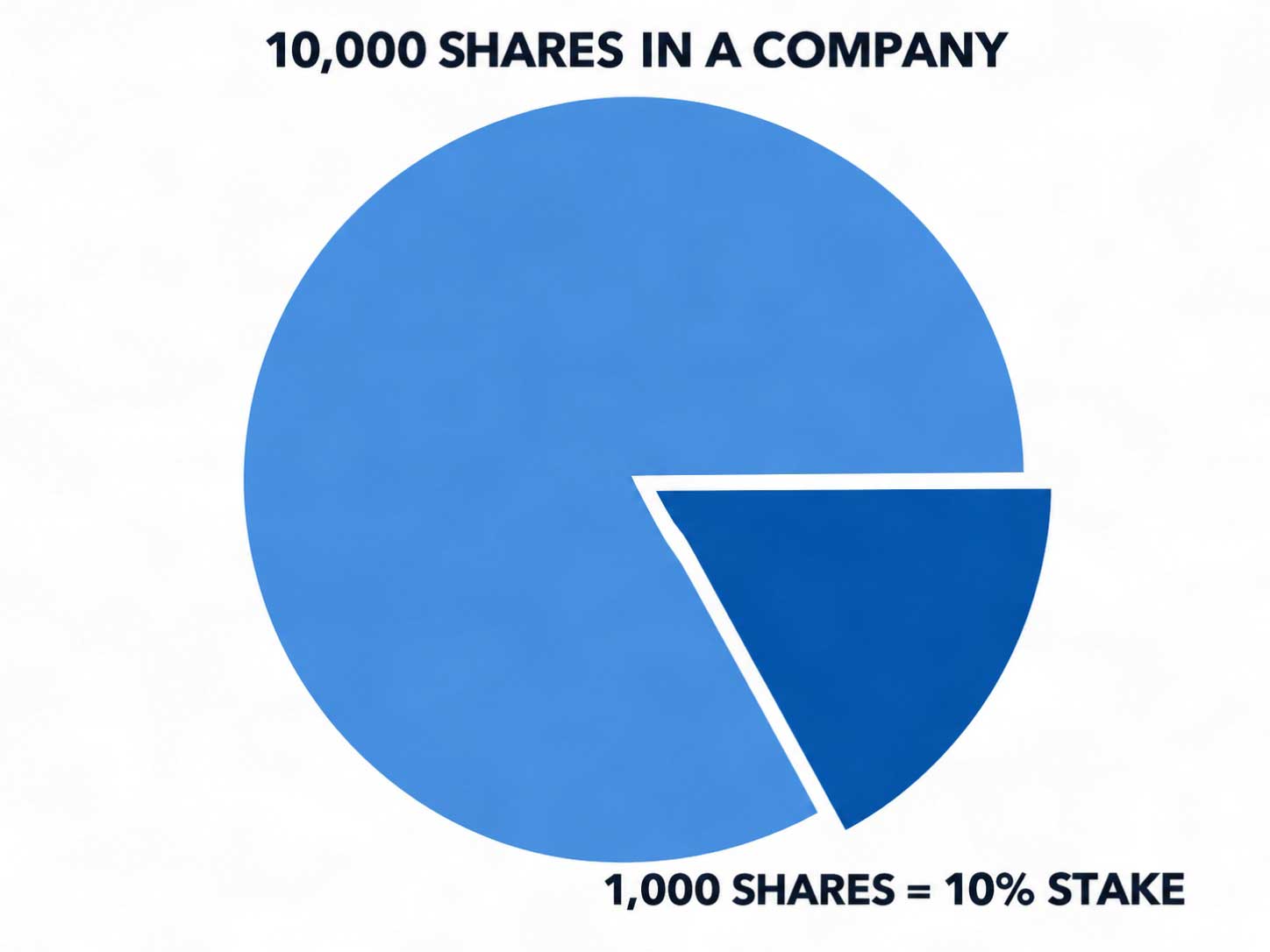
Companies like National Australia Bank, BHP and Coles, which are all household names, are listed on the Australian Securities Exchange (ASX).
Commonly referred to as the stock market or stock exchange, the ASX is where investors buy and sell shares in listed companies. When shares are traded, ownership transfers from one investor to another.
In addition to individual stocks, you can also purchase other investment products, including Australian real estate investment trusts (A-REITs), listed investment companies (LICs), listed managed funds and exchange-traded funds (ETFs).
How the stock market works
The best way to understand how the Australian share market works is to think of it as an auction, where buyers and sellers meet to trade shares.
The ASX acts like the auctioneer, operating an electronic market that matches buyers and sellers. When someone wants to buy shares, they place an order through a stockbroker.
The ASX matches that order with someone willing to sell at an agreed price, allowing the transaction to take place.
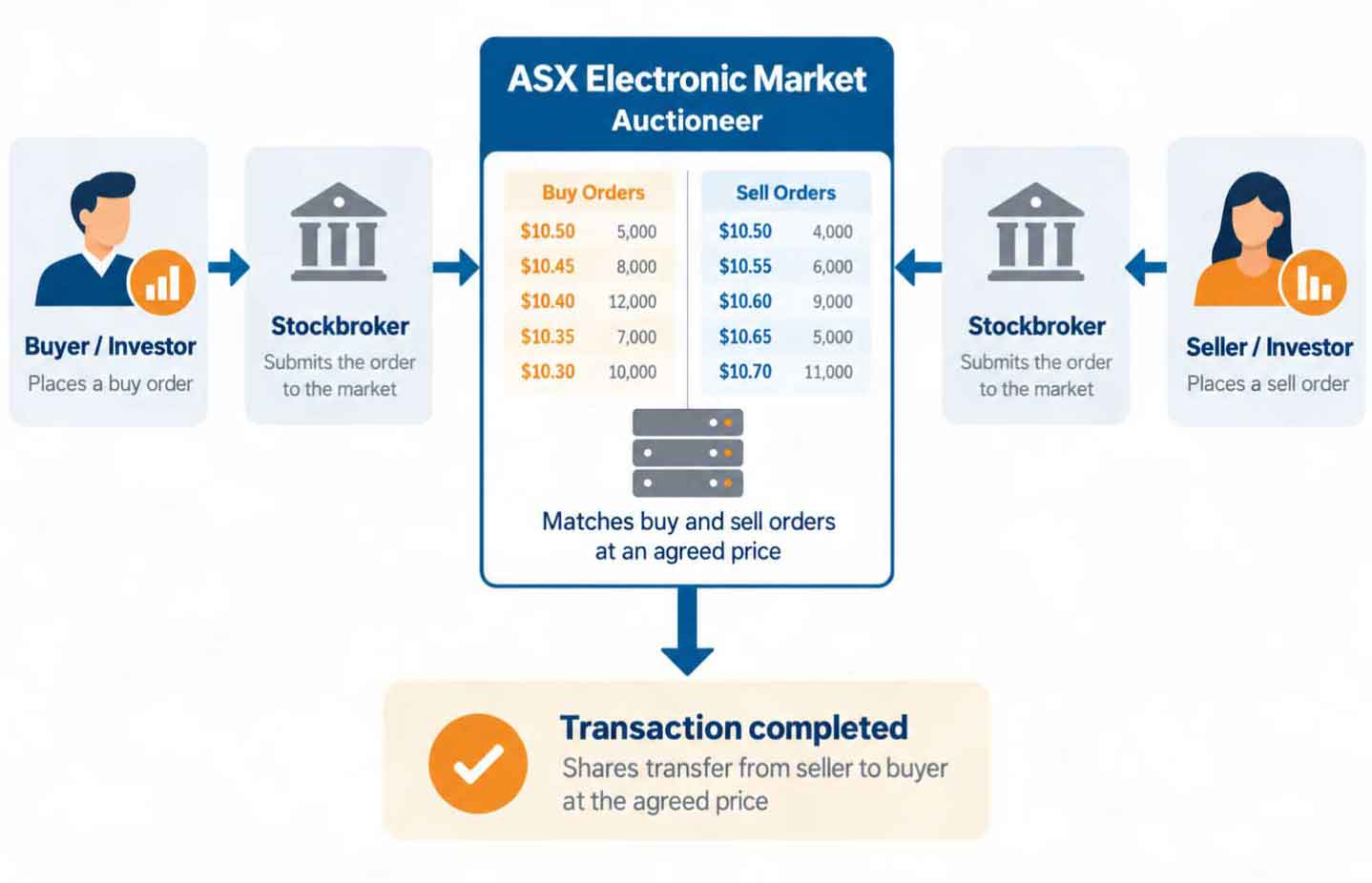
The share price of an individual company is therefore determined by supply and demand, reflecting buying and selling activity in the market.
Why invest in stocks
Historically, Australian shares have provided higher returns than other investments, such as cash and bonds. While investing in shares carries risks, the potential long-term rewards can be substantial.
As the 2026 Vanguard Index Chart below shows, Australian shares returned an average of 9 per cent a year over the 30 years to 30 June 2026, Australian bonds 5.2 per cent and cash 4 per cent.
These returns exclude transaction costs, including brokerage and the difference between bid and ask prices.
This performance was achieved despite stock market crashes, the Global Financial Crisis (GFC), a global pandemic, natural disasters and changing economic conditions.
While these historical returns highlight the potential benefits of long-term share investing, remember that past performance does not guarantee future results.
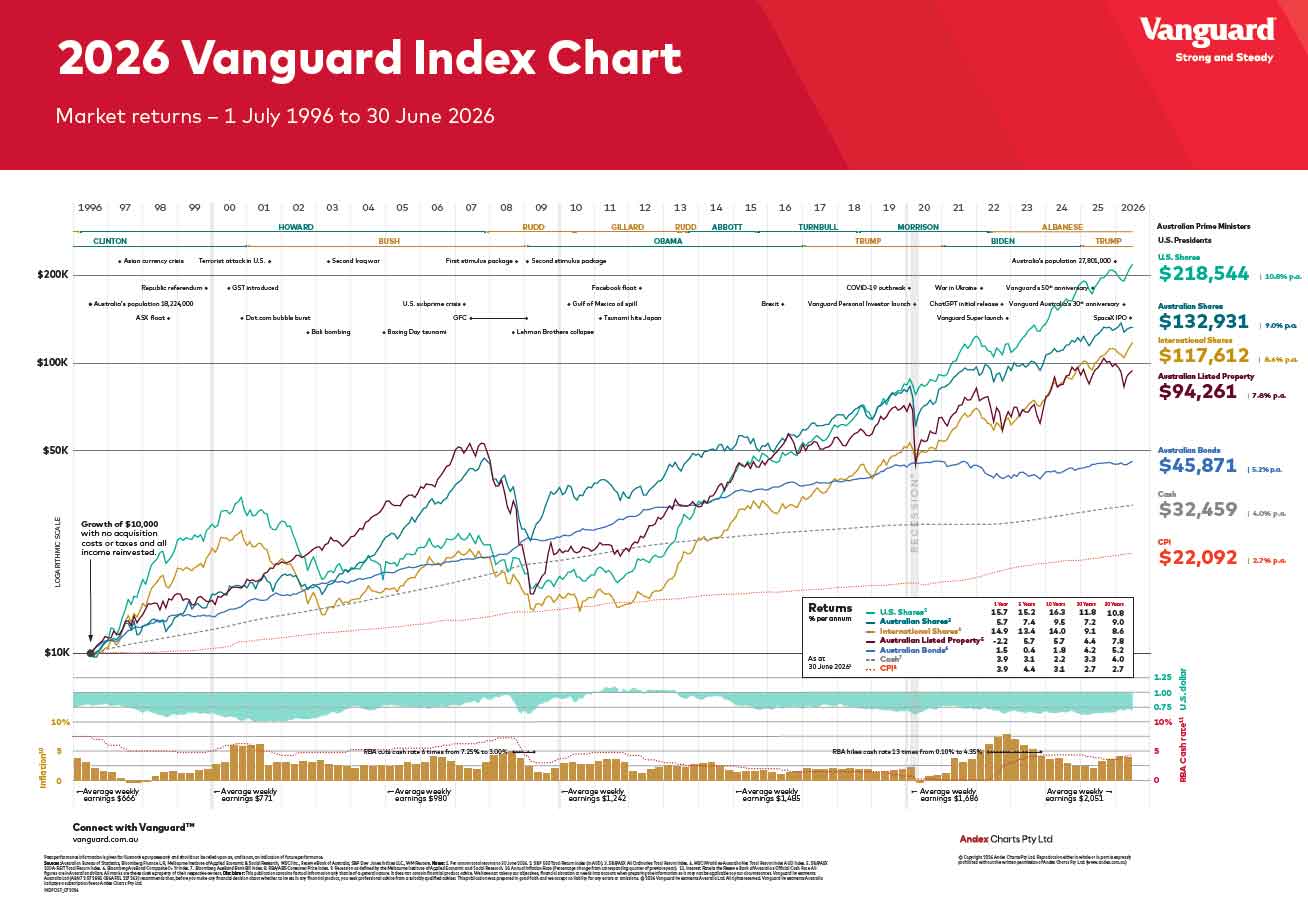
2026 Vanguard Index Chart Click to enlarge image
As you can see in the All Ordinaries Index chart below, despite significant fluctuations and periods of decline, the Australian share market has trended upward since 1982.
While not every stock will follow the broader market, imagine the opportunities you could identify if you had the knowledge and skills to actively trade the share market!
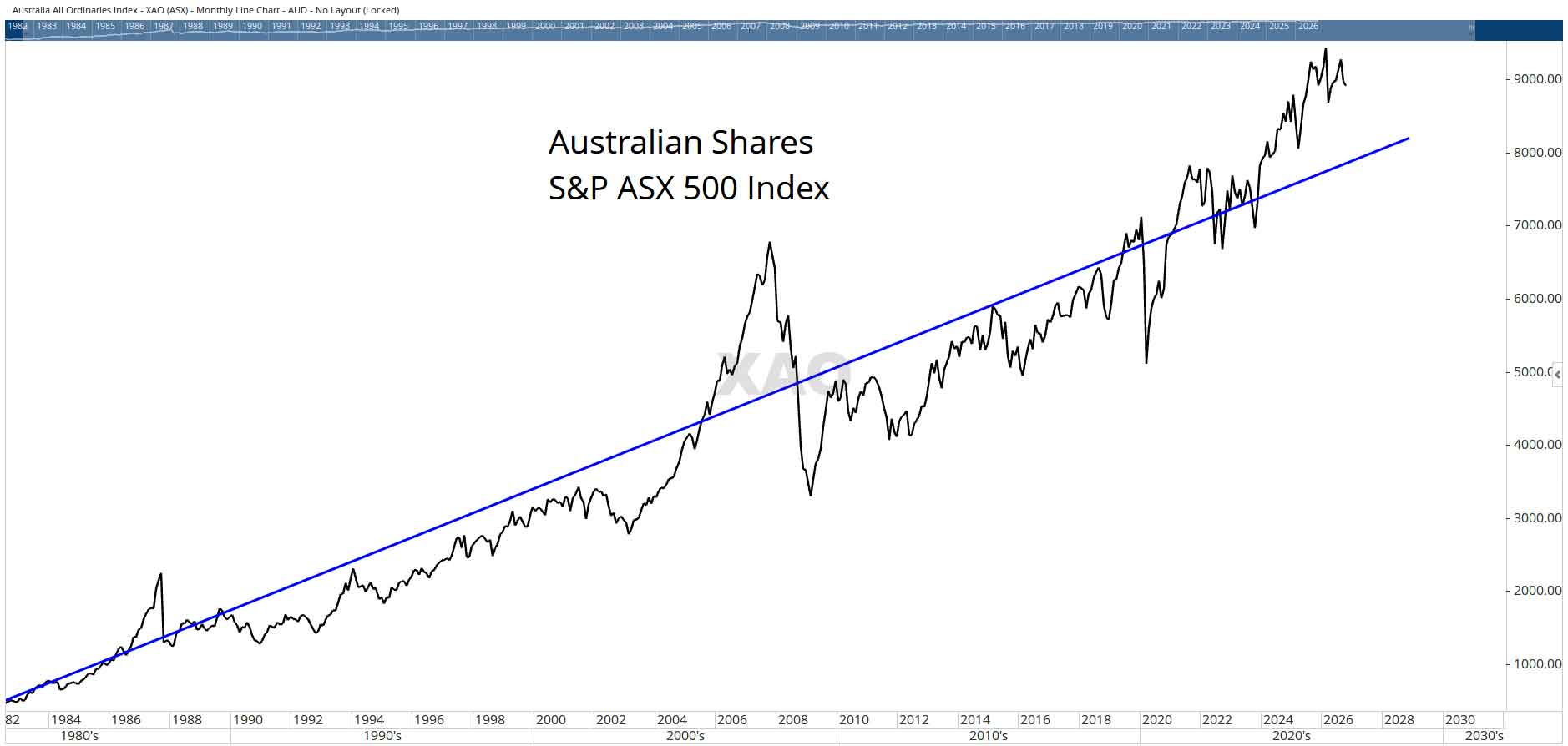
Performance of Australian Stock Market 1982 to 2026
Why beginners should focus on the Australian share market
As the Vanguard Index Chart shows, US shares have historically outperformed Australian shares over certain periods.
While these returns may be attractive, many beginners overlook that investing internationally adds risks and costs.
For example, fluctuating exchange rates can significantly affect investment returns, particularly when the Australian dollar appreciates.
You may also incur foreign currency conversion fees, overseas brokerage charges and other transaction costs, which can eat into your profits.
In my experience, beginners are better off focusing on the Australian share market until they have developed the necessary knowledge and trading skills.
This lets you build experience without the added complexity and risk of investing internationally.
Understanding the rewards and risks of investing in stocks
The key to investing well is buying quality stocks with growth potential.
To achieve better-than-average returns, focus on stocks that are rising in value and increasing your wealth.
While trading the stock market can be rewarding, it also comes with risks. Share prices fluctuate, and even quality companies can decline significantly.
Unfortunately, many beginners underestimate these risks, believing substantial losses are unlikely to happen to them.
One advantage of shares is their liquidity. Unlike property, shares in actively traded companies can generally be sold quickly, giving you greater flexibility to access your capital when needed.
Ultimately, your long-term success in the share market depends on how well you manage your risk.
As Warren Buffett famously said, "Risk comes from not knowing what you are doing." Before investing, you need to understand the risks involved and how much capital you are willing and able to risk.
The reality is that investing without the right knowledge can be expensive, sometimes costing far more than a quality education.
How do I make money investing in stocks?
When you invest in shares, you can make money in two ways: through capital gains and dividends.
Capital gains
As a company grows and becomes more profitable, its share price may increase.
If you sell your shares for more than you originally paid, you make a capital gain. Conversely, if you sell your shares for less than their purchase price, you realise a capital loss.
Dividends
You may also receive income in the form of dividends, which are payments companies make to shareholders, generally from their profits.
Some dividends come with franking credits, which reflect tax already paid by the company and may reduce the tax payable by eligible shareholders.
Many Australian companies pay dividends twice a year, although payment frequency varies and dividends are not guaranteed.
Dividends can be particularly attractive to investors looking to supplement their income or those in retirement seeking additional cash flow. You can check the ASX website for information about company dividend payments.
How much money do you need to start investing?
There is no definitive answer to how much money you need to start investing in shares.
As a beginner, you can start investing with as little as $1,000, although developing a regular savings plan can help you gradually build your investment portfolio.
To illustrate how an investment can grow over time, let's use the historical average annual return of 9 per cent for Australian shares from the 2026 Vanguard Index Chart discussed earlier.
If we assume this return continues, and all earnings are reinvested, an initial investment of $1,000 would more than double over ten years, as shown in the table below.
Of course, actual market returns vary from year to year, and past performance is not a guarantee of future results.
| Initial investment | 2 years | 5 years | 10 years |
|---|---|---|---|
| $1,000 | $1,188 | $1,539 | $2,367 |
| $5,000 | $5,941 | $7,693 | $11,837 |
| $10,000 | $11,881 | $15,386 | $23,674 |
Illustrative calculations, rounded to the nearest dollar. Assumes a constant 9% annual return with reinvestment, before fees, costs and taxes.
An important factor to consider when determining your initial investment amount is the brokerage fee incurred on each transaction.
For example, if you buy $1,000 worth of shares and pay $20 in brokerage when buying and another $20 when selling, your total brokerage costs will be $40.
This means your shares would need to rise by approximately 4 per cent just to break even.
Understanding the costs associated with buying and selling stocks will help you determine how much capital to allocate to each investment.
How should a beginner start investing in stocks?
Investing in shares can be exciting and rewarding, but for beginners, it can also feel overwhelming, especially if you lack the right knowledge or a clear strategy.
The key is to take a methodical approach.
Before committing your money to the share market, you need to establish your investment goals, understand the risks involved and develop a plan to guide your decisions.
Set clear investment goals
Before you start investing, it's important to understand why you're investing and what you want to achieve.
Your investment goals will be influenced by several factors, including your age, income, family circumstances and current financial position.
Some of the questions you need to ask yourself include:
- How long do I want to invest?
- How much money do I need to achieve my investment goals?
- What returns do I expect to achieve?
- What level of risk am I comfortable taking?
- How much investment capital am I prepared to risk to achieve higher returns?
- Do I want income, capital growth or both from my investments?
- How many stocks do I want to hold in my investment portfolio?
- What knowledge and skills do I need to make informed investment decisions?
Build a diversified share portfolio
One way to manage investment risk is to build a diversified portfolio by spreading your capital across different companies and sectors.
This helps reduce your exposure to the performance of any single stock or industry.
You can also achieve diversification through exchange-traded funds (ETFs), which allow you to invest in a basket of shares or other assets through a single transaction.
However, if you invest in ETFs, remember that while they diversify across individual stocks, they don't eliminate market risk.
For example, if you invest in an ETF that tracks the ASX 200 and the broader market falls, your investment will generally decline with it.
This is known as systematic risk, which diversification alone cannot eliminate.
Knowledge is power
Once you have established your investment goals, the next step is to acquire the knowledge and skills to make informed investment decisions.
After all, there's much more to investing in shares than simply opening a brokerage account and placing a trade.
If you want to become consistently profitable in the stock market, you need to understand:
- How to build a diversified portfolio
- The four golden rules to investing in shares
- The best time to sell your stocks
- How to apply stop losses to manage risk
While many beginners rely on free information to learn about the share market, this often leads to confusion because they encounter conflicting opinions and advice.
Information tells you the 'what', whereas a quality education teaches you the 'how', providing the strategies, techniques and processes to make informed decisions and protect your capital.
That's why I encourage those new to the share market, as well as experienced traders struggling with inconsistent results, to study a quality trading course.
Developing the right skills and learning how to apply them consistently can make a significant difference to your long-term trading results.
Develop a trading plan
If you want to increase your probability of success when investing in shares, it's important to develop a trading plan that outlines your investment strategy, risk tolerance, entry and exit rules, and money management rules.
Every stock you buy should have its own trading plan because stocks behave differently.
Your plan should also help you determine whether a stock fits your investment goals and contributes to a diversified portfolio.
Most importantly, you need to follow your trading plan rather than making impulsive decisions based on emotions.
Start with paper trading
Before you commit capital to the share market, practice applying your trading strategy with a demo account or through paper trading.
Paper trading involves buying and selling shares in a simulated environment without risking real money. This allows you to test your strategy and develop your skills before investing your capital.
You wouldn't jump out of a perfectly good aircraft if you knew your parachute wouldn't open.
The same principle applies to investing. Before risking your money, test your trading strategy to see whether it can produce consistent results.
Paper trading lets you identify weaknesses in your strategy, refine your approach, and build confidence in your investment decisions.
However, remember that trading with real money introduces emotions you may not experience when paper trading.
Build a watchlist to test your trading strategy
Start by creating a watchlist of a few quality stocks you want to follow.
Monitor their price movements each week and practice buying and selling them according to the rules in your trading plan.
Over three to six months, record your simulated trades, review how the stocks perform and assess how well you manage your portfolio.
This will help you identify what works, where your strategy needs improvement, and whether you consistently follow your trading rules.
Once you're ready to invest real money, start with a small amount you can afford to risk.
As you gain experience and consistently apply your strategy, you can gradually increase your position sizes.
Why beginners should focus on blue-chip stocks
With more than 2,000 companies listed on the ASX, how do you know which stocks to concentrate on when you're starting out?
I recommend is to focus on the top 50 stocks by market capitalisation, many of which are commonly referred to as blue-chip stocks.
These are some of Australia's largest and most established listed companies and offer several advantages for beginners:
- High liquidity: These stocks generally attract significant daily trading activity, making them easier to buy and sell, although liquidity can deteriorate during severe market downturns.
- Established businesses: Many have long operating histories, experienced management teams and established positions within their industries.
- Institutional investment: Large companies often attract significant investment from superannuation funds and other institutions.
- Access to information: Financial reports, company announcements and independent research are generally readily available, making it easier to research these companies.
- Financial strength: Many established companies have substantial assets and established earnings, although their financial position and future prospects still need to be assessed.
- Capital growth and dividends: Many blue-chip stocks have a history of providing shareholders with capital growth and dividend income.
Unfortunately, many beginners mistakenly believe large-cap, blue-chip stocks generate returns slowly.
Instead, they're attracted to small-cap companies, speculative shares or penny dreadful stocks, hoping to find the next big opportunity.
But investing in smaller, more speculative companies generally involves greater risks, particularly where businesses have limited operating histories, uncertain earnings or low liquidity.
While these stocks can deliver substantial returns, they can also experience significant losses.
Let me say that it's not how much you make on any one investment that makes you wealthy; it's how much you don't lose over time.
By focusing on quality blue-chip stocks and taking a methodical approach, beginners can build knowledge and confidence while learning to invest in the share market.
Once you have gained the skills and experience to apply your trading strategies consistently, you can gradually expand your focus to include the top 150 shares on the ASX.
How can a beginner invest in shares?
Once you've developed your trading plan, tested your strategy and decided which stocks to focus on, the next step is to understand how to buy and manage shares on the ASX.
Here are four practical steps to get started.
Step 1: Open a trading account
Before buying shares, you'll need to open a trading account with a stockbroker operating under an Australian Financial Services Licence (AFSL) regulated by the Australian Securities and Investments Commission (ASIC).
You can choose an online broker, where you're responsible for researching stocks and making your investment decisions, or a full-service broker who can provide professional advice and recommendations.
Many Australian banks offer online share trading services, although you can also choose an independent broker. The ASX provides a list of stockbrokers to help you explore your options.
When choosing a stockbroker, consider the brokerage fees, the ease of using their trading platform and the quality of customer support. You'll also need to fund your trading account before placing your first order.
Step 2: Research stocks
Before investing in shares, take the time to research the companies you're considering. Look for quality businesses with sound financial performance, experienced management and a history of growth.
As discussed earlier, I recommend beginners concentrate on the top 50 stocks on the ASX while developing their knowledge and confidence. However, you should still analyse each company's share price and ensure it meets the criteria in your trading plan before buying.
Step 3: Place an order
Once you've identified a stock you want to buy, you'll need to place an order through your stockbroker, either online or over the phone.
You'll generally need to specify the company, the number of shares you want to purchase and the type of order you wish to place.
Two common order types are:
- Market order: An instruction to buy or sell shares at the best available market price. The final execution price may differ from the price displayed when you submit the order.
- Limit order: An instruction to buy shares at a specified price or lower, or sell shares at a specified price or higher. This gives you greater control over the price, although your order may not be executed.
Before submitting an order, check the details carefully, including the stock, quantity, order type and brokerage costs.
Step 4: Manage your investments and cash flow
Once you start investing, regularly monitor your investments and review their performance against your trading plan.
I recommend reviewing your portfolio each week and making any necessary adjustments outside market hours, rather than reacting emotionally to short-term price movements.
You also need to maintain sufficient cash reserves and keep your portfolio aligned with your investment goals and risk-management rules.
Common mistakes beginners make when investing in stocks
While you can make money investing in shares, many beginners make critical mistakes that can cost them a significant amount of money. So, to avoid making these same mistakes, let’s take a brief look at what they entail.
Cheap doesn't always mean a good deal
Just because a stock has a low share price doesn't mean it represents good value.
While speculative stocks trading at 10 or 20 cents may seem attractive, they can carry significant risks, particularly if the company has a poor financial track record.
For example, investing $1,000 in a stock priced at $0.20 gives you 5,000 shares, while the same amount invested in a stock priced at $60 buys approximately 16 shares.
What matters isn't how many shares you own, but how much their value increases over time.
Avoid buying shares when the price is falling
One of the mistakes beginners make is buying shares simply because the price has fallen.
However, a falling share price may reflect deteriorating company performance, a profit downgrade or changing market conditions.
Before buying a stock, look at its price chart to understand its historical performance and current trend.
Just because a stock appears cheap doesn't mean the price won't fall further.
Don't follow the herd
Many investors buy shares because everyone else seems to be doing it, particularly when stock prices are rising and market sentiment is positive.
Unfortunately, following the crowd often means making decisions based on emotion rather than sound analysis.
As Warren Buffett famously said, "Be fearful when others are greedy and greedy when others are fearful."
Rather than following market sentiment or the latest stock tip, take the time to research your investments and make decisions based on your trading plan.
Trade well, not often
Too many beginners believe that trading more frequently means making more money.
This is one reason why day trading can seem so attractive, even though it requires considerable knowledge, experience and discipline.
In my experience, trading less frequently and using weekly and monthly charts allows you to see the bigger picture of what's happening in the market.
After all, the aim should be to trade to achieve the lifestyle you want, not to make trading your lifestyle.
Use leverage wisely
Leverage allows you to control a larger market position using borrowed capital, but it also magnifies your losses when the market moves against you.
For inexperienced traders, this can result in substantial financial losses.
Before considering leverage trading, you need to demonstrate that you can consistently apply your trading strategies and manage risk when investing in shares.
Even then, consider leverage only with a clear understanding of the risks and strict money-management rules.
Tax Implications
Investing in shares has tax implications every investor should understand.
When you sell shares for a profit, you may be liable for capital gains tax (CGT).
The taxable gain generally depends on the difference between what you paid for the shares and what you received when you sold them, adjusted for costs such as brokerage and other tax considerations.
If you hold shares for at least 12 months, you may qualify for a 50 per cent CGT discount, depending on your circumstances.
The 50 per cent discount is changing from 1 July 2027, so check the current rules with the ATO or a qualified tax adviser before you sell.
This is one reason why understanding the tax implications of buying and selling shares is important.
You may also receive tax benefits, such as franking credits attached to dividends, which represent tax a company has already paid and may reduce your personal tax liability.
To ensure you meet your tax obligations, it's important to maintain accurate records of your investments, including purchase and sale dates, prices, brokerage fees, dividends and franking credits.
Because tax rules can be complex and change over time, I recommend seeking advice from a qualified tax adviser.
This will help you understand your obligations and any tax benefits you may be entitled to when investing in shares.
Ready to start investing in stocks?
Investing in shares offers opportunities to build wealth over time, but achieving consistent results requires more than simply choosing a few stocks and hoping their prices rise.
The key is to acquire the right knowledge, develop a proven trading strategy and have the discipline to follow your trading plan.
By taking a methodical approach, managing your risk and continuing to build your skills, you'll be better prepared to make informed decisions as your experience grows.
Continue your share trading education with Wealth Within
If you want to build on what you've learnt, watch our Australian Stock Market Show, streamed live every Tuesday from 7 pm.
Our experienced analysts share their insights into the Australian share market, including trading opportunities, strategies and techniques to manage risk.
For those wanting to develop their knowledge and skills further, Wealth Within offers a range of trading courses for beginners and experienced traders.
You can also explore our student reviews and testimonials to learn about the experiences of those who have studied with Wealth Within.