How to Buy ASX Shares: The Definitive Guide

By Dale Gillham
Reading Time: 24 minutes
Buying ASX shares is one of the best ways to create wealth over the long term. You can also receive income from dividends and ride the growth of some of the biggest companies on the Australian Securities Exchange (ASX).
It may sound scary at first, but it’s easy and, as you’ll learn in this guide, simple once you grasp how the share market works and follow a proven strategy.

Whether you want to prepare for retirement, build wealth or take control of your financial future, this article will show you how to buy ASX shares.
You’ll discover what you need to get started with confidence and why you should invest in the stock market. You'll also learn how to choose a broker and open a trading account to place your first order. We'll also investigate how to avoid the common mistakes beginners make.
Buying shares is just one part of the overall picture. The most important components that will determine your long-term success are the ability to recognise what to buy, when to buy and how to manage risk in the stock market.
That’s why this guide doesn’t just talk about how to buy shares. It also gives you practical insights that can help you make more informed decisions.
Why do people invest in shares?
Before you buy your first shares, you probably have many questions. You may even feel a bit intimidated about investing in the share market, which is very common. That’s why before you learn how to buy ASX shares, it’s important to understand why individuals invest in the stock market.
Benefits of buying ASX shares
One of the key benefits of buying shares is that, over the long run, you can grow your wealth faster than inflation. History has demonstrated that quality companies reward investors who are patient and disciplined with capital appreciation and dividends. That said, there are no assurances that stocks will increase in value, as share prices rise and fall.
Another key feature is that it's accessible. Unlike buying a property, which usually requires a large deposit, you can start investing in shares with a relatively small amount of money. This means you can start growing your portfolio sooner and increase its size as your financial situation changes.
Another benefit of share investing that many people don't fully grasp until they own shares is liquidity. Unlike many other growth investments, you can buy and sell shares within minutes during market hours. After the trade settles, the proceeds will be deposited into your bank account within a few business days.
This gives you flexibility because, if your circumstances change, you can access your money more quickly than with property. That said, shares continue to be considered a medium-to long-term investment.
If you sell when the market is down, you might get back less than you paid for the shares. That's why we suggest putting aside money that you don't need in the short term.
What are the risks?
All markets rise and fall, and companies can underperform. You may also make poor investment judgements, resulting in a loss.
That’s why you need to know more than just how to buy ASX shares. You need the knowledge and skills to understand what you are buying, when to buy, and how to limit your risk. The good news is that it is far easier than most people believe.
You do not have to be a financial expert to become a great investor or a disciplined trader.

How much do you need to start investing?
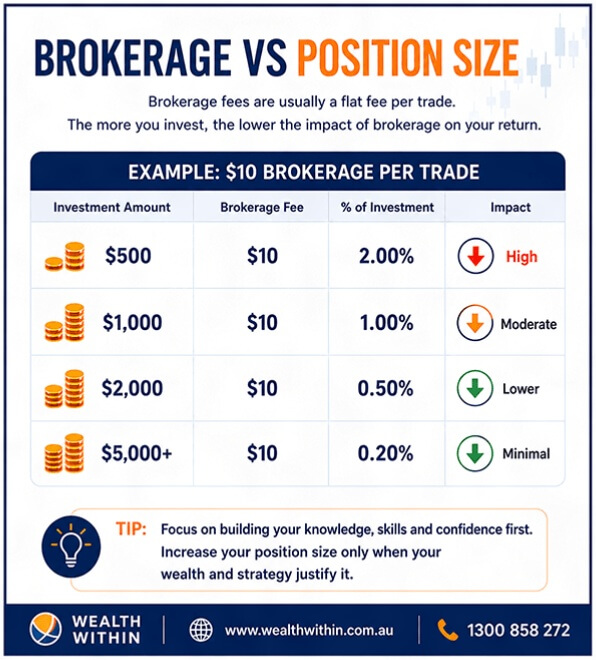
One of the most typical questions beginners ask is, “How much do I need to start investing?” There’s no minimum to acquire shares, but the dollar amount you invest can affect your ability to diversify your portfolio and control the impact of brokerage fees.
In general, we suggest that you invest at least $1,000 whenever you buy shares. Smaller quantities can make the transaction charges, such as brokerage fees, less economical. That said, if $500 is all you can afford, it’s usually preferable to start investing than to wait.
For example, if you invest $500 and your broker charges a $10 brokerage fee, you will pay 2% of your investment in fees before you make a return. But if you invest $2,000, that same cost is only half a per cent. Brokerage fees may seem minor, but they may eat into your returns if you are investing smaller sums.
Now, let's see what you need to do to buy shares through the ASX.
How to buy ASX shares
If you want to acquire shares, you'll need to open a share trading account with a stockbroker. A broker acts as the conduit between you and the share market, enabling you to buy and sell shares.
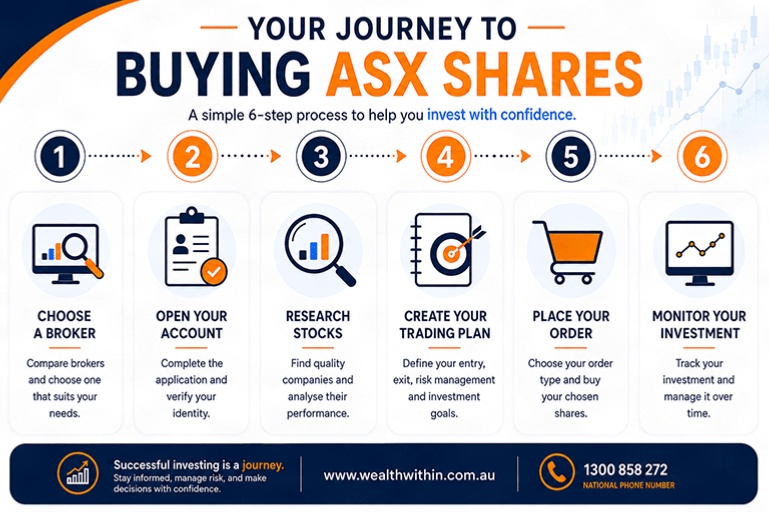
Step 1: Choosing a broker
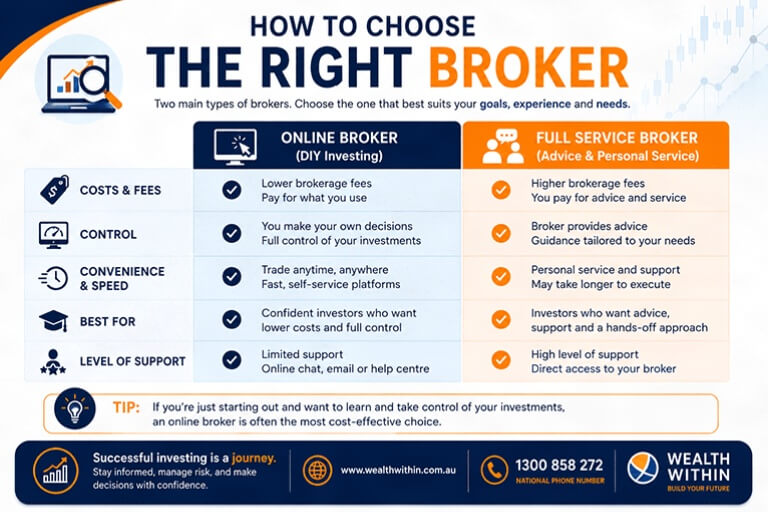
There are two kinds of brokers: a full-service broker and an online broker.
Full-service brokers usually offer access to professional research and portfolio management. These are more costly, but they are better for investors who do not have the time to learn how to trade stocks and prefer ongoing advice from an expert.
On the other hand, an online broker allows you to purchase and sell shares from their trading platform. The benefit of managing your own investments is that you will pay less brokerage.
When comparing brokers, you should consider:
- Brokerage: Each time you buy a stock, you will pay brokerage. Compare the brokerage fees that each broker charges to determine what suits your needs.
- Trading platform and research tools: Choose a platform that’s easy to use and includes research tools, market data, and educational resources.
- Customer assistance: Good customer service is vital too, especially if you are new to investing and need a little help.
If you are buying and selling shares in Australia, the ASX maintains a list of regulated brokers.
When deciding on a broker, some investors like the ease of being able to trade through a broker connected to their bank account. While others are interested in lower brokerage fees, better trading tools or access to more investing services.
If you don’t know where to start, comparison sites such as Finder and Canstar can help you to compare the features offered by various online trading platforms.
Keep it simple when starting out
When you're starting, it's best to keep things simple. Focus on developing the knowledge and skills to invest well. That's a better strategy than taking on the additional risks of investing across multiple markets.
When opening your first trading account, I recommend choosing a simple trading platform that allows you to buy Australian shares and ETFs. Bell Direct is one example.
Avoid looking for a platform packed with features such as foreign exchange, CFDs and other investment products. Focus on developing your investing skills first.
Some people also want a trading account that provides access to overseas stocks. There's nothing wrong with that. But investing internationally introduces additional considerations, including different settlement times, currency risks, costs and tax rules.
Having access to thousands of companies around the world may seem like a major advantage, but it can quickly become a distraction. When you're starting, less is more. It's far better to learn how to analyse a smaller group of quality Australian companies.
This is preferable to spreading your attention across many markets. Once you've gained the knowledge, skills and confidence to invest well, you can always change brokers if your needs change.
Step 2: Open a trading account
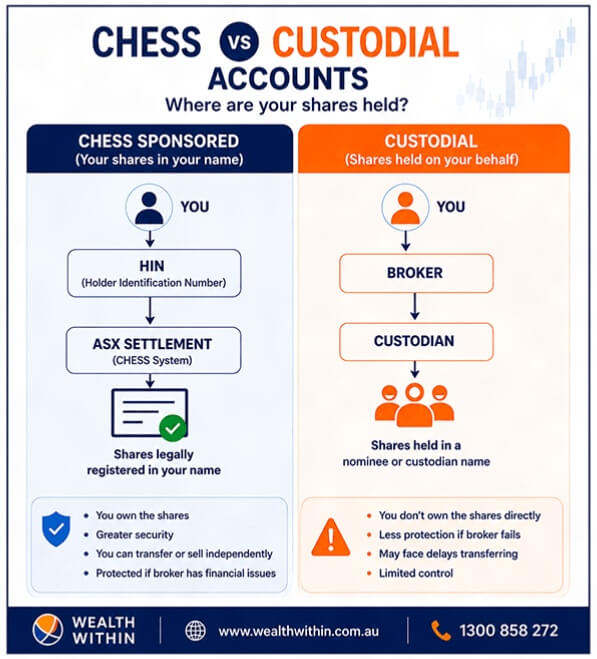
Before opening a trading account, you need to understand the difference between a CHESS-sponsored account and a custodial account.
CHESS-sponsored
If you buy ASX shares through a CHESS-sponsored account, your shares are registered in your name and linked to a Holder Identification Number (HIN).
A HIN is a unique number that identifies you as the registered owner of your CHESS-sponsored holdings. Every time you buy and sell shares, your holdings are registered against your HIN, making them easy to identify and manage.
If you want to change brokers, you can transfer all your CHESS-sponsored holdings using your HIN, without needing to sell your shares.
Custodial accounts
The shares are maintained on your behalf by the broker or custodian. However, you remain the beneficial owner. This means you'll receive dividends and participate in corporate actions.
Some custodial accounts may have reduced brokerage prices, but often include other fees, such as administration fees. That's why we normally advocate opening a CHESS-sponsored account. It gives you direct legal ownership and greater control over your shares.
Complete an application
Once you’ve selected a broker and the type of account to open, the next step is to complete an application.
Most brokers allow you to complete an application online. You'll need to provide your personal details, including your name, address, contact details and Tax File Number (TFN).
You'll also need to prove your identity under Australia’s anti-money laundering legislation. This usually requires identification such as your driver's licence or passport.
Once your application is approved, your broker will provide you with a HIN.
Financing your trading account?
Before buying your first shares, you’ll need to connect a bank account to your trading account. The broker uses this to settle the stocks you buy and sell.
More experienced investors may choose a margin lending facility to finance their trading account. This involves borrowing money to invest. While this has the potential to increase your returns, it also increases your risk because losses are magnified.
That’s why we advocate that if you're new to investing, it is advisable to use your own money. It's better to gain the knowledge, skills and experience to manage your shares before introducing the increased risks of borrowing to invest.
Step 3: Research ASX stocks to buy
The first shares you buy shouldn't be based on what's popular or the latest market trend. Experienced traders follow a process to narrow thousands of listed companies down to a shortlist of quality investment opportunities.
Focus on quality companies
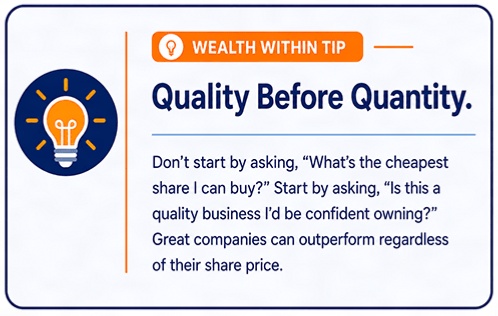
With more than 2,000 companies listed on the ASX, knowing where to start can feel overwhelming. We recommend beginners focus on quality companies, particularly those within the ASX top 50. They are generally more established, highly liquid and financially resilient.
This makes them an ideal starting point. At the same time, you will build your investing knowledge and confidence.
These companies are often referred to as blue-chip stocks. They typically have strong management teams, consistent earnings and a long history of operating successfully.
Their higher trading volumes also make it easier to buy and sell shares when required. Reliable information about these companies is also easier to access and analyse.
As your knowledge and experience grow, you can gradually expand your research to include other quality companies outside the largest stocks on the ASX.
Use fundamental analysis to narrow your list
When researching a company to buy shares, we focus on three areas of fundamental analysis to narrow down the companies to put on your watchlist. The idea is to filter those stocks that are at the end of a long-term downtrend and potentially about to turn.
- Dividend Yield: How much income a company pays its shareholders relative to its share price, expressed as a percentage.
- Price Earnings (P/E) Ratio: Compares a company's share price with its earnings to assess how fast it is expected to grow. In other words, the PE provides investors with an indication of the company's prospects.
- Earnings Per Share (EPS): Measures the profitability of a company. If the EPS is consistently rising, this indicates that the company is well managed.
It’s also a good idea to investigate the company's announcements on the ASX. These can be a great source of information and alert you to possible changes in a stock.
You can find dividend-paying companies by searching the ASX website. Most online brokers also provide fundamental data.
Analyse the share price trend
A company's financial performance is only one part of the overall picture. Even quality companies can experience periods where their share price declines.
Before you invest, analyse the price chart to determine whether the trend is rising, moving sideways or falling. Understanding the trend can help you avoid buying a quality company at the wrong time.
Most brokers provide price charts as part of their trading platform or research tools.
The goal of combining fundamental and technical analysis is to develop a trading strategy to determine what stocks to buy and when to buy them.
Decide how much to invest
The next step is to decide how much capital you'll allocate to buying shares. Once you've done this, you need to determine how much capital you'll allocate to each trade. This amount is referred to as the position size for the trade and is based on:
- your tolerance to risk (low, medium or high),
- whether you want to be a trader or investor, and
- the number of stocks you want to hold in your portfolio.
Diversifying your portfolio across several companies helps reduce risk by avoiding excessive exposure to any one investment.
When buying shares, we generally recommend that you invest no more than 20% of your total capital in any one trade. However, if you have a lower risk tolerance, you may decide to reduce your position size to 10%.
Reducing your position size means any loss on a single trade has less impact on your overall portfolio. To better understand my rules for building a powerful portfolio, read my Four Golden Rules to Investing in Shares.
If you only have a small amount of capital, you may initially only own a few companies until it grows. You can grow your capital by regularly adding any savings you have accumulated or by reinvesting your profits over time.
As it grows, review the amount you invest in each new position to ensure it aligns with your overall money management strategy.
Define your trading rules
Before buying any ASX shares, define the rules that will tell you when to buy and when to sell. Having predetermined entry and exit rules removes emotion from your decision-making. It also helps ensure every investment is based on a consistent process rather than instinct.
Using trendlines is one of the simplest and most effective ways to identify buying and selling opportunities. As I explain in my best-selling book How to Beat the Managed Funds by 20%, trendlines help identify when the balance between buyers and sellers is changing. It provides an early indication that a trend may be about to reverse.
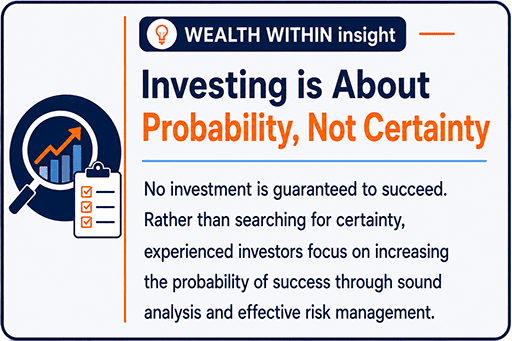
Generally, a buy signal occurs when a share price breaks above a downtrend line, while a sell signal occurs when it breaks below an uptrend line. Although no trading method is perfect, trendlines provide beginners with a simple and objective framework for identifying higher-probability buying and selling opportunities.
Always use a stop loss
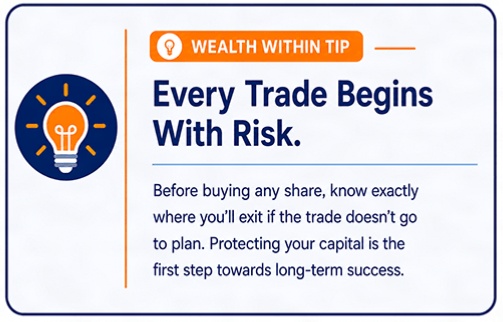
Knowing when to sell is just as important as knowing when to buy. Before entering a trade, decide on the price you'll sell if the stock doesn't perform as expected. This is called a stop loss.
Think of it like the brakes on your car. Just as they help protect you if something goes wrong, a stop loss helps minimise the risk to your capital.
A stop loss is a predetermined exit price that forms part of your trading strategy and helps protect your capital if the share price falls. Deciding your exit point before you buy removes emotions from your decisions. It also reduces the temptation to hold losing trades in the hope they recover.
We generally recommend that new investors place an initial stop loss around 15% below the purchase price when investing in highly liquid companies. This gives the share price room to move under normal market conditions while limiting potential losses if the trade doesn't work out.
As your knowledge and experience increase, you'll learn how to adjust your stop loss to suit different stocks and over different timeframes.
Step 4: Record your analysis in a trading plan
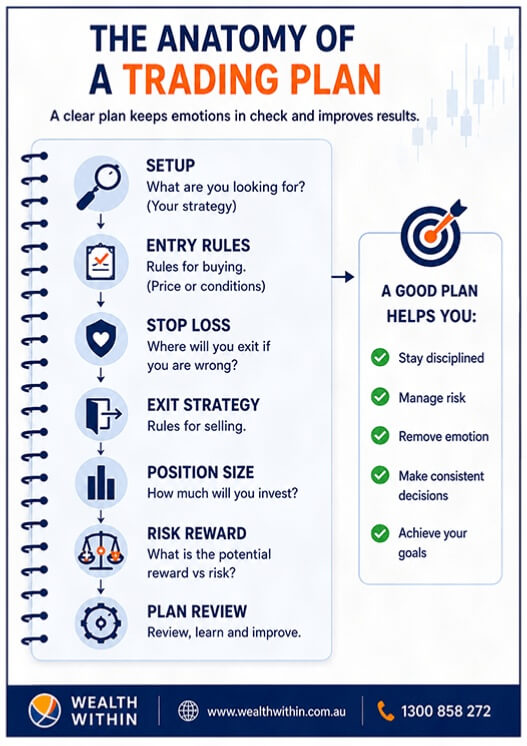
Now that you've researched the company and decided on your rules for buying it, it's important to record your research and decisions in a trading plan. A trading plan helps remove emotion from your decision-making by recording why you are considering the investment. It includes the rules you'll follow before, during and after the trade.
Your trading plan should include:
- The ASX code and the company name of the stock you are considering
- Why it meets your investment criteria
- The amount of total capital you plan to invest
- The position size for the trade
- Your intended buy price
- Your initial stop loss
- Your entry and exit rules
A written trading plan also helps you stay disciplined. Making these decisions before you buy is far easier than trying to make them after the market has moved against you.
Before you place your first order, ask yourself:
- Does the company meet my investment criteria?
- Have I reviewed the fundamentals?
- Is the share price trending in the right direction?
- Do I know how much capital I'll invest in each stock?
- Have I recorded my buy price?
- Have I set my initial stop loss?
- Have I documented my entry and exit rules?
Once you've completed your research, documented your trading plan and confirmed the stock meets your investment criteria, you're ready to place your first order.
Step 5: Execute your first trade
To fill your order to buy through an online broker, you need to enter your trade on the broker's order pad. While each trading platform looks different, the information you enter is generally the same.
Search for the company
First up, you need to find the company in the order pad by searching for the ticker code. Every listed company on the ASX has a unique three-letter code. For example, BHP Group trades under the ticker code BHP, while Commonwealth Bank trades under CBA.
Before placing your order, double-check that you've selected the correct company, as some ticker codes and company names can look similar.
Choose your order type
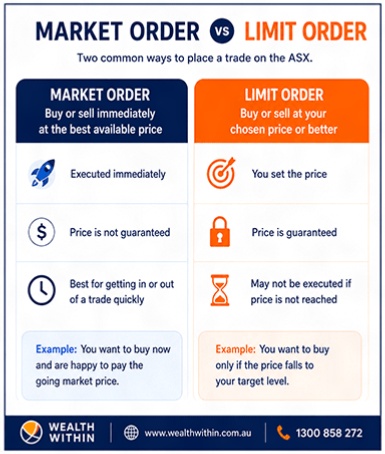
The two most common order types are market orders and limit orders.
A market order instructs your broker to buy or sell shares at the best price available in the market. Market orders can be placed at any time. However, orders entered outside the ASX’s trading hours will be executed at the best available market price when the market opens.
This method is the quickest way to have an order filled. However, the final price may differ from the price you set, particularly in fast-moving or less liquid markets.
A limit order can be placed at any time. It allows you to set the maximum or minimum price when buying or selling. The order is then executed if the share price reaches your limit price.
While limit orders provide greater control over the price your trade is executed, there's no guarantee the order will be filled. If the share price doesn't reach the limit you set, your order will not be filled.
When you place a limit order, you'll also need to decide whether it remains in the broker's system for the day or until cancelled. If you can't monitor the order regularly, we recommend using a day order. If it isn't filled, you can review your analysis and submit a new order the next day.
Understanding the bid and ask price
Every listed share on a stock exchange has two prices:
- Ask price: The lowest price a seller is willing to accept.
- Bid price: The highest price a buyer is willing to pay.
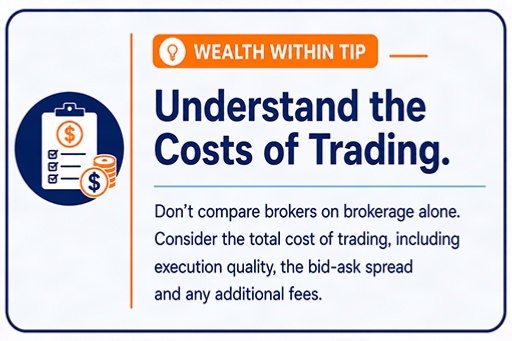
When you buy shares, you'll generally pay the ask price, and when you sell, you'll receive the bid price. The difference between the two is called the bid-ask spread.
Certain online brokers also offer commission-free trading using the difference between the bid and ask price. Typically, the ask price is higher when you buy, while the bid price is lower.
While commission-free trading sounds enticing, the downside is that your profits are lower while your losses increase. That’s why we recommend using a broker who charges brokerage fees, as you can control your costs on each trade.
Enter the number of shares
Next, enter the number of shares you want to buy or the dollar amount you want to invest.
To determine the number of shares to buy, divide your position size (the amount you plan to invest in the stock) by the current share price and round the result down, as you can only buy whole shares.
For example, if you have capital of $10,000 and decide to invest 10% in each trade, your position size would be $1,000. If the current share price is $5.00, divide $1,000 by $5.00 to determine the number of shares to buy.
Alternatively, if you enter the dollar amount you want to invest, your broker's trading platform will automatically calculate the number of shares you can buy.
Review and confirm your order
Once you've selected your preferred order type, enter the stock's ASX ticker code, the number of shares you wish to purchase. If you're using a limit order, you also enter the nominated purchase price. Before submitting your order, carefully review every detail to ensure it is correct.
Once your purchase has been executed, record the actual purchase price in your trading plan. You also need to confirm your initial stop loss is based on the price you paid to execute the trade.
When the order is filled, your broker will send you a contract note confirming the order was filled. While settlement occurs two business days after the trade date (T+2), the shares typically appear in your trading account immediately.
Step 6: Monitor your investment
Buying shares is only the beginning. Once you execute your trade, it's important to monitor your stocks and continue following your trading plan.
Avoid the temptation to check your stocks every day or react to short-term market movements. Share prices can flucuate, and making decisions based on emotions can lead to costly mistakes.
If the share price triggers your stop loss, sell the shares. Likewise, if it indicates it's time to sell and take your profits, follow your plan.
After you've sold the shares, review the trade by comparing the outcome with your trading plan. Document what worked well, what you could improve, the emotions you felt during the trade, and how well you followed your trading rules.
This process helps you identify areas to improve and prepares you for your next trade. Over time, it will help you become a more disciplined and confident investor.
Common mistakes to avoid when buying shares
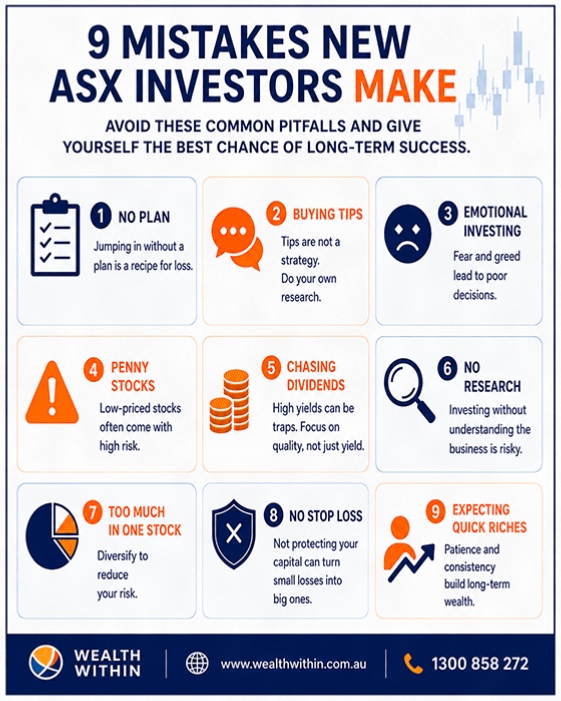
Even when you have the best intentions, mistakes can still happen. Avoiding these common mistakes can help to protect your capital and support you in becoming a more disciplined investor or trader.
Investing without a plan
In my experience, buying shares based on a tip, news headline, or social media recommendation rarely leads to consistent success. Before you invest, it's important to do your research so you can make an informed investment decision.
That includes understanding why you are buying the company, how much you'll invest and the conditions that will tell you when it's time to sell.
Risking too much on one trade
Investing all your capital in a single trade significantly increases your risk. By diversifying your portfolio and applying the correct position sizing, you can protect your capital if the stock doesn't perform. You will also minimise your risk in the stock market.
Failing to research the company and its share price
Buying a quality company at the wrong time can still result in poor returns. Before investing, research the company's fundamentals and analyse its share price. You need to determine whether it meets your investment criteria and is trending in the right direction.
Ignoring risk management
Many beginners focus on finding the next winning trade and spend very little time planning how to manage a losing trade. Setting an initial stop loss before you buy and following your exit rules is the most effective way to protect your capital.
Investing amounts that are too small
While you can start investing with a relatively modest amount of money. However, investing very small amounts can make brokerage fees a significant percentage of your investment. This reduces your overall returns.
Building your investment capital over time and investing sensible amounts can help improve your long-term results.
Letting emotions drive decisions
Fear and greed are the two greatest challenges investors face. Fear causes you to sell too early, while greed tempts you to hold on for too long. Following a written trading plan helps remove the emotion from your decision-making and encourages more consistent trading.
Failing to review your trades
Every trade provides an opportunity to learn. Reviewing your trades to see what worked well and where you can improve will help you become a more consistent trader.
Choosing penny stocks
Many beginners believe low-priced shares offer the greatest opportunity because they seem "cheap". In reality, a low share price doesn't necessarily mean a company is good value. Penny stocks are often more volatile and speculative.
This makes them higher-risk investments for inexperienced investors.
Chasing dividends
Many beginners are attracted to stocks with high dividend yields, believing they'll receive a better return. However, a high dividend yield is often the result of a falling share price rather than a stronger company.
Your focus should be on buying quality companies that have the potential to deliver strong capital growth, with dividends providing an additional income. Rather than chasing high-yield stocks, identify companies with strong fundamentals and rising share prices that meet your investment criteria.
FAQs
1. How much money do I need to buy shares?
The amount you need depends on the share price and your broker's minimum investment requirements. While you can start investing with as little as a few hundred dollars, we generally recommend beginning with around $1,000. This allows you to build a diversified portfolio over time while keeping brokerage costs to a reasonable level.
2. Can non-Australian residents buy ASX shares?
Yes. Non-Australian residents can invest in ASX-listed companies through many Australian brokerage firms. Depending on your country of residence, you may need to provide additional identification and comply with local tax and reporting requirements.
3. Can I buy ASX shares without a broker?
No. Before you can buy shares listed on the ASX, you'll need to open an account with either a full-service broker or an online broker.
You can also gain exposure to ASX shares through an Initial Public Offering (IPO) or by investing in a managed fund or your super fund.
4. Are dividends automatically reinvested?
No. Dividends are usually paid as cash unless you choose to participate in a company's Dividend Reinvestment Plan (DRP). A DRP allows you to use your dividends to purchase additional shares instead of receiving a cash payment.
5. How are profits from ASX shares taxed?
Profits made from selling ASX shares are generally subject to Capital Gains Tax (CGT) in Australia. If you hold your shares for more than 12 months, you may be eligible for a 50% CGT discount. As individual circumstances vary, it's important to seek advice from a qualified tax professional.
6. How long does it take to buy ASX shares?
Once your trading account is open and funded, buying shares takes only a few minutes. However, successful investing involves much more than placing a trade. Taking the time to research the company, analyse the share price and developing a trading plan can significantly improve your success of a winning trade.
7. Can I lose all my money investing in ASX shares?
Like any investment, shares carry risk, and prices can fall. However, you can significantly reduce your risk by investing in quality companies and diversifying your portfolio. Following a proven investment strategy and using risk management techniques, such as an initial stop loss can also reduce risk.
8. What's the difference between investing and trading?
Investors generally buy shares with the intention of holding them over the medium-to-long-term to benefit from capital growth and dividend income. Traders focus more on taking advantage of shorter-term price movements.
Both approaches can be successful when following a structured trading plan with defined entry and exit rules. This also needs to supported by sound risk management and disciplined decision-making.
9. What are the best shares to buy?
There isn't a single best company to buy because the right investment depends on your financial goals, risk tolerance and trading strategy. Rather than following tips or chasing the latest market trend, which can increase your risk, focus on researching quality companies.
Only buy them when they meet the criteria in your trading plan.
Can beginners buy shares on the ASX?
Yes. Anyone over the age of 18 can buy shares on the ASX by opening an account with a licensed broker. If you are under 18, shares can generally be purchased on your behalf through a trust or by a parent or guardian, depending on the broker's requirements.
Before investing, take the time to understand how the share market works, develop a trading plan and only invest money you won't need in the short term.
Continue building your share market knowledge
Learning how to buy ASX shares is only the first step towards becoming a successful investor or trader. To consistently grow and protect your wealth, you need to continue developing your knowledge.
Continue developing your knowledge through Wealth's free Learning Centre, Australian Stock Market Show, Hot Stock Tips and Talking Wealth Podcast. Our analysts use these resources to share ongoing market education and commentary.

If you want to develop your knowledge and skills through structured education, Wealth Within’s government-accredited Diploma of Share Trading and Investment can help. It teaches you how to analyse markets, manage risk and develop a structured trading plan.
Disclaimer
This article contains general information and educational market commentary only. It does not take into account your objectives, financial situation or needs and should not be treated as personal financial advice or as a recommendation to buy, sell or hold any financial product.