Trading Psychology: Why You Struggle to Take Losses

By Fil Tortevski and Pedro Banales
Reading Time: 10 minutes
General Advice Disclaimer
This article is for general educational purposes only and does not take into account your personal financial circumstances, objectives or needs. Before making any investment decisions, consider your individual circumstances and seek independent financial advice if necessary.
You buy a stock at $10 and watch it rise to $15. You are up 50 per cent and feeling pretty good about yourself. Then it falls to $14, then $13. You are still sitting on a 30 per cent profit, yet somehow it does not feel like you have made $3. It feels like you have lost $2. So, what do you do?
You tell yourself you are not selling now. You will wait until it gets back to $15.
This is where trading psychology can start working against you. A profitable trade suddenly feels like a losing one, while an actual losing trade can become something you refuse to close because selling means admitting the loss is real.
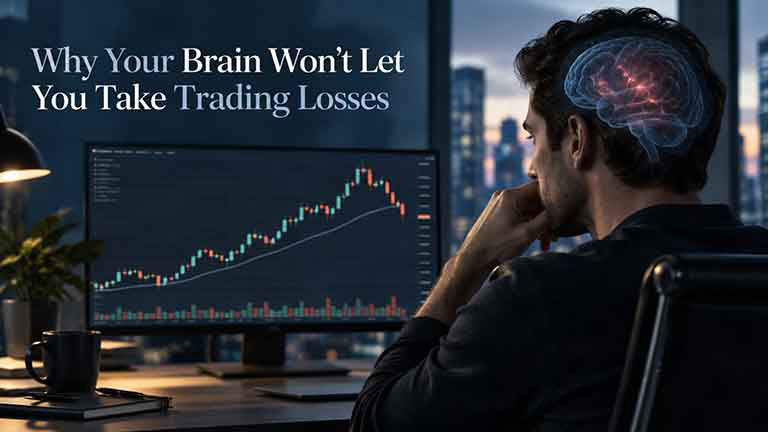
We have both made these mistakes over the years, and we have seen plenty of traders do the same. Understanding why it happens can make a considerable difference to the decisions you make.
Why trading losses hurt more than gains feel good
One way to understand this behaviour comes from Daniel Kahneman and Amos Tversky's prospect theory.
Their work helps explain why people do not evaluate financial outcomes purely mathematically. Instead, we tend to judge gains and losses relative to a reference point, while losses generally carry more psychological weight than equivalent gains.
Consider two situations.
You are $1,000 ahead and can take the money or risk it for a chance to make $2,000. Many people become protective of the $1,000 they have made.
Now reverse it.
You are down $1,000. You can accept the loss or take another risk that might get you back to breakeven but could also leave you losing even more.
Suddenly, taking the risk can become much more attractive.
Replace the word 'gambling with trading', and you begin to see the problem.
Traders can become highly protective of relatively small profits while becoming increasingly willing to gamble with losing positions. They cut winners short and let losers run, when what they want to do is the opposite: let profits run and cut losses short.
You can read more about how psychology affects trading decisions in Wealth Within's Guide to Mastering Trading Psychology.
Why admitting you are wrong can be harder than losing money
Another common thought is, "It's only a paper loss. "I haven't sold, so I haven't actually lost anything."
Selling changes the story. Instead of saying, "I'm temporarily down", you now have to say, "I was wrong, and I lost $5,000." That acknowledgement can be difficult.
We have seen traders down 10 per cent tell themselves they will give the stock a little more room. Then it becomes 15 or 20 per cent, and the stop loss is ignored. The internal conversation starts.
Maybe the analysis was slightly wrong. Maybe the stock will recover. Maybe averaging down will solve the problem.
If you bought at $10 and the stock has fallen to $8, buying more lowers your average purchase price. You might convince yourself you have made it easier to get back to break even.
But you have also increased the size of your position in a falling stock. Keep doing it, and one losing position can become disproportionately large relative to the rest of your portfolio.
This is why the question we think traders need to ask themselves is simple:
Are you protecting your capital or protecting your ego?
At some point, refusing to sell can stop being an investment decision. It becomes about avoiding admitting you were wrong. The market has a way of humbling you very quickly.
Being wrong, however, doesn't have to be a personal failure. You are never going to be right 100 per cent of the time. A losing trade can expose problems with your strategy, timing or decision-making and give you something you can improve.
The objective is profitability, not perfection.
Forget about getting back to break even
Another psychological trap occurs when traders become anchored to their original purchase price.
You buy at $10, and the stock falls to $8. The response is often: I'll sell when it gets back to $10.
But why $10?
The market does not know what you paid for the stock. Your entry price isn't inherently important just because that is where you happened to buy. Your brain has made $10 significant.
A much better question is: If I did not already own this stock, would I buy it at $8 today?
If the answer is no, why are you continuing to own it? Your decision should be based on where your remaining capital is best placed now, not on trying to recover your original loss from the same stock.
This becomes even more important if you are trading CFDs or using margin. As Pedro points out, holding a losing leveraged position can also mean continuing to incur funding or interest costs while the position moves against you.
No rule says you must recover the money from the stock that lost it.
If another opportunity fits your strategy and has greater potential, you may be better off using your capital there than waiting indefinitely for a losing position to return to your purchase price.
A paper profit can become another psychological trap
Trading psychology affects more than losing positions. It can also interfere with how you manage profitable trades.
Returning to our original example. You buy at $10. The stock rises to $15 and then falls to $13.
You are still up 30 per cent, but your reference point has moved.
Originally it was $10. After spending time watching the stock trade around $15, that price becomes the new psychological benchmark.
Instead of seeing a $3 profit, your brain starts seeing the $2 you have "lost". The same thing can happen with an entire portfolio.
Your portfolio rises from $100,000 to $150,000, and you start mentally treating that $150,000 as though it is already sitting safely in your bank account. If the portfolio falls to $135,000, it feels like you have lost $15,000.
But when did that $15,000 actually become yours? You have psychologically taken ownership of the peak value even though you never realised the profit.
Why good traders don't expect to sell at the top
Trying to avoid ever giving back profit creates another problem.
Trading with confirmation means accepting that you are unlikely to buy at the exact bottom and sell at the exact top. That is part of the deal.
Waiting for confirmation that a move has changed means you may give back some profit before you exit. The benefit is that you also avoid selling every time a stock pulls back normally.
If the stock falls slightly, then resumes its rise, you remain in the position because your exit conditions have not occurred. This gives profitable trades the opportunity to keep running.
When the evidence does tell you the move has changed, you exit. You may not capture the entire move, but that is not the goal.
To learn more about how to manage risk read: What is a Stop Loss and Why Should You Use One?
Pedro also makes an important point here: using a defined exit strategy gives you something you can apply again on future trades. Selling simply because you become nervous is difficult to replicate. A structured process allows you to review and improve what you are doing.
What if you sell and the stock keeps rising? Regret creates another powerful reason for doing nothing.
You are considering selling at $13 and immediately imagine the stock rising to $18 after you get out. You picture yourself watching it go higher and thinking, 'Why did I sell?'
So, you stay in. Then it continues falling. The important point is that not selling is still a decision.
If you own $20,000 worth of a stock today and decide to continue holding it, you are effectively deciding that, based on what you know now, you are comfortable keeping $20,000 invested in that position.
A structured trading plan can help remove some of this emotional debate.
You know before entering what conditions would cause you to sell. You also accept that circumstances can change after you exit.
And if the stock presents another valid opportunity later, nothing prevents you from buying again.
Your job is not to punish yourself because a stock rose after you sold it. Your job is to assess what the market is doing now and determine whether another opportunity exists.
The maths shows why large trading losses matter
There is another reason to control losses that has nothing to do with emotion. The deeper the loss, the greater the return required simply to recover your capital.
A 10 per cent loss requires an 11.1 per cent gain to recover. Lose 20 per cent and you need 25 per cent.
A 30 per cent decline requires approximately 42.9 per cent. A 40 per cent loss requires 66.7 per cent.
And if you lose 50 per cent of your capital, you need to make 100 per cent simply to return to where you started.
That changes the way you should think about risk vs reward in trading. Risk management is not simply about preventing losses. Losing trades are unavoidable.
It's about protecting enough capital to take advantage of the next opportunity and keep compounding over time.
You don't need to predict every market crash
This becomes especially important when markets suffer major declines.
Imagine two people entering a severe bear market with $100,000.
The first follows an exit process and gets out after a decline of around 15 per cent. They have approximately $85,000 remaining and need roughly 17.6 per cent to return to $100,000.
The second refuses to sell and loses 50 per cent.
They are left with $50,000 and now need a 100 per cent return just to get back to where they started. You do not need to predict the precise top before every crash for this difference to matter.
Over a trading career lasting 20 or 30 years, avoiding the full impact of a handful of catastrophic declines can significantly affect long-term compounding.
That does not mean sitting permanently on the sidelines waiting for the next crash either.
Our view is the opposite.
Markets rise and fall. The aim is to participate while your strategy tells you conditions remain favourable and to have a process that allows you to respond when those conditions change.
Make your trading decisions before emotion takes over
So how do you stop your brain from undermining your trading?
Make as many important decisions as possible before entering the trade.
Know why you are entering. Know where your stop loss sits.
Know what would tell you that your original analysis is wrong. Know how you intend to manage the trade if it moves in your favour.
The point isn't that every trader should use the same numbers. It is that you make these decisions while emotionally neutral, not after your money is already on the line.
If your portfolio rises and then pulls back, stop obsessing over its highest value.
Ask whether your exit condition has occurred. If it has, follow your process.
If it has not, you have a reason to remain in the trade.
Your beliefs about what the market should do and what the market is doing are two very different things.
Pedro's advice is to think like a strategist, not a gambler.
A strategist understands that you will win some battles and lose others. If conditions change, stepping back and reassessing the situation is not failure. It is part of the strategy.
And that leads to perhaps the most important point from our discussion:
A losing trade isn't necessarily a bad trade, and a profitable trade isn't necessarily a good trade. A good trade is one where you followed a sound process.
Learning to accept that distinction may be one of the most important changes you make to your trading.