10 ASX Stocks That Could Win Big From AI
By Janine Cox and Fil Tortevski
Reading Time: 14 minutes
General Advice Disclaimer
This article is for general educational purposes only and does not take into account your personal financial circumstances, objectives or needs. Before making any investment decisions, consider your individual circumstances and seek independent financial advice if necessary.
While investors are chasing the next AI chip maker, some of the biggest ASX stocks may be hiding in plain sight, as they are likely to benefit from artificial intelligence. In this week’s episode of the Australian Stock Market Show, Wealth Within analysts Filip Tortevski and Janine Cox are joined by Blueberry Markets’ Zoran Kresović to break down the impact of AI on ASX-listed companies.
They are not necessarily businesses building chips, language models or data centres. They are banks with enormous back-office operations. Supermarkets managing millions of products and transactions. Logistics companies moving assets across global networks. Recruitment platforms matching candidates with employers. In other words, they are established businesses with large cost bases and plenty of repetitive work.
ASX Companies Turn to AI Amid Rising Wage Pressures
Goldman Sachs recently identified 35 ASX-listed companies where wage costs have been rising faster than revenue, putting increasing pressure on profit margins. The investment bank expects those businesses to face greater pressure to improve productivity, with AI likely to become an important tool for reducing labour costs and protecting earnings.
This was evident in the previous half-year reporting season. Companies including Woolworths, Qantas and Telstra were rewarded after outlining cost reductions, productivity improvements and automation initiatives. Investors liked what those changes did to the bottom line. This reporting season will be different.
We are now roughly 12 months into the wider corporate AI experiment. Management teams will have to demonstrate that their initiatives are producing more than an attractive presentation slide. The market will want answers:
- Did the technology lower costs?
- Did it improve productivity?
- Did it create new revenue?
- Or was implementation more expensive and disruptive than management originally expected?
Recent McKinsey research supports that distinction. AI by itself is unlikely to produce the largest gains. The bigger opportunity may belong to companies that redesign their workflows and operating models around the technology.
Which ASX Stocks Could Benefit from AI?
1. WiseTech Global (ASX: WTC): Is the Share Price Finally Turning?
WiseTech Global is an obvious place to begin because AI could benefit the company on both sides of its income statement. It can be used internally to improve efficiency, but it can also be embedded into WiseTech’s logistics software. That creates the possibility of new revenue as well as lower operating costs.
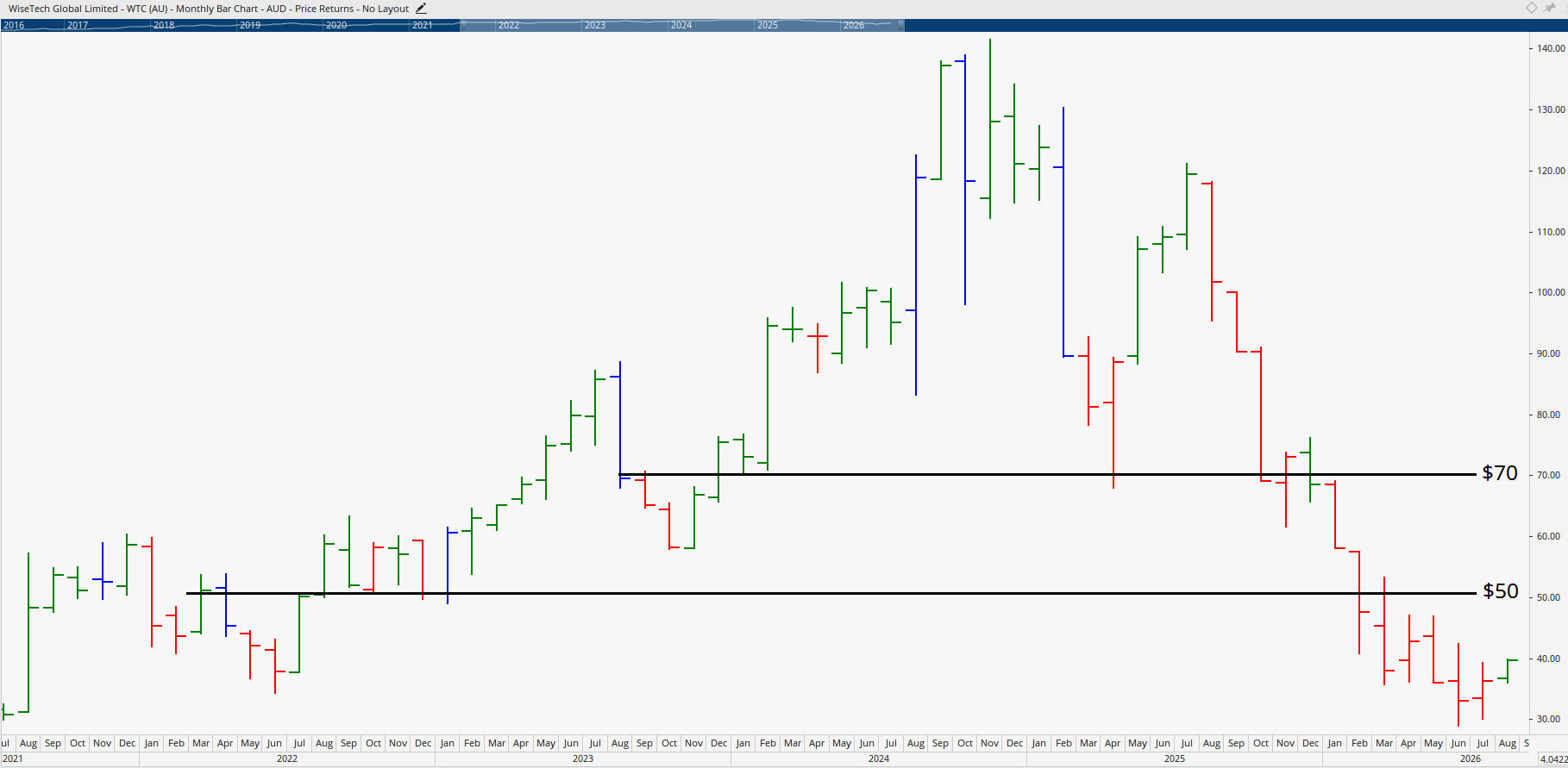
The share price has been through a serious decline for months, but the monthly chart is now showing the first signs that the brakes may be coming on. The stock appears to be finding support, and the recent move higher occurred on stronger trading volume. This suggests the recovery is attracting buyers rather than simply drifting upwards in a quiet market.
There is potential for WiseTech to work towards the $50 to $60 region. Approximately $60 has also been an important historical level for the stock. Should the recovery gather more momentum over time, $70 may eventually come back into the conversation.
2. National Australia Bank (ASX: NAB): Can AI Improve Bank Profit Margins?
The major banks may be among the clearest corporate beneficiaries of AI. They operate enormous lending, compliance, customer-service and back-office systems. AI can potentially assist with loan processing, fraud detection, risk management, document handling and routine customer enquiries.
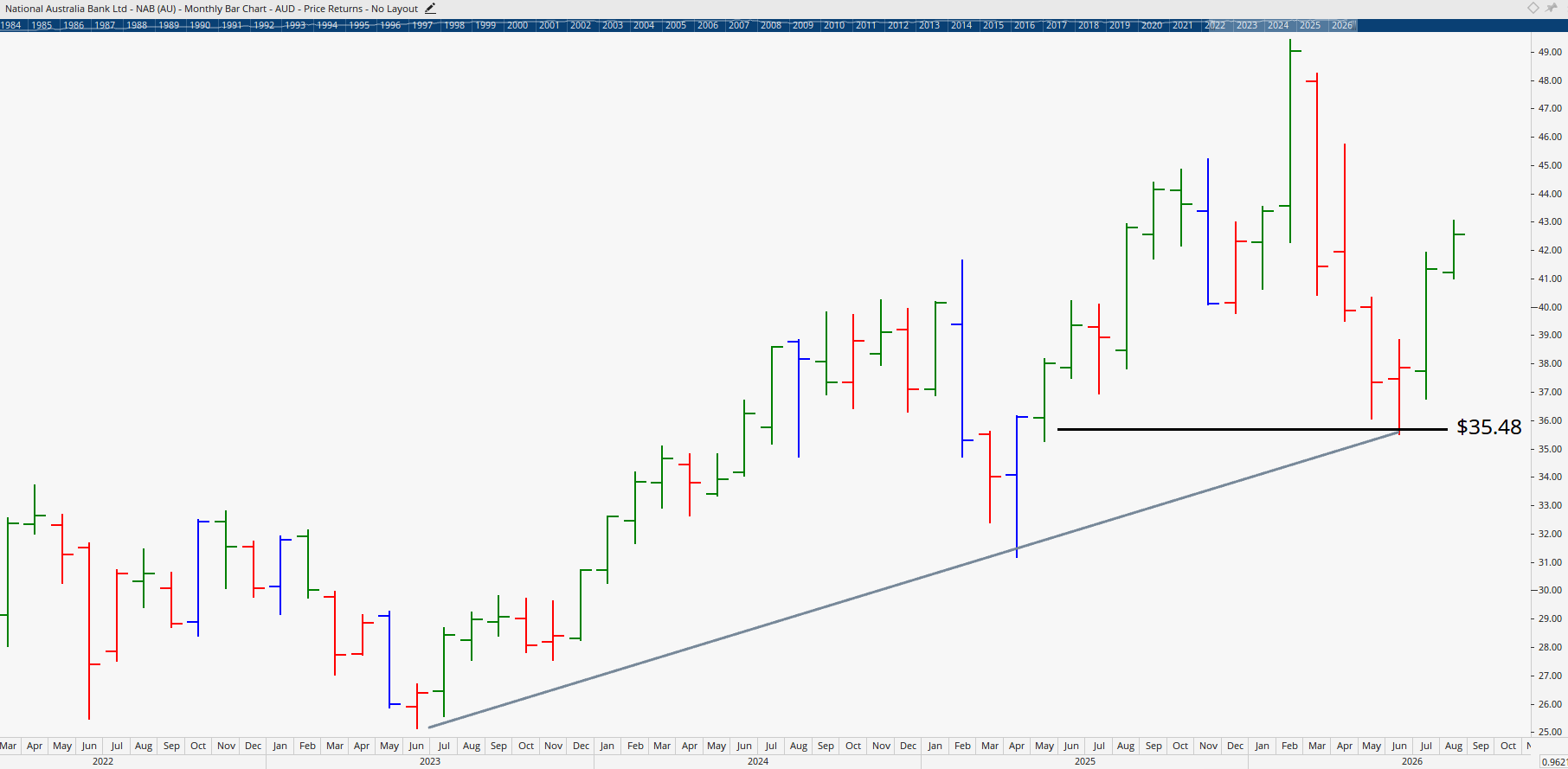
NAB’s chart has started to improve with support around $35.48. The share price has made a substantial reversal and is now moving towards the gap near $40. This move would be constructive, but the way the stock behaves once it gets there will tell us far more. It may close the gap and continue higher, or the area may attract another round of selling.
Australia’s major banks trade at expensive multiples compared with many international peers. AI-driven efficiencies may support earnings, but they do not automatically make a highly valued bank cheap. If they cannot break to new all-time highs while the financial sector is strong and productivity initiatives are supporting the cost base, we are not prepared to become aggressively bullish on the long-term story.
3. Coles Group (ASX: COL): AI Automation Meets a Bullish Share Price
Coles has several obvious areas where AI could support margins. Inventory optimisation, demand forecasting, supply-chain management, staff rostering and checkout automation can all be improved through better use of data. In some respects, Coles has been moving in this direction for years. While AI can produce meaningful savings, companies are still learning where automation improves the experience and where it simply moves the bottleneck.
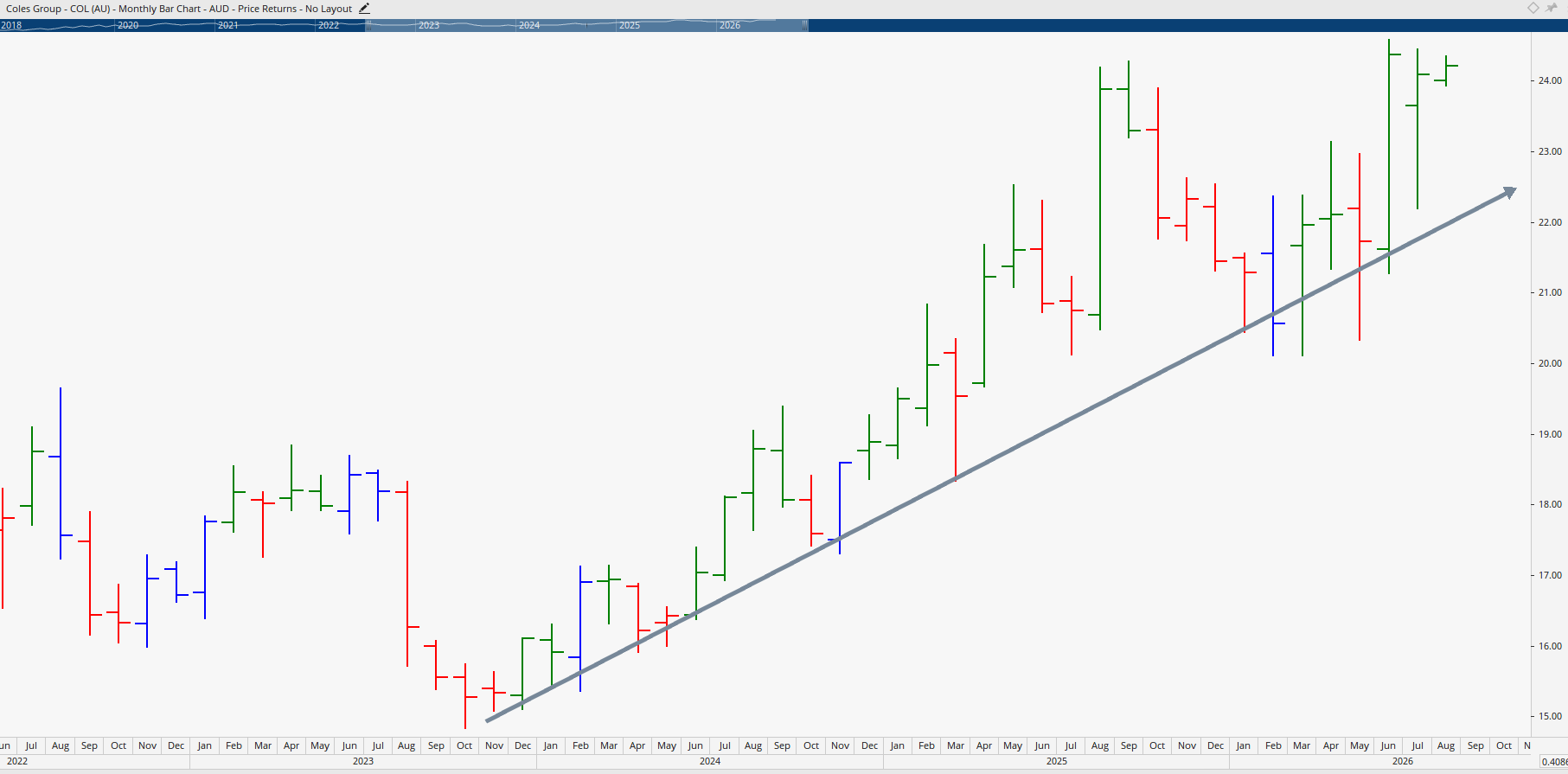
The Coles chart is already strong. The stock turned higher from its March 2026 low and has been approaching another all-time high. The trend underneath the price remains robust, although there may be a period of sideways movement before the next advance. Coles, however, has not tended to remain still for long once a strong trend is underway.
Historically, the stock has produced periodic runs in the region of 15% to 20%. It has recently completed another substantial rise, followed by a pullback, and is now trying to resume the move. This reporting season will be the proof in the pudding.
4. PEXA Group (ASX: PXA): AI Opportunity Attached to a Falling Share Price
PEXA operates a digital property-settlement platform. Documentation, compliance checks, settlement administration and other repetitive processes can potentially be automated at scale. From a business-process perspective, it is one of the clearest AI opportunities in the group, but then you look at the chart.
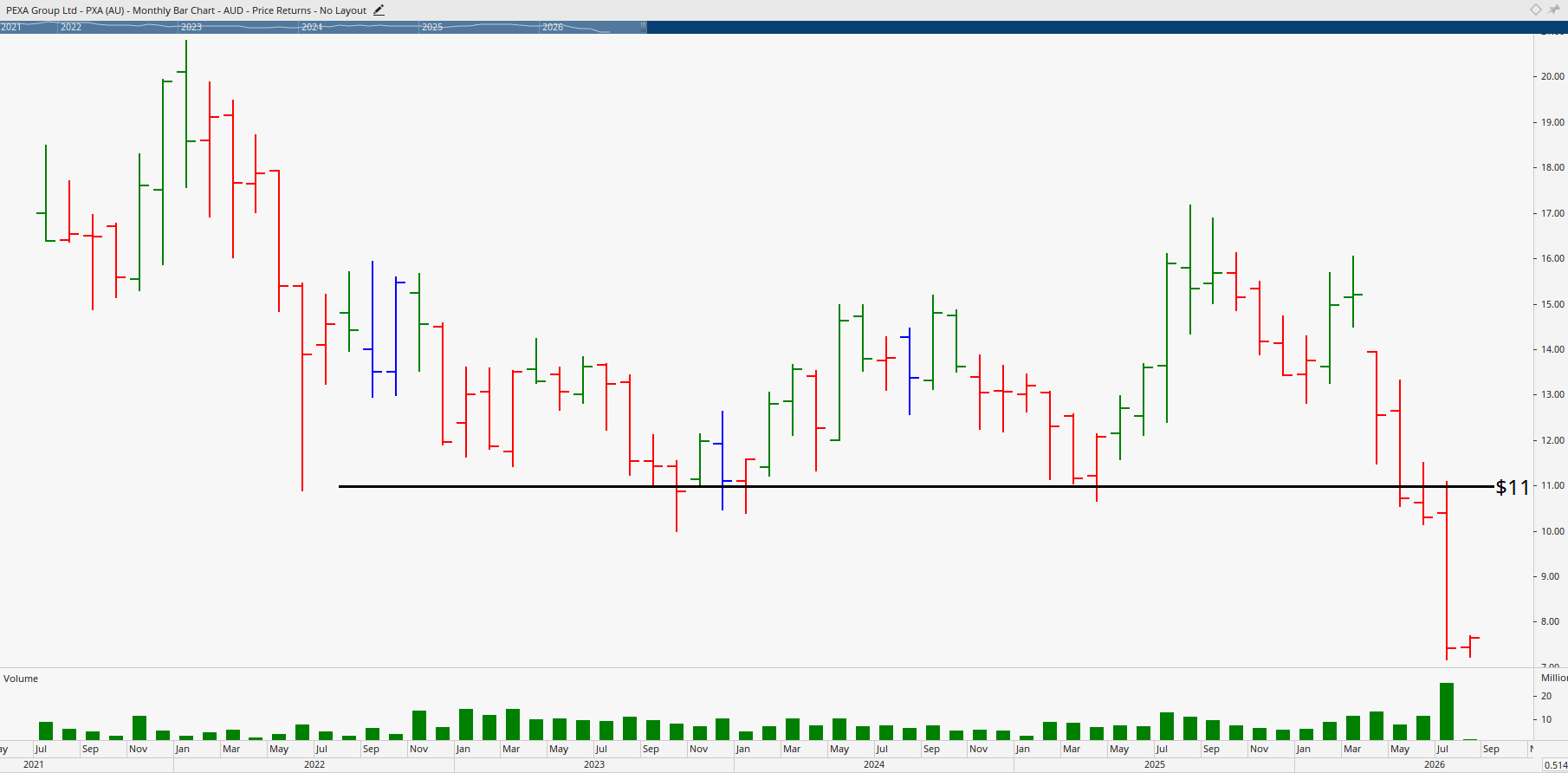
The share price has fallen sharply, broken through a downside gap and continued to trade under pressure. The area around $10 to $11 is the first obvious level to monitor, but the reduction in volume is not yet supporting a sustainable recovery.
There was an initial volume spike during the decline. Since then, activity has faded, and sellers appear to remain in control. The stock may eventually spend enough time around its lows to form a base. Should it consolidate and begin attracting genuine buyers, it would then justify a full analysis of the recovery potential. The AI opportunity may be real, but the chart is saying it can wait.
5. REA Group (ASX: REA): Is the Share Price Pullback a Buying Opportunity?
REA Group has something PEXA does not currently have: a dominant position in its market and a long-term chart that still looks constructive. That does not make every pullback a buying opportunity, but it makes the decline worth examining.
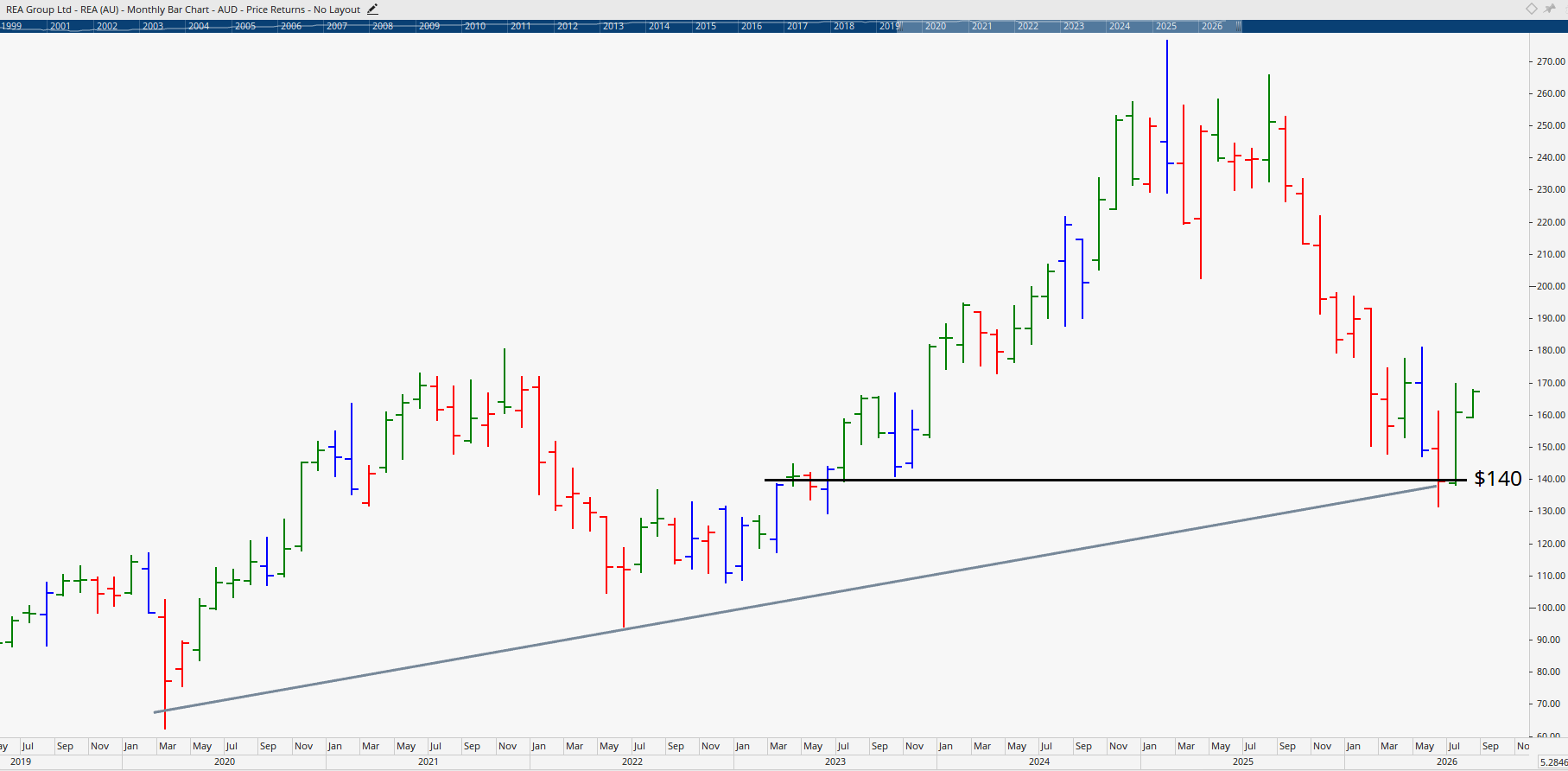
REA used to trend beautifully. The recent movement has been more difficult, although the long-term trend remains intact and the stock has now returned to test it. Buyers have begun appearing around the broader $140 to $150 level. The question is who those buyers are. They may be long-term investors who see value in a dominant online property platform. They may also be short sellers taking profits and closing positions after the decline.
The market will probably need to return and test the area before the answer becomes clear. If the stock moves higher, approximately $180 is the next serious resistance area. A break through that level would make the recovery considerably more interesting. Before then, investors need to watch the company’s reporting-season results and the market’s reaction to it.
6. ASX Limited (ASX: ASX): Can AI Support a Share Price Recovery?
ASX Limited operates in areas where AI could have an obvious role. Clearing, settlements, market surveillance, compliance and market operations all involve enormous quantities of data and repeatable processes. The company has also experienced problems with major technology rollouts, making execution just as important as the opportunity itself.
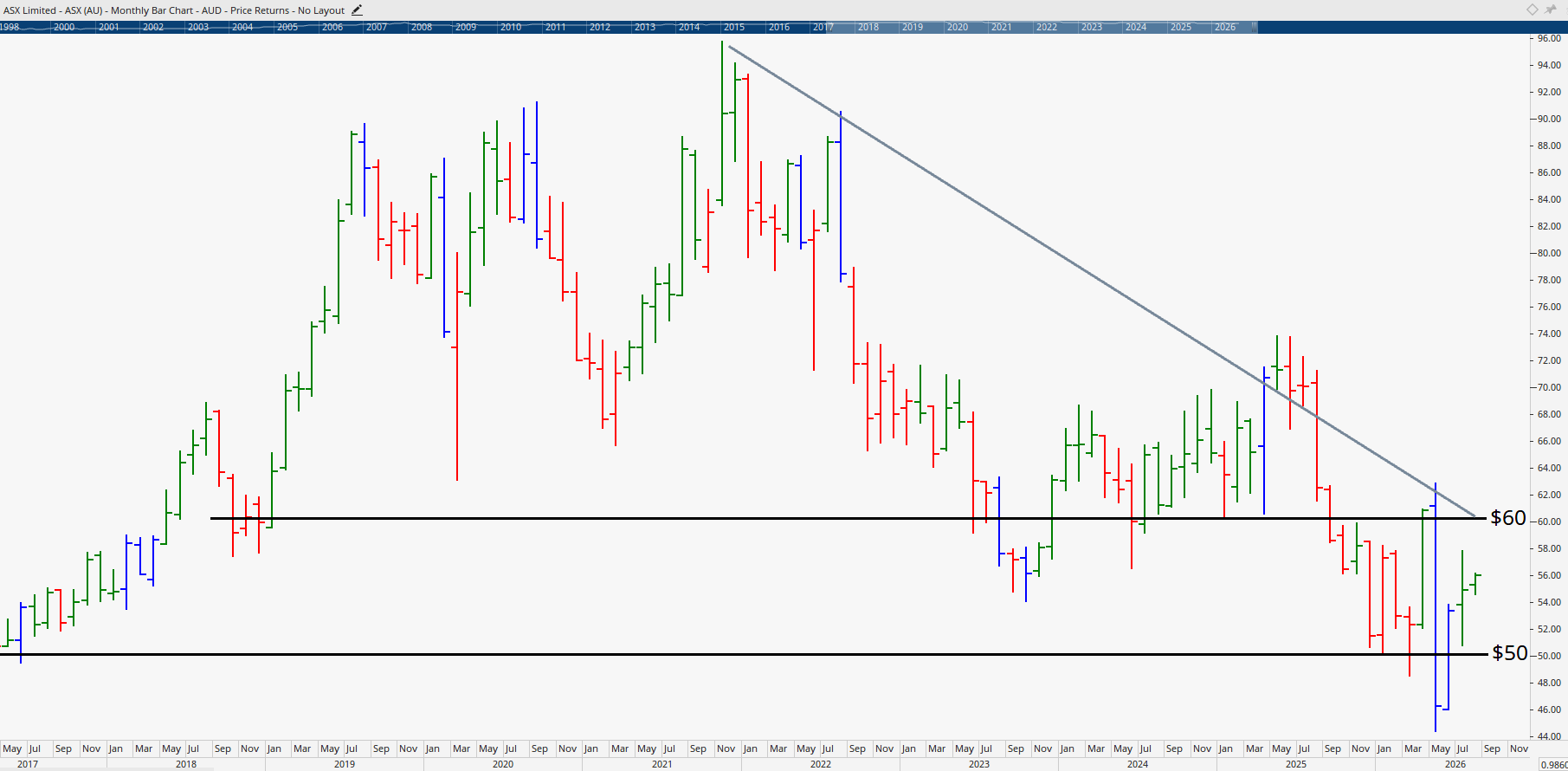
The stock remains in a long-term downtrend, although it has been declining in a more orderly way than PEXA. A substantial fall took the share price from close to $60 towards $44. Since then, the stock has consolidated, rebounded and moved back above the psychologically important $50 level.
That rebound suggests buyers are beginning to see value. The next major barrier is around $60. A move through $60, together with a break of the longer-term downtrend, could create a pathway towards approximately $70, but you would want to see more volume supporting the recovery. Without it, the move remains promising rather than complete.
7. Codan (ASX: CDA): Can the Share Price Reach $50?
Codan is another company where AI could improve practical areas of the business. Design, forecasting, engineering and production planning all offer opportunities for automation and better decision-making.
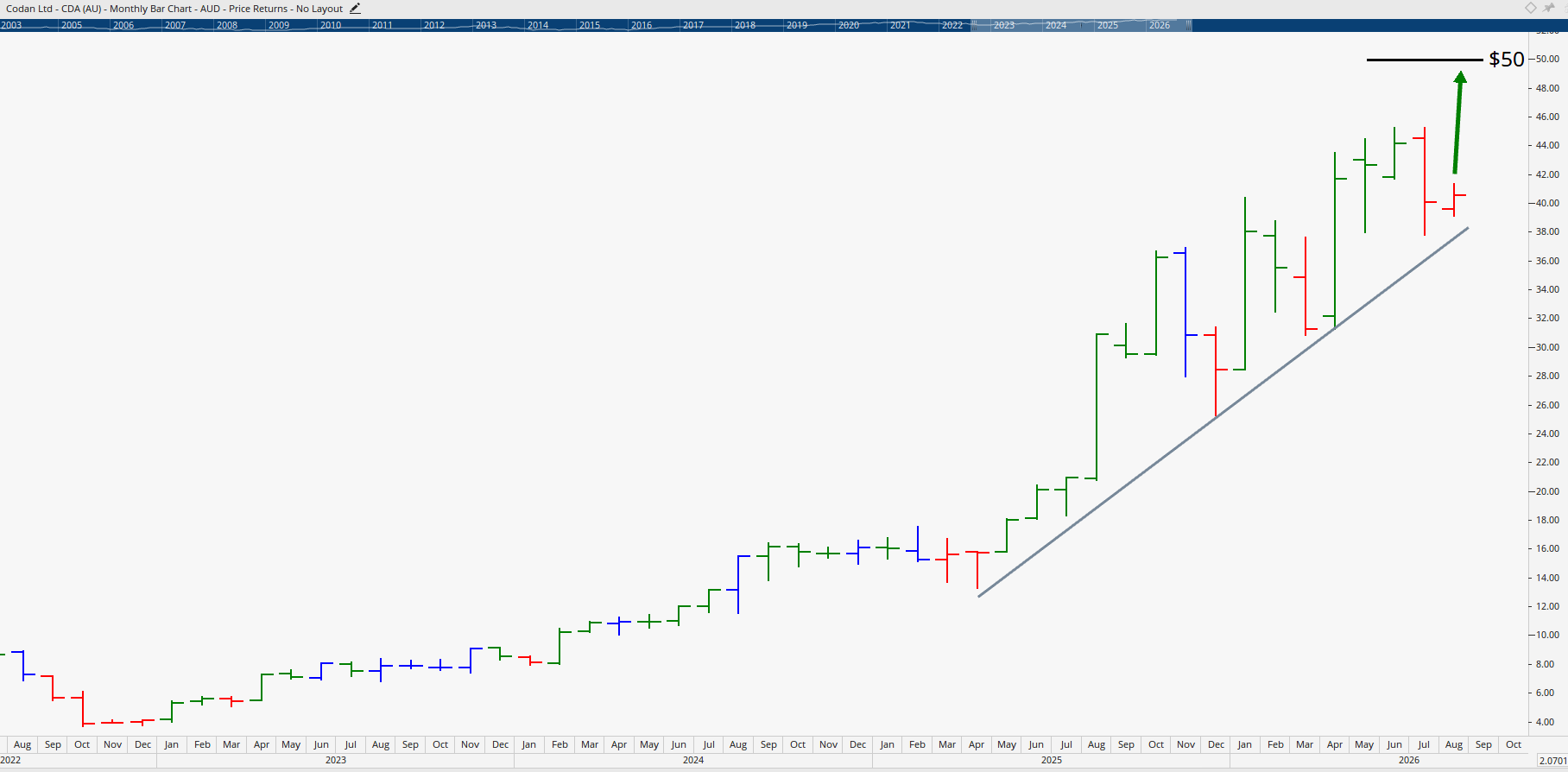
The chart is already doing much of the talking. Codan continues to produce higher highs and higher lows. Every time the stock appears to be approaching exhaustion, it finds another reason to move. That creates an awkward question for new buyers, as any future benefit may already be reflected in the share price.
There is potential for Codan to move to $50. The April 2026 low is an important reference point. A return to that area would suggest the current trend has run its course for the time being. Until then, disciplined trend-following rules are more useful than attempting to predict the exact high.
8. Brambles (ASX: BXB): Can AI Improve Logistics Margins?
Brambles has one of the most practical AI opportunities on the list. Its global logistics network depends on moving, routing and recovering pallets efficiently. AI could improve pallet movements, routing decisions and asset utilisation across that network. At Brambles’ scale, small improvements can become meaningful.
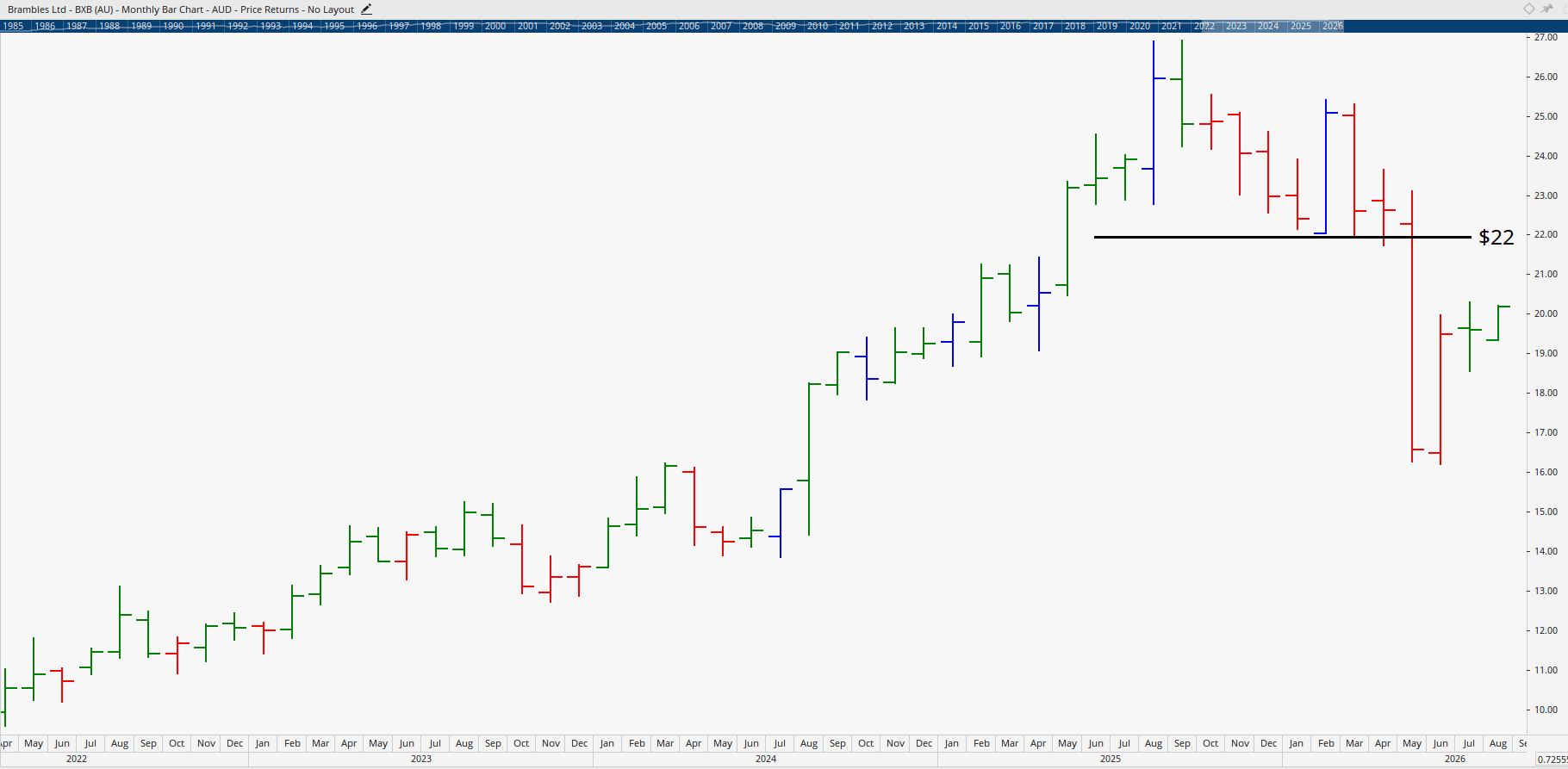
The share-price chart is currently far less encouraging. The stock has fallen by approximately 40% from its previous level and left a large gap behind it. Trading volume is not providing strong support for the attempted recovery. It is expected that the share price may rebound towards approximately $21.40 to $22 as it attempts to close part of that gap. After that, the stock may come under pressure again.
For the short-to-medium term, Zoran sees a possible trading range between approximately $18 and $22. There may eventually be a stronger recovery. At present, the chart is not making that case. While the AI opportunity is easy to understand, its next sustained share-price move is not.
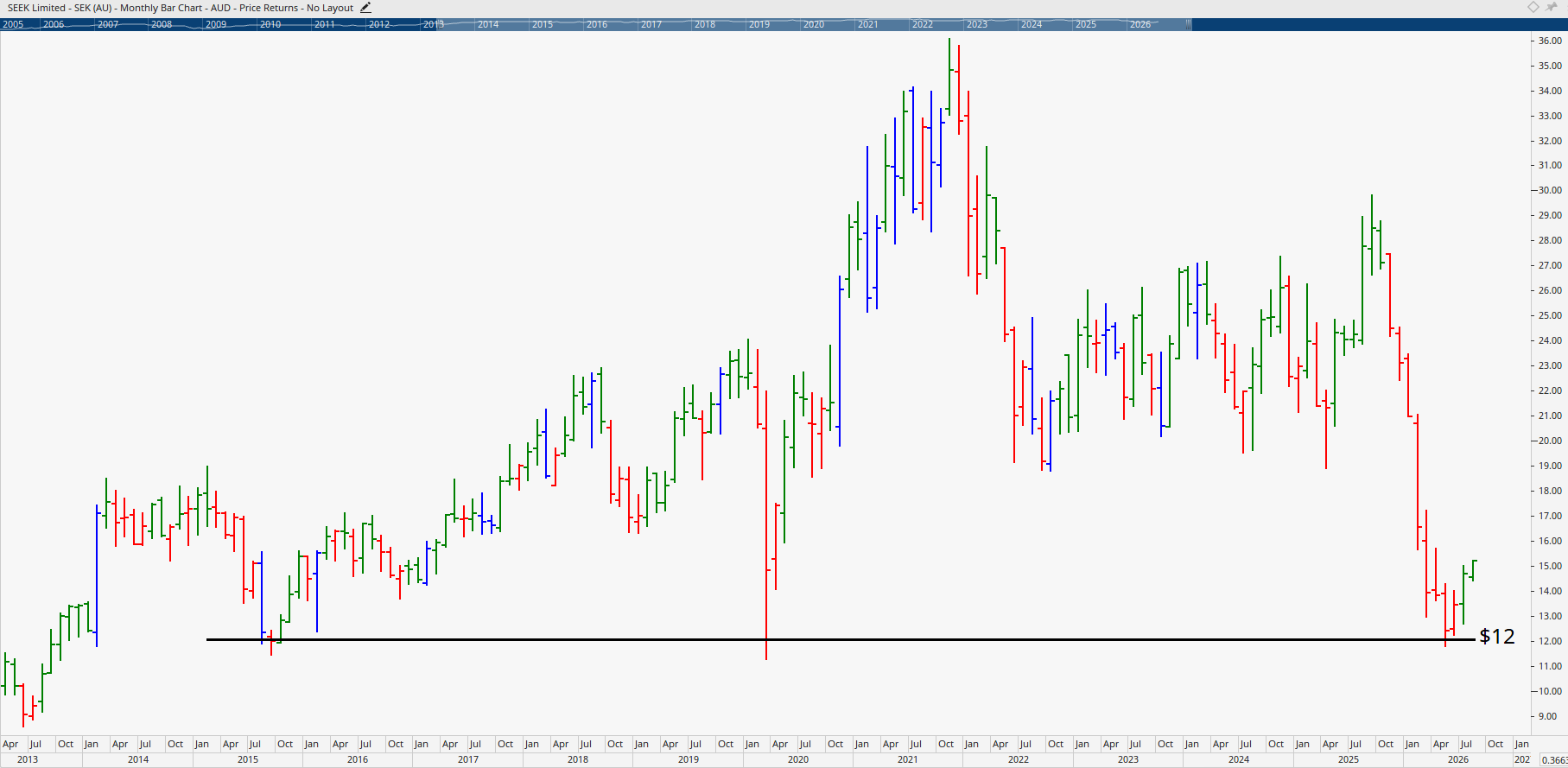
9. SEEK (ASX: SEK): Is the Share Price Downtrend Near an End?
AI could transform several parts of SEEK’s business. Better use of data can improve candidate matching, recruitment advertising, job recommendations and screening. That opportunity comes with a competitive risk. The same technology that helps SEEK improve its services may also make it easier for new competitors to enter the market or reproduce parts of the existing product.
The chart is not yet reflecting the full upside case. While the stock may be approaching the end of a broader process, the decline may not be complete. Around $12 could still become an important level.
Short-term traders may find opportunities inside the current movement. A medium-term investor has a different job. The monthly chart needs to provide clearer confirmation that the decline has ended, and a new trend is beginning.
10. Aussie Broadband (ASX: ABB): Key Share Price Support Near $4.30
Aussie Broadband can use AI across customer support, network monitoring and fault detection. The last two may be just as important as the first. Finding network problems earlier and allocating technical resources more efficiently can improve service while lowering the cost of resolving faults.
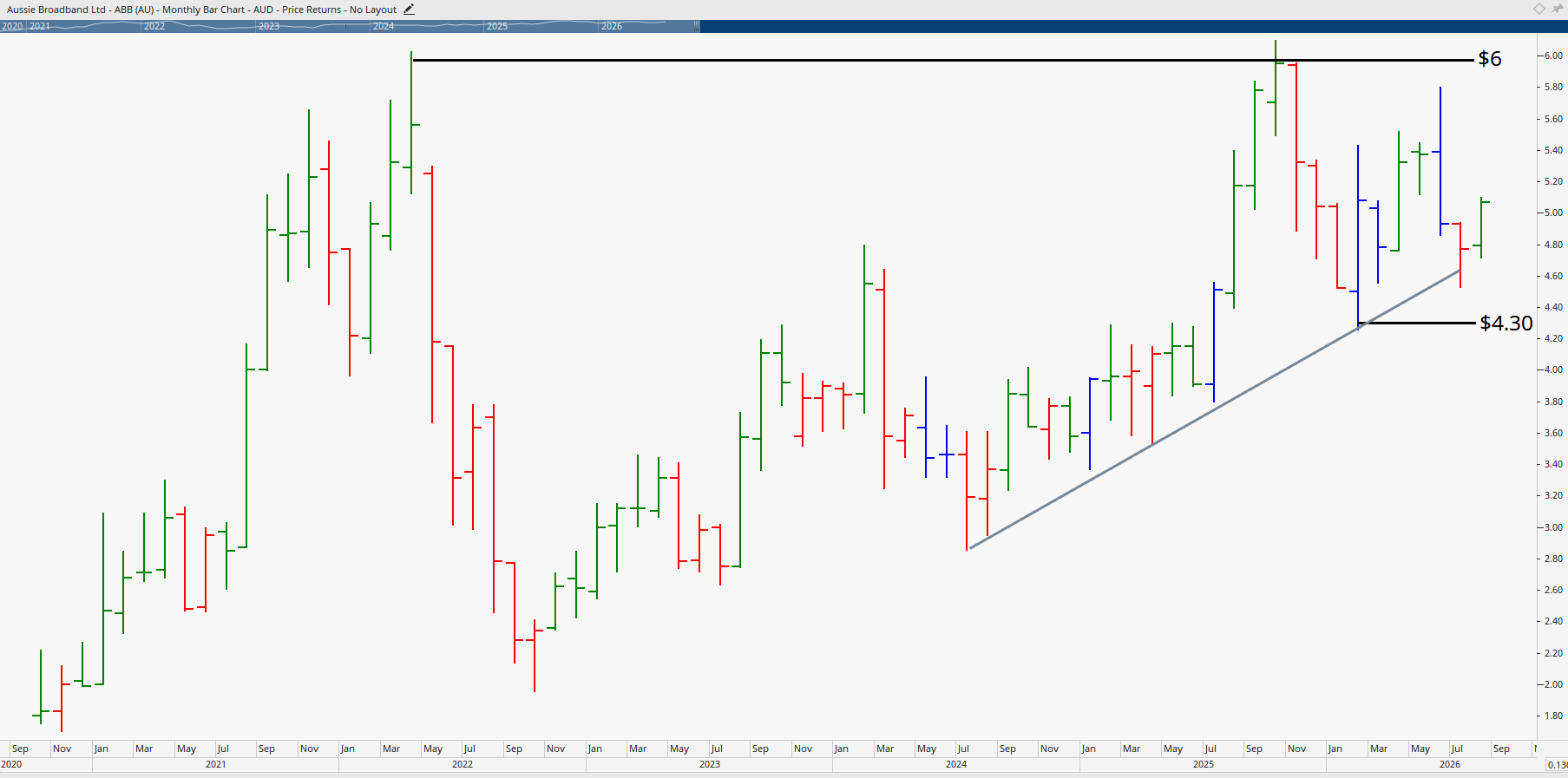
On the monthly chart, Aussie Broadband still appears to be within a long-term rising structure. The stock began a broader advance from its September 2021 low and later reached an all-time high near $6.10. It has since pulled back and entered another consolidation.
The share price has formed a lower high from its October 2025 peak, volume remains subdued, and another move lower is possible. Approximately $4.30 is the first important support area. If the stock returns to that level without breaking its major low, the broader structure may remain intact. For now, the likely range sits between approximately $4 and $6. A breakout accompanied by stronger volume would make the opportunity considerably clearer.
Trending Topic: How a Reported $45 Billion Fund Fell to $10 Billion
Leopold Aschenbrenner was described as one of Silicon Valley’s most prominent young thinkers on artificial intelligence. He identified the likely importance of AI and many of the companies positioned to benefit.
According to the Daily Mail, Aschenbrenner became a hedge fund manager at 24 and built the Situational Awareness Fund to an estimated $45 billion in assets. The fund then reportedly fell to approximately $10 billion after a highly leveraged AI strategy moved against it.
The fund was said to have borrowed heavily to support its AI positions. When the sector weakened, leverage magnified the damage. The situation reportedly became worse as other hedge funds familiar with its holdings began selling some of the same positions.
One of the most interesting parts about what unfolded had nothing to do with finding the next AI winner. It was about what happens when somebody correctly identifies a major trend and still loses an extraordinary amount of money. Whether an investor is managing $10,000 or tens of billions, the lesson is the same. Being intelligent does not replace risk management. Being right about the future does not guarantee that a particular trade will survive long enough to benefit from it.
Key Lessons and Takeaways from this Case Study
Lesson 1: A Strong Fundamental Thesis is Not a Risk Plan
The first mistake is believing that strong fundamentals protect a position from price movement. They do not. A company can have excellent long-term prospects and still fall by 30%, 50% or more. A sector can eventually transform the economy while destroying overleveraged investors along the way.
Fundamentals can explain why an opportunity may exist. They do not tell you how much capital to risk, where to exit or what to do when the market disagrees. That is why Wealth Within places risk management at the beginning of its trading education rather than treating it as something to add later.
Lesson 2: Leverage Amplifies Everything
Leverage can amplify a correct decision. It can also turn a manageable error into an account-ending loss. Zoran pointed to a recent intervention-driven move in the foreign-exchange market as an example of why unexpected events matter. The move reportedly involved US activity in the Treasury and currency markets, including purchases of Japanese yen and sales of euros, with the yen subsequently moving by approximately 5.5%.
Most traders would not have predicted the event in advance. A trader does not need to predict every possible intervention, announcement or geopolitical shock. They only need a position size and exit plan capable of surviving events they did not predict. A leveraged position on the wrong side of a sudden 5.5% currency move can become destructive very quickly.
You Do Not Need to Be Right on Every Trade
Many traders begin with the wrong objective. They want to prove that their market opinion is correct. That usually causes them to focus on the potential profit while overlooking the risk required to pursue it. We recommend turning the process around.
Suppose a trader only takes opportunities where the potential reward is four, five or six times greater than the initial risk. The trader does not need a perfect strike rate. A strategy with three winning trades out of ten can still be profitable when the winners are sufficiently larger than the losses.
For example, seven losses of one unit each produce a loss of seven units. Three winners returning four units each produce 12 units. The net result is a gain of five units before costs. The calculation is simple. Following it consistently is the difficult part.
Want to improve the way you analyse ASX shares?
Get Dale Gillham’s book, How to Beat the Managed Funds by 20% for free, just pay postage. You can also learn more about Wealth Within’s government-accredited Diploma of Share Trading and Investment.
Which ASX Stocks Look the Strongest Right Now?
The ten AI-related companies are not moving as one group. Coles has the strongest established trend. Codan is also moving well, although buyers need to consider how far the existing advance has already travelled. WiseTech is becoming an interesting turnaround candidate, particularly with volume beginning to support the move.
NAB has a credible shorter-term recovery towards $40, but valuation and the wider lending environment still matter. REA Group, ASX Limited and Aussie Broadband are trying to establish more convincing recoveries. There is potential, but each needs another piece of evidence from the chart. SEEK may be approaching the end of its decline. PEXA and Brambles remain the weakest technical setups on the list.
None of this makes the AI thesis irrelevant. It simply means AI does not have the authority to overrule price. A company can automate its operations, improve its product and reduce costs while its share price continues to fall. The market may have expected more; the benefit may already be priced in, or another part of the business may be deteriorating. Reporting season should begin separating the genuine productivity stories from the companies still talking about potential.
Final Thoughts
As always, the key to profiting from these stocks is discipline: confirmation before entry, clear stop losses, and a willingness to let the chart tell the story rather than the headlines. If you’re new to the stock market, start with our How to Invest in Stocks Beginners guide.
To explore more expert analysis and market insights from Wealth Within, visit the Hot Stock Tips videos. Wealth Within has over two decades of experience guiding Australians towards financial independence through the Short Course in Share Trading and the Diploma of Share Trading and Investment.