Data Centres 101: What Do They Actually Do?

By Fil Tortevski and Pedro Banales
Reading Time: 7 minutes
General Advice Disclaimer
This article is for general educational purposes only and does not take into account your personal financial circumstances, objectives or needs. Before making any investment decisions, consider your individual circumstances and seek independent financial advice if necessary.
Australian data centres have become one of the biggest talking points around artificial intelligence. New facilities are being planned across Australia, bringing questions about electricity, water, noise, diesel generators, and how many data centres the country actually needs.
Before deciding whether the boom is an opportunity or a problem, it helps to understand what these facilities actually do.
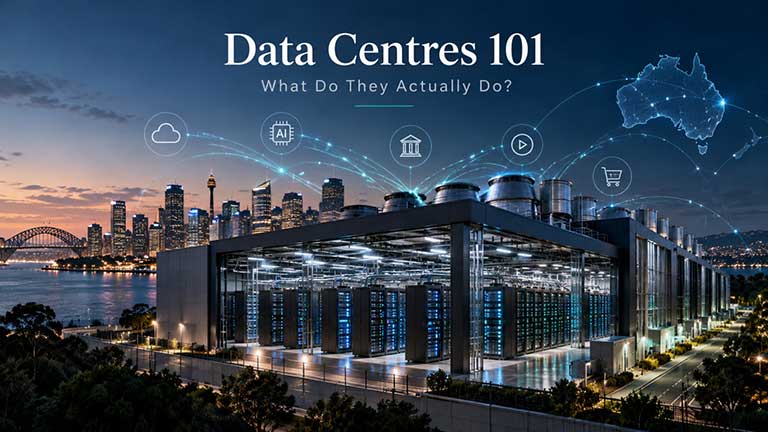
At its simplest, a data centre is a highly secure industrial building filled with servers. Those servers store and process the information behind cloud computing, artificial intelligence, banking, streaming services, government systems, websites, corporate software and telecommunications.
As demand for faster services and greater computing power grows, so does the infrastructure required to support it.
Why AI is pushing demand higher
Artificial intelligence has added another layer because more capable AI requires enormous processing power.
Fil is cautious about where that leads. His concern is that as AI becomes more powerful, the amount of computing and energy required to produce the next improvement can rise sharply. In his experience, higher-powered AI models can take longer to process a task and consume far more computing capacity, even when the improvement in the final result is relatively modest.
At what point does the extra cost and energy required start producing diminishing returns?
Fil also questions whether the data centres being built today will remain essential if computing technology changes significantly. A new generation of chips, quantum computing or another technological breakthrough could change how much infrastructure is needed.
Pedro sees it differently. His view is that we may need today’s processing capacity to reach those new technologies in the first place. The infrastructure may eventually be repurposed, but that does not mean it is unnecessary now.
AI is already creating demand well beyond the technology companies developing the models. Memory, processing, power and digital infrastructure are all part of the equation, something we have also explored in The AI Resource Boom Nobody Is Talking About.
Electricity is the real pressure point
Data centres need enormous amounts of electricity and, just as importantly, they need it reliably. A banking platform, cloud service or AI system cannot simply shut down because the grid has a problem.
According to the Australian Energy Market Operator (AEMO), Australia already has around 162 operational data centres, accounting for roughly 2 per cent of grid-supplied electricity. The forward numbers are far larger.
AEMO forecasts data centre electricity consumption in the National Electricity Market to rise from around 5 terawatt hours in 2025-26 to about 34 terawatt hours by 2035-36. That would lift the sector from around 3 per cent to approximately 13 per cent of electricity supplied through the grid.
Pedro believes this changes the focus of the debate. Rather than simply blaming data centres for using too much electricity, Australia needs to consider how it increases supply to meet the demand that is coming.
If these facilities are supporting AI, banking, healthcare, cloud computing and the broader digital economy, the electricity system needs to grow with them.
Water use sounds enormous, but location matters
Cooling is another major concern because servers generate heat. Traditional cooling systems can consume water, while newer closed-loop liquid cooling systems can reuse the same water and significantly reduce consumption.
Australian data centres used an estimated 5.5 gigalitres of water for cooling in 2025. That represented about 0.04 per cent of Australia’s total industrial water use. Australian Government: Data centre water requirements
For Pedro, the more important issue is where that water is being used.
A large data centre in a water-abundant area is very different from building several huge facilities in a water-stressed catchment. Location and existing infrastructure can make a significant difference.
Gippsland is one example. The region already has power infrastructure from its history as an electricity-generating area, while decommissioned coal mines create another potential water source. Using areas where power, water and industrial infrastructure already exist makes more sense than forcing the same facilities into densely populated areas.
What happens when the power goes out?
Data centres are designed to stay online, which creates another issue: backup power.
Large facilities can require hundreds of diesel generators that start quickly if grid power fails. That means fuel storage, exhaust stacks, regular testing and potentially significant diesel infrastructure sitting alongside the servers.
This creates questions about nitrogen oxides, particulate matter, diesel exhaust and the effect on surrounding communities. The impact depends on operating hours, the facility size, emission controls, prevailing conditions, and how close the site is to homes and other sensitive areas.
It also creates another part of the data centre investment story. As the number of facilities grows, so does the need for equipment that can keep them operating when the normal power supply is interrupted.
The noise does not switch off
For nearby residents, noise may prove more noticeable than electricity or national water consumption.
The servers themselves are not necessarily the problem. Cooling fans, chillers, pumps, transformers, ventilation systems and backup generators all create noise, and a data centre operates 24 hours a day.
Even when a facility meets regulatory limits, the background sound can be completely different from what residents previously experienced.
Planning assessments therefore need to consider generator testing, emergency operation, plant start-up and shutdown, night-time impacts, low-frequency noise and tonal noise.
Fil and Pedro both see this as one of the more legitimate community concerns, particularly when large facilities are proposed close to established residential areas.
What about electromagnetic fields?
Data centres do not produce ionising radiation like X-rays or nuclear sources, although the large amount of electrical infrastructure does generate electromagnetic fields.
The government agency for radiation protection, ARPANSA, classifies these as extremely low frequency, non-ionising electromagnetic fields. It states there is no established evidence that long-term exposure to ELF electromagnetic fields causes health effects, although some epidemiological research has investigated possible associations between prolonged higher-than-normal exposure and childhood leukaemia. ARPANSA: Extremely low frequency electric and magnetic fields
For Fil, a broader question remains about how close major infrastructure should be to homes and how much consultation residents should receive before a project goes ahead.
People buying into new areas should know what major infrastructure is planned nearby. Compliance with regulations is one part of the issue. Residents also want some say in what is being built around them.
Australia’s data centre boom is only getting started
Australia’s 162 operational data centres are only part of the picture. At least 27 approved but unbuilt facilities have a combined capacity of around 3.38 gigawatts.
The development pipeline includes major global operators as well as Australian-listed companies, including NextDC, Goodman Group and Stockland.
For traders, there are several ways to approach the theme. Some companies develop or operate data centre infrastructure, while others supply the equipment needed to build and run it.
We have previously examined several listed companies exposed to this growth in 3 ASX Data Centre Stocks Set to Surge in 2026.
Stockland caught Pedro’s attention because of the way the share price has been behaving after a long period of weakness. He sees the $4 area as an important support level, with the stock currently trading within a broader range.
The opportunity behind the generators
One of the less obvious areas is the equipment required to keep these facilities powered.
SGH provides exposure to this through its industrial businesses, including Caterpillar equipment and Coates Hire. That makes it interesting as data centre operators increase their need for generators and backup equipment.
Fil sees a strong longer-term growth story in SGH, but he is more cautious about the current price action. The stock had a large rise between 2022 and 2025 and is now pulling back, so he would want the chart to show that the decline is ending rather than assuming the data centre theme will automatically drive the price higher.
Pedro agrees. A company can be exposed to a powerful long-term trend and still be the wrong trade at a particular point in time.
A strong fundamental story does not guarantee the share price will immediately follow it. That is why the chart matters.
Data centres are coming, and demand for electricity, cooling, generators and supporting infrastructure will grow with them if the current expansion continues. For traders, identifying the theme is only the first step. The next is working out which companies are exposed to it and whether the price action confirms that money is actually flowing into the stock.
Understanding a market theme is one thing. Knowing how to analyse the stocks behind it is another. Wealth Within’s government-accredited Diploma of Share Trading and Investment teaches you how to read price, pattern, and time, manage risk, and build a disciplined trading plan with confidence.