3 ASX Stocks to Lead an October Rebound?

By Fil Tortevski and Pedro Banales
Reading Time: 8 minutes
General Advice Disclaimer
This article is for general educational purposes only and does not take into account your personal financial circumstances, objectives or needs. Before making any investment decisions, consider your individual circumstances and seek independent financial advice if necessary.
If the Australian share market is preparing to turn higher, three of its biggest stocks may show us before the broader index does.
September has been a difficult month, and October is seasonally another period that can test investor confidence. That makes the behaviour of BHP, Wesfarmers and Macquarie Group especially important. Together, they give us a read on resources and global growth, the Australian consumer, and investment activity and risk appetite.
In this week’s Hot Stock Tips Show, Senior Analyst Fil Tortevski and Analyst Pedro Banales examine what these three market heavyweights are telling us now and what would need to change before an October rebound becomes more convincing.
BHP: Has the rise gone too far, too fast?
BHP is an important place to start because resources carry so much weight in the Australian market. If BHP begins strengthening again, it would suggest improving confidence around global growth, China and commodity demand, particularly copper.
The longer-term copper story remains significant, with BHP itself pointing to digitalisation, AI and electrification as major drivers of future demand. But a strong long-term story does not tell us whether the timing is right today.
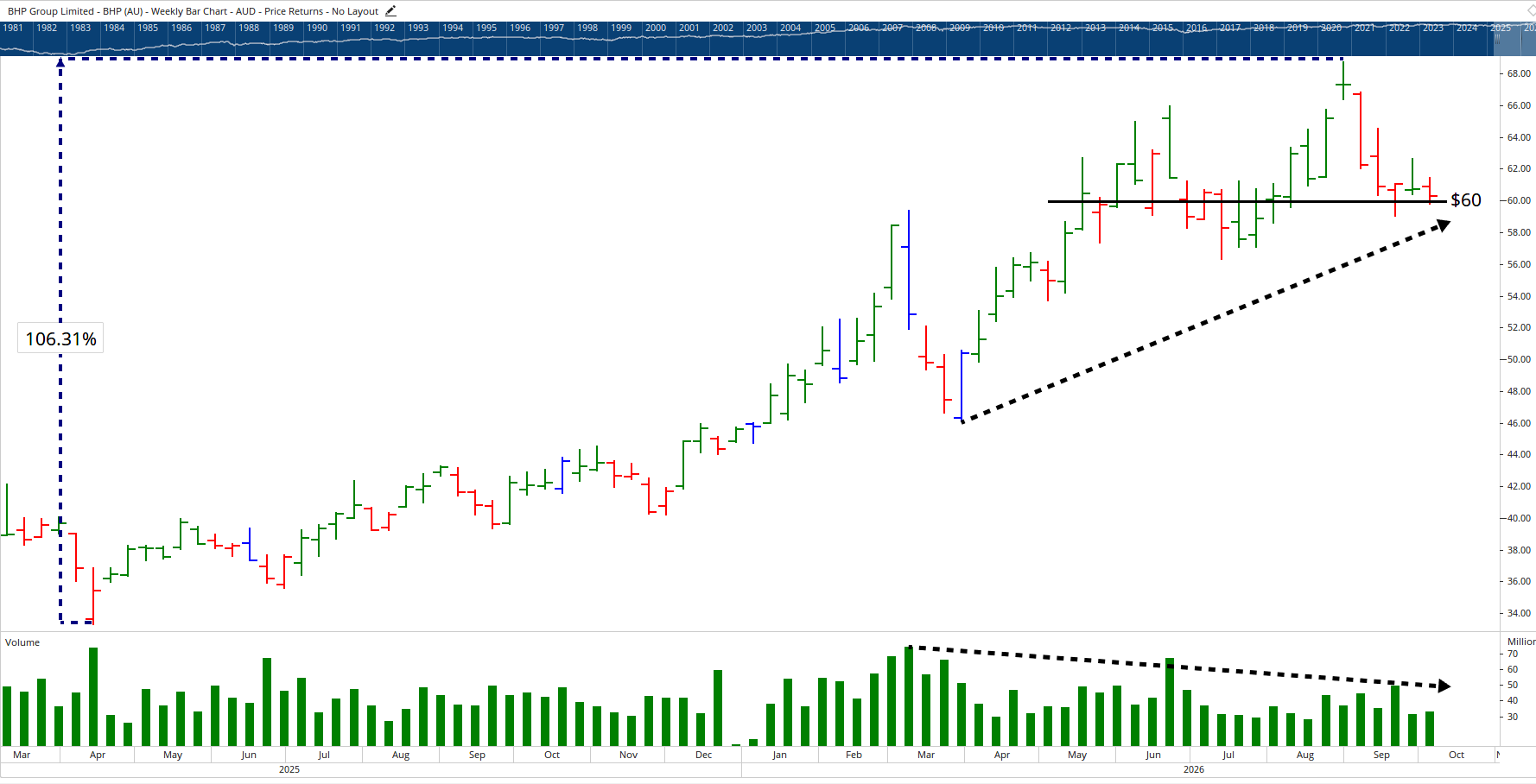
BHP has enjoyed a powerful rise since June 2025. What stands out is not simply how far it has travelled, but how steep the move has become. Looking back through previous major advances, BHP has produced expansionary moves of roughly 100 to 125 per cent before meaningful corrections followed.
On the weekly chart, BHP has recorded three strong weeks of selling. Earlier pullbacks during the rise tended to establish a higher base and then resume the trend relatively quickly. This time, the first attempt to turn higher failed, and the price started pointing lower again.
Volume adds another warning. Participation faded as BHP pushed higher, while volume increased during the recent selling.
The first important test is around $60. If that level holds and BHP can then push back through approximately $62, the picture becomes more constructive. If $60 fails, the probability of a deeper correction increases, with the previous all-time-high region around $49 to $50 becoming significant. That would represent a pullback of around 26 per cent.
Has BHP become too extended?
The monthly chart puts the current rise into perspective. After the major downturn that began in 2011, BHP took roughly 12 years to make another all-time high. More recently, it has taken only around three years to establish another new high and move about 35 per cent above the previous one.
The gradient is also noticeably different. Earlier long-term rises developed at a more sustainable angle, whereas the latest move has become far more vertical.
The recent selling therefore deserves respect. For now, the price has not confirmed that buyers are returning.
Wesfarmers: What is the Australian consumer telling us?
Through businesses including Bunnings and Kmart, Wesfarmers has significant exposure to Australian consumer activity. It is also more diversified than many investors realise, including exposure to lithium through the Mt Holland operation.
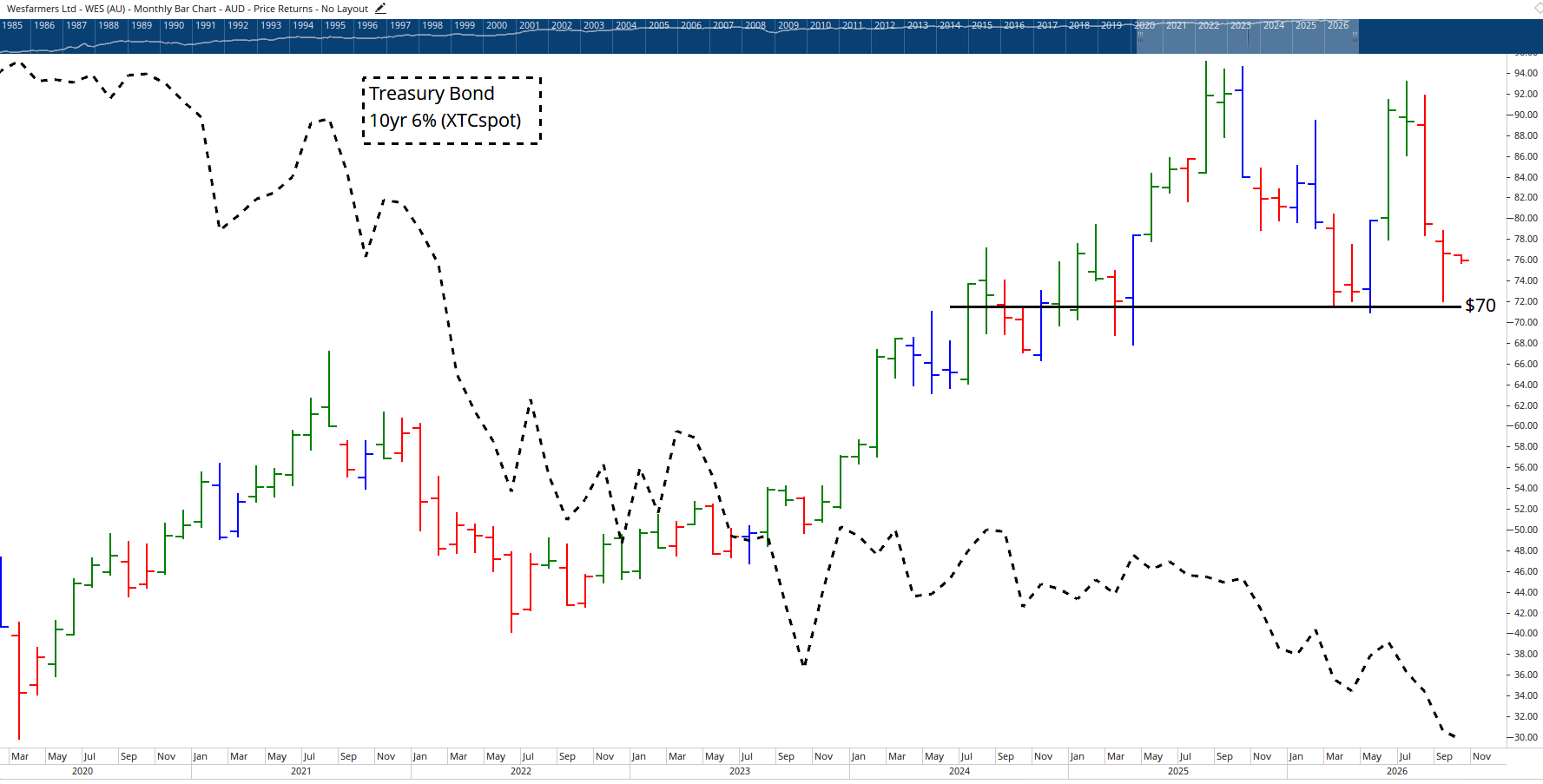
One of the more interesting relationships in the analysis is the way Wesfarmers has behaved alongside long-term bond prices.
There have been periods when bond prices were falling as interest-rate pressure increased, yet Wesfarmers continued climbing. Investors appeared confident enough in the economy and the business to look beyond tighter financial conditions.
Bond prices have again been under pressure, but this time Wesfarmers has fallen sharply as well. That raises the possibility that investors are becoming less willing to overlook pressure on the economy and the consumer. The domestic backdrop adds to that concern, with Australia’s seasonally adjusted unemployment rate rising to 4.6 per cent in August 2026.
Can buyers defend the $70 level?
After a strong rise between May and July, Wesfarmers pushed towards the $91 region, where the stock had previously encountered resistance. What followed was roughly seven weeks of persistent selling, a type of decline that has not appeared regularly in the stock’s recent history.
The $70 area is now important. It has acted as a significant level since 2024, and there have been some early signs of buyers appearing there. That is encouraging, but it is not yet enough evidence to conclude the decline has finished.
Wesfarmers has experienced much larger declines in previous cycles. The current fall from its all-time high is around 22 per cent, while earlier major declines discussed in the show reached approximately 40 per cent and, during the GFC period, around 66 per cent.
The stock has also changed character over time. Since around 2018, it has behaved more like a growth stock than simply a traditional dividend payer, while still showing that it can spend extended periods moving sideways.
If $70 holds, the stock has room to establish a constructive range and potentially recover. If the level fails, the historical behaviour discussed in the show suggests a move into the $60 to $50 region would not be inconsistent with its past.
The early buying around $70 is worth watching. What matters now is whether it develops into something stronger.
Macquarie Group: Is risk appetite starting to return?
Of the three stocks, Macquarie offers the most encouraging picture.
Macquarie is also a useful gauge of confidence because stronger investment activity and risk appetite should show through in its price behaviour.
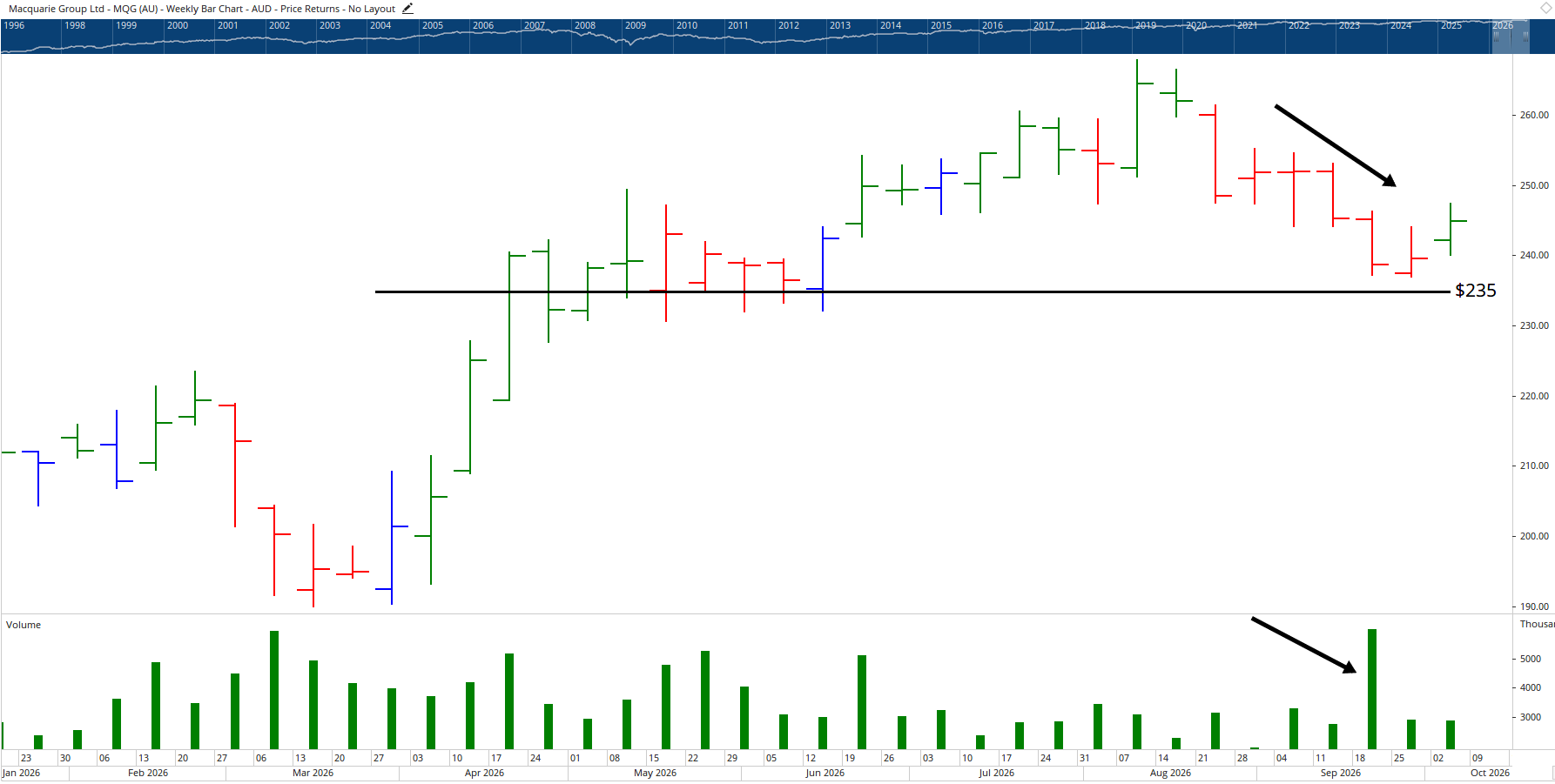
Macquarie recently broke through to a new all-time high before correcting. Compared with BHP and Wesfarmers, however, the damage has been relatively contained. The decline from the high has been around 11 to 12 per cent, and the stock has already recovered part of its September fall.
Strong selling volume appeared during the decline, showing that sellers had real conviction. More recently, the price action has started to look different, with tighter opens and closes followed by a gap higher that could be an early indication of a reversal.
The first area that needs to hold is around $234 to $240. If buyers can defend that region, attention moves towards $250. That is the more significant test because failure to generate strong buying at that level would change the picture.
There is also an interesting longer-term comparison. Macquarie spent roughly two years moving sideways from 2024 into 2026 before breaking higher. A similar period between 2021 and 2023 also saw the stock move sideways for around two years before advancing to a new all-time high.
If Macquarie can hold around $240 and show convincing buying through $250, it would add weight to the argument that investors are becoming more comfortable taking risk again.
Right now, Macquarie is showing more promise than the other two stocks, but it still needs to prove that the recent recovery has enough strength behind it.
The common lesson: Let the market prove the story
There is an important distinction running through all three stocks: a compelling story is not the same thing as a trading opportunity.
BHP has powerful long-term themes. Wesfarmers is a strong, diversified business. Macquarie has been more resilient through the recent weakness. None of those facts tells us exactly when conditions are right.
The analysis gets its context from the combination of the bigger market cycle and what is actually happening with price. We compare the current move with previous cycles, examine whether the trend is accelerating or weakening, watch volume, identify the levels that matter and then observe what buyers and sellers do when those levels are tested.
This is also why different timeframes matter. A short-term rise can look convincing in isolation, while the monthly chart may show that a stock has already travelled unusually far or moved much faster than it typically does. A sharp fall may look alarming on a shorter chart while still sitting within the stock’s longer-term behaviour.
The aim is not to predict the market turn before everyone else. It is to know what evidence needs to appear before concluding that conditions have changed.
Building the skills behind the analysis
This episode demonstrates several skills working together: understanding where a stock sits in its broader cycle, comparing current behaviour with its history, reading volume, identifying meaningful price levels and waiting for confirmation before drawing a conclusion.
Those skills create a framework traders can apply across different stocks and market conditions rather than relying on somebody else to continually provide the next opportunity.
Wealth Within’s government-accredited Diploma of Share Trading and Investment (11398NAT) teaches you a structured approach across technical and fundamental analysis, strategy, risk and capital management, with the aim of helping students understand what they are doing, why they are doing it and when to apply it.
The Short Course in Share Trading provides a structured pathway into the Diploma.
Final Thoughts
Taken together, these three stocks are not yet showing that confidence has decisively returned to the Australian market.
Early signs of improvement are emerging, particularly where selling has begun to slow, and buyers are appearing around important levels, but that is different from a confirmed change in direction.
The outlook becomes more constructive if that buying develops into sustained strength and the key areas identified in the analysis begin to hold. If sellers regain control instead, the recent weakness may still have further to run.
October is therefore less about predicting a rebound and more about watching for evidence that one is actually beginning.