Risk vs Reward: How Smart Traders Protect Their Capital

By Dale Gillham
Reading Time: 13 minutes
Most people enter the stock market thinking about how much money they could make. Very few give the same attention to how much they could lose. That is the first mistake.
After decades in the market, I have learnt that successful investing is not about chasing the biggest possible return. It is about taking a sensible level of risk, protecting your capital and giving profitable investments the opportunity to grow.
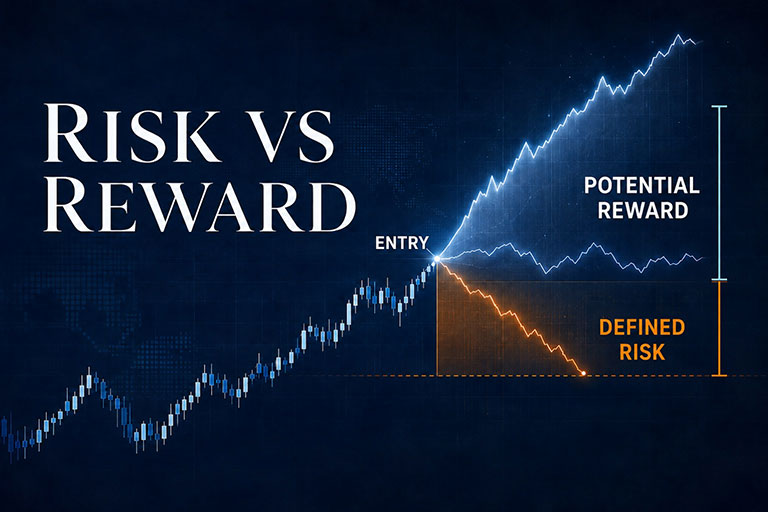
Risk and reward are often presented as though taking more risk automatically creates an opportunity to earn a higher return. I disagree. Taking on more risk simply increases the potential size of your loss; it does not improve your probability of making a profit.
The probability of achieving larger gains comes from having the knowledge to identify higher-probability opportunities and the rules to manage your capital effectively.
While risk can never be eliminated, it can be defined, limited and managed, which means you do not need to expose yourself to unnecessarily large losses in pursuit of better returns. The better question is not, “How much could I make?” It is, “Does the potential reward justify the capital I am putting at risk, and do I have the knowledge and a plan to manage the position?”
In this article, I will show you how to assess risk before you buy, why position size and portfolio structure matter, how chasing higher returns changes your risk vs reward, and why you need to consider how you will exit your position before committing any capital. You will also learn how to decide whether the potential reward genuinely justifies the risk you are taking.
What does risk really mean in the share market?
Risk is usually defined as the possibility that an investment will fall in value. While true, that is only part of the story.
For a trader or investor, risk also comes from what you do not know and what you fail to plan for. Whenever you buy a stock, you expose your capital to risk. That risk increases when you lack the knowledge to understand the stock market and manage your investment effectively.
You increase that risk further if you invest based on a tip, commit too much capital to one company, purchase an illiquid or speculative share, or continue holding a falling stock in the hope that it will eventually recover.
This is why I have always said there is a direct relationship between knowledge and risk. The more risk you take, the more knowledge and skill you require to manage it. If you do not understand what you are buying, why you are buying it and what would cause you to sell, you are not investing with confidence; you are gambling on an outcome.
When knowledge and proven rules replace hope, you significantly increase your probability of achieving a successful outcome.
The amount of money involved does not change this principle. An investor placing $1,000 into a stock should follow the same research process as someone investing $100,000. A smaller loss may be easier to tolerate in dollar terms, but careless decision making is still careless decision making. Practice with a small amount, and it will eventually follow you when the stakes are much higher.
Reward is more than a headline return
The reward from owning shares can come from capital growth, dividend income or both. In my view, the strongest investments can deliver both income and capital gains.
However, a potential return is not the same as a realised profit. You can watch a stock rise substantially, but until you have a sound method for managing the position and eventually selling it, that gain remains on paper. Markets change, trends end, and companies that once looked strong can begin to underperform.
Buying is only one part of an investment decision. It is also the easiest part and, in my view, not the most important. The most critical part is knowing how you intend to manage the stock from the time you purchase it until you eventually sell.
Traders often undermine their returns in one of two ways. They sell a profitable stock too early because they fear the gain will disappear, or they let a losing stock keep falling because they don't want to admit their original decision was wrong or accept a loss. In both cases, emotion has replaced a sound trading plan.
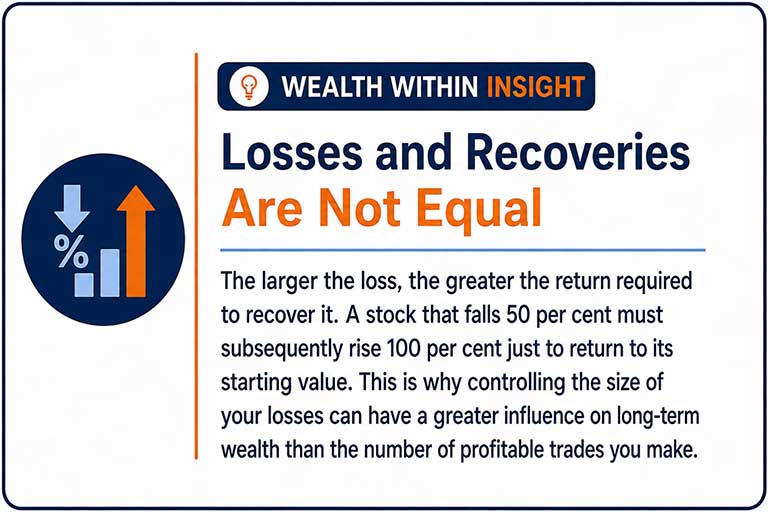
Over time, the size of your losses can have a greater influence on your wealth than the number of profitable trades you make.
Why higher risk does not automatically produce higher reward
The belief that high risk equals high reward encourages traders to look in the wrong places. They chase cheap shares, speculative companies and the latest market story because a rapid rise appears possible.
But a low share price does not make a company good value. A 10-cent stock can still fall to five cents, which is a 50 per cent loss. Meanwhile, a higher-priced quality company can continue rising because its business and market support remain strong.
The number of shares you own is irrelevant. What matters is the percentage return on your capital and the risk required to achieve it.
In How to Beat the Managed Funds by 20%, I explain why traders and investors should focus on quality rather than quantity. Large established companies generally offer better liquidity, more reliable information and a lower probability of business failure than highly speculative shares.
This does not mean every large company will rise or that a blue-chip stock cannot fall. It means you begin your search in an area of the market where risk is generally easier to assess and manage.
A methodical approach may not sound as exciting as finding the next market darling, but excitement is not the objective: consistency is.
Why a rising market hides the risk
Several years ago, I spoke with John, a middle-aged labourer with a wife and young children. After reading online about the money people were making in the stock market, he opened a trading account without gaining a structured education or developing a proven plan.
John entered while the market was rising and quickly made more than he earned in a year from his physically demanding job. Those early profits convinced him that he had figured out trading when the market had simply been moving in his favour. He borrowed heavily, increased his leveraged exposure and left his job to trade full time.
When market conditions changed, leverage magnified John’s losses. His account was wiped out, and he lost hundreds of thousands of dollars. Instead of stepping back, he took even greater risks to recover what he had lost. This placed his family’s finances under severe pressure. Moneysmart explains that borrowing to invest can produce larger losses when markets fall.
The decline was not the real cause of John’s situation. Early success had hidden the weaknesses in his approach. He lacked the knowledge to manage leverage, had committed too much capital and had no objective buy-and-sell rules or predetermined exit plan.
John’s experience demonstrates why higher potential reward never compensates for uncontrolled risk. A rising market can make a poor process look successful, but when conditions change, capital exposure and pressure-driven decisions determine the result. You need to understand and limit the risk before you enter, not after the market turns against you.
How to assess risk vs reward before you buy
Assessing risk vs reward requires more than comparing how much you could gain with how much you could lose. Before placing any trade, consider four practical questions:
- Why am I buying this stock? Your decision needs to be supported by an objective method, not a rumour, headline or emotional impulse.
- How much of my total capital will be committed? Your position size determines how much one trade can affect your portfolio.
- What evidence would tell me the investment is no longer performing as expected? Consider this before money and emotion get involved.
- Is the realistic potential return worth the risk being taken? A trade that exposes too much capital for a modest potential gain is not attractive simply because it might make money.
Imagine two opportunities could each deliver a similar return. One is a liquid, established company in a confirmed rise, while the other is a thinly traded speculative company moving on market hype.
The possible percentage gain may look similar, but the probability of achieving it, and your ability to manage the position if conditions change, can be very different.
Never consider potential reward in isolation, as it can cloud your judgement and lead to poor decisions. Weigh it against the probability of success, the amount of capital exposed, and the consequences of being wrong.
Only then can you determine whether the potential reward justifies the risk.
Position size can matter more than stock selection
No trader or investor will be right every time. Position sizing therefore becomes one of the most important parts of managing risk because it determines how much one unsuccessful position can affect your portfolio.
In Accelerate Your Wealth, I explain a principle that applies to traders and investors alike: allocate no more than 20 per cent of your total share portfolio to any one stock. This cannot guarantee that every stock will perform, but it limits the damage one position can cause when it moves into a loss.
For a detailed explanation of position sizing and managing portfolio risk, read my Four Golden Rules for Investing in Shares.
Position size must also be considered alongside your stop loss, which defines where you will exit if the trade moves against you. To learn how to calculate this level without risking too much capital, read What Is a Stop Loss and Why Should You Use One?
Diversification has a limit
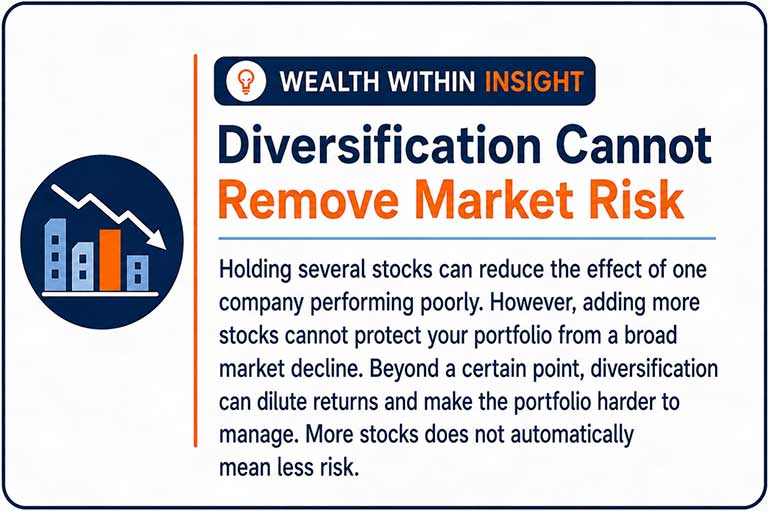
Spreading your capital across several positions can reduce the effect that one poorly performing company has on your portfolio. However, simply owning more stocks does not necessarily reduce your overall risk or improve your returns.
In my experience, the appropriate number of stocks in a portfolio is not determined by the trading timeframe. A share portfolio generally needs between five and 12 stocks, with an active trader who has the knowledge and time to manage company-specific risk typically holding closer to five.
This is consistent with the CFA Institute research into portfolio diversification, which found that the average volatility of a 10-stock large-cap portfolio was approximately 20 per cent, compared with 17 per cent for a 40-stock portfolio.
Adding another 30 stocks, therefore, reduced volatility by only three percentage points. For an individual trader, that relatively small reduction must be weighed against the additional time and complexity involved in monitoring 40 positions.
Holding more stocks can increase the risk of market volatility and the inability to manage each position effectively.
Once a portfolio grows beyond 12 stocks, it becomes harder to manage because each position requires more time and attention. The portfolio is also more likely to include shares that move sideways or fall simply to remain diversified.
At this point, diversification becomes over-diversification and can produce the opposite result to what a trader intended by increasing risk and diluting returns.
Over-diversification can also dilute the contribution made by your best-performing stocks. The aim is not to collect companies; it is to hold a manageable number of quality stocks that are performing.
Another important distinction is that diversification can reduce company-specific risk, but only to a point. Adding more stocks cannot protect your portfolio from broader market risk.
If the market falls heavily, holding 30 stocks rather than 10 simply exposes more positions to the broader decline; it does not make market risk disappear.
A falling investment is not automatically better value
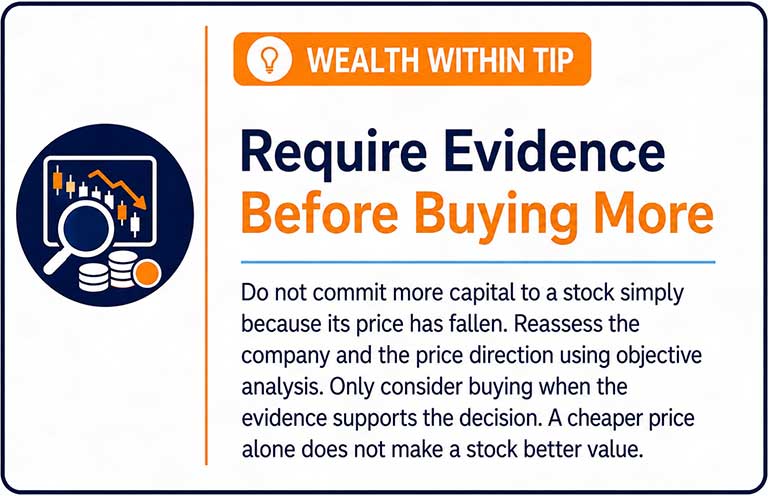
One of the most damaging habits I see is committing more capital to a falling stock simply because its lower price makes it appear better value.
Dollar-cost averaging is often promoted as a way to lower your average purchase price by investing the same amount at regular intervals, regardless of whether the market is rising or falling.
However, committing more capital to a falling asset does not transform a poor investment into a good one and prevents that money from being invested in a stock rising in value.
If you buy at progressively higher prices, your average cost rises, allowing a subsequent fall to erode earlier profits more quickly.
My main concern is that dollar-cost averaging can encourage investors to keep directing money into a falling asset without any evidence that the decline has ended.
By replacing analysis and judgement with automatic purchases, it can create the false impression that following a regular investment schedule is the same as investing wisely.
Your exit is part of the original decision
Many traders devote all their energy to finding an entry and almost none to deciding how they will sell. Yet the quality of your exit determines whether a promising position becomes a profit, a small loss or a serious hit to your capital.
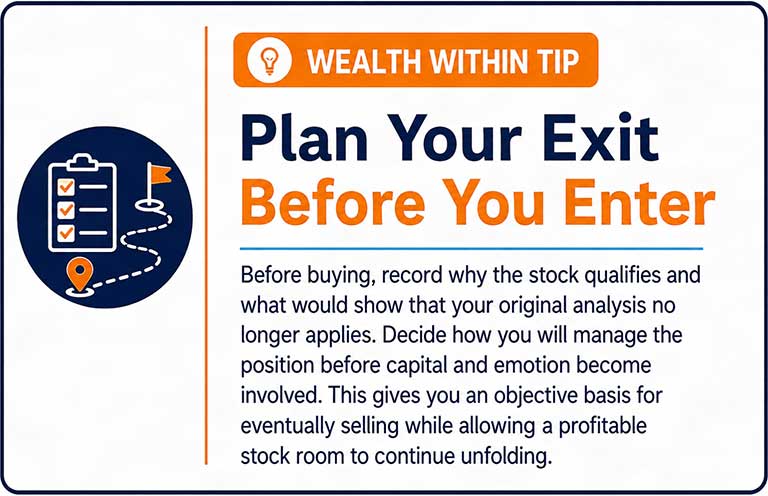
Before buying, you need to understand why you are entering the trade and have a clear strategy for managing it through to the eventual exit. Your rules should identify when the original reason for owning the stock no longer applies while also giving a profitable position room to continue unfolding.
An arbitrary dollar or percentage target is not a substitute for this knowledge. Traders who rely on arbitrary targets are often hoping the stock reaches a chosen price because they lack the strategy and skills to determine objectively when to sell.
Knowledge and tested rules remove much of the emotional pressure from managing a trade. They make you less likely to panic during normal price movements, hold onto a deteriorating position or sell a strong stock because you fear losing capital or giving back potential profits.
The specific techniques used to identify entries and exits require proper education and practice. They cannot be replaced by a slogan, a generic percentage or a computer-generated signal. At Wealth Within, we teach classical analysis and risk-management principles so traders can make objective decisions across short-, medium- and longer-term timeframes.
How to balance risk vs reward
Balancing risk vs reward is not achieved by assigning yourself a comfort score and choosing investments labelled “conservative”, “balanced” or “aggressive”. It comes from developing the knowledge and rules required to make sound decisions with your money and applying them consistently.
Before you buy, know:
- why the opportunity qualifies;
- how much capital you will allocate;
- how the position fits within the whole portfolio;
- what would show that your analysis is no longer valid; and
- whether the possible return justifies the risk and effort involved.
The most successful traders and investors do not try to eliminate risk, because that is impossible. They define it, limit it and manage it. They understand that preserving capital keeps them in the market long enough to benefit from the profitable opportunities that follow.
That is the point many people miss. Wealth isn't created by one spectacular trade. It is built by consistently applying sound processes, keeping losses under control and allowing good decisions to compound over time.
The market will always contain uncertainty. Your job is not to predict every outcome. It is to ensure that no single outcome can derail your long-term financial goals.
If you want to develop these foundations properly, Wealth Within’s Short Course in Share Trading teaches the skills and knowledge contained in the first three modules of the government-accredited Diploma of Share Trading and Investment. Within a structured framework, you'll learn the skills to achieve consistent profitability and be supported by the Wealth Within team, who have more than 80 years of combined market experience.