3 ASX Stocks Where the Shorts Could Get Squeezed

By Fil Tortevski and Pedro Banales
Reading Time: 8 minutes
What happens when too many short sellers crowd into the same stock and the market suddenly turns against them?
That is the question we explored on this week’s Hot Stock Tips Show, where Filip Tortevski and Pedro Banales looked at three heavily shorted ASX stocks: DroneShield, Domino’s Pizza Enterprises, and Silex Systems.
All three have substantial short interest, but that alone does not make them opportunities. A short squeeze becomes interesting only when price action begins to change, and short sellers are forced to reconsider whether the original bearish case still holds.
So the real question is not simply how many investors are short. It is whether the market is beginning to show that the sellers are losing control.
DroneShield is starting to test the short thesis
DroneShield Limited (ASX: DRO) is the most heavily shorted of the three stocks, with short interest of around 15 per cent and roughly 34 days to cover. Days to cover matters because it indicates how difficult it could be for short sellers to close their positions if buying returns suddenly. The longer that period becomes, the more pressure can build if the trade starts moving against them.
The fundamental debate is straightforward. The short thesis appears to reflect valuation concerns after the enormous re-rating earlier in the year. Against that, DroneShield continues to benefit from strong demand for counter-drone technology and ongoing defence spending.
The company was also awarded a three-year contract for the US counter-UAS procurement vehicle with a maximum contract value of up to US$500 million. That is important, but it is a procurement framework rather than US$500 million of guaranteed revenue. Further orders, recurring revenue growth or another significant defence contract would place greater pressure on the bearish case.
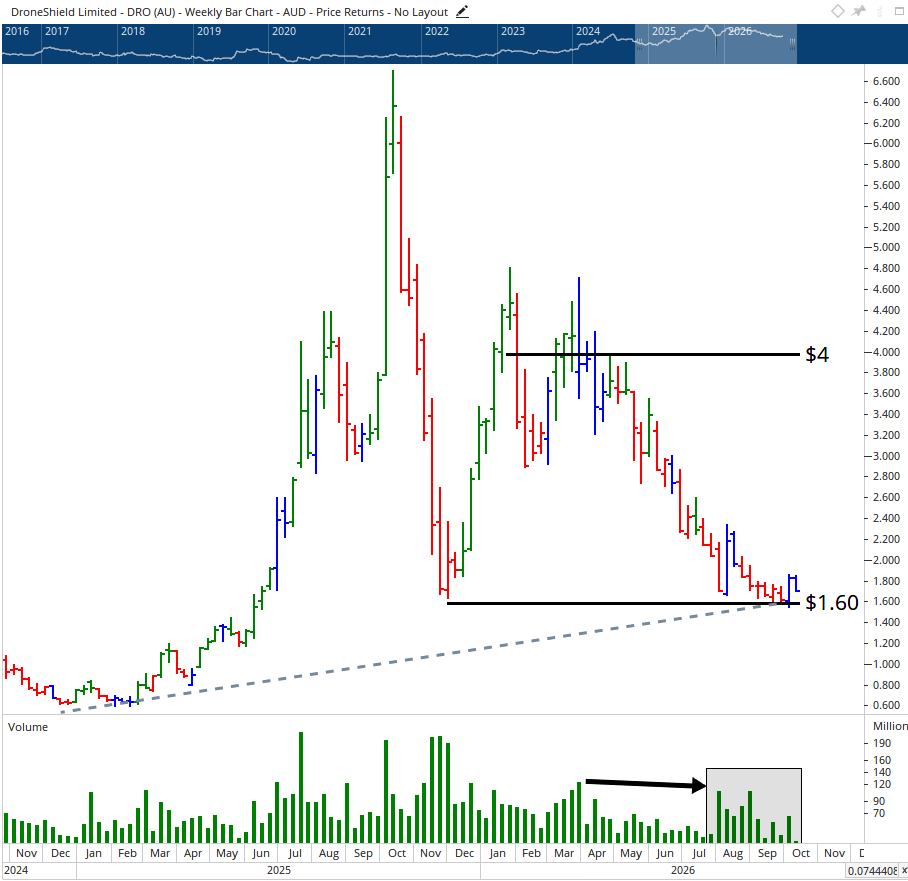
For us, though, the chart is where the more interesting development is taking place. After the sharp rise, DroneShield has pulled back towards what we regard as a more sustainable long-term rate of movement. Selling has remained heavy, but prices have stopped falling at the same rate, and October has started to rise.
That does not confirm the low, but it changes the conversation. The area around $1.60 to $1.63 is now an important test because it lines up with previous support and with a region from which strong buying previously emerged.
The latest move higher is also beginning to attract volume. If buying becomes sustained, short sellers may become increasingly uncomfortable. Once shorts begin covering while new buyers enter at the same time, buying pressure can accelerate quickly.
We want to see a sustained rise while the stock holds above roughly $1.63. If that develops, the previous region around $4 to $4.50 becomes relevant again. If support fails, the short thesis remains very much alive.
Domino’s Pizza may finally be building a base
Domino’s Pizza Enterprises (ASX: DMP) presents a different setup. Short interest is around 11.8 per cent, while the day-to-cover figure is close to 39. That gives short sellers an even tighter exit than DroneShield.
The reason the stock has attracted shorts is understandable. Domino's has endured one of the largest declines in its history, with concerns around weak sales growth, store closures and execution risk. But the issue now is whether those problems are already reflected in the price and whether the underlying business is beginning to improve.
Its latest full-year results showed franchise partner profitability at a four-year high, underlying EBIT up 1 per cent, free cash flow of $164.1 million and net debt reduced by $227.8 million. Those figures do not erase the problems, but they do show the business's economics are improving.
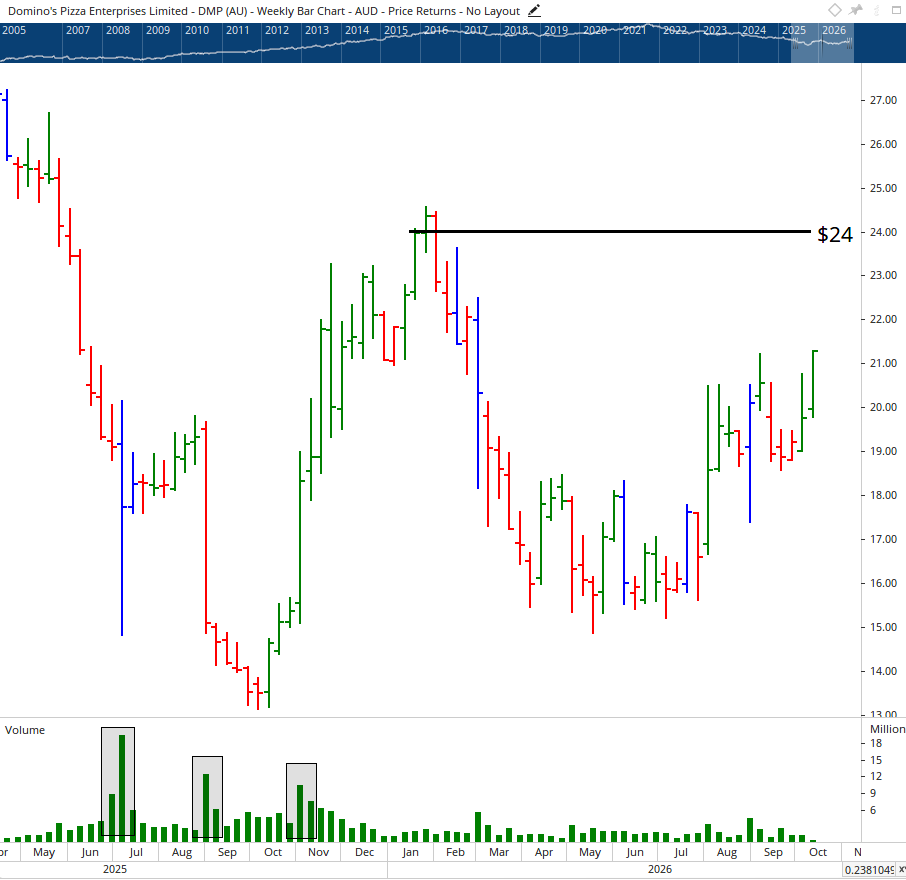
What has our attention most is the chart. Since late 2025, the stock has stopped making significant new lows. During the decline from 2021, sellers repeatedly pushed the price lower. That behaviour has now changed.
The stock has begun moving sideways, buyers are appearing more regularly, and some of the previous heavy selling is no longer having the same impact. Sideways action after a long decline can be frustrating to watch, but it can also be where a major low begins to form.
The immediate area we are watching is around $24 to $25. A decisive move above that zone would increase confidence that the market is transitioning from a long-term decline into a recovery phase. From there, the next meaningful region sits around $35 to $36.
The bigger picture matters here. Domino’s has previously moved through large cycles of rising and falling share price. Now, it’s entering the phase where the stock appears ready for the next long-term leg up.
Volume is another clue. Earlier selloffs occurred on heavy volume, while a later rise also attracted heavy volume. More recently, activity has fallen away. That may indicate the market is moving away from aggressive short selling and into a more neutral phase where buyers and sellers are again determining value. It is still early, but the behaviour is materially different from what we saw during the decline.
Silex Systems has the biggest potential bottleneck
Silex Systems (ASX: SLX) has the lowest short interest of the three at around 7.7 per cent, but it has the most extreme liquidity pressure, with roughly 67 days to cover. If the short thesis begins to weaken, exiting the position could potentially take a very long time.
The fundamental debate centres on whether Silex’s laser uranium enrichment technology can successfully move from development into commercial production. In September, Global Laser Enrichment and Cameco entered an exclusive offtake agreement under which Cameco will purchase all future production from the planned Paducah Laser Enrichment Facility. That strengthens the commercial case, although development, approvals and production milestones still matter.
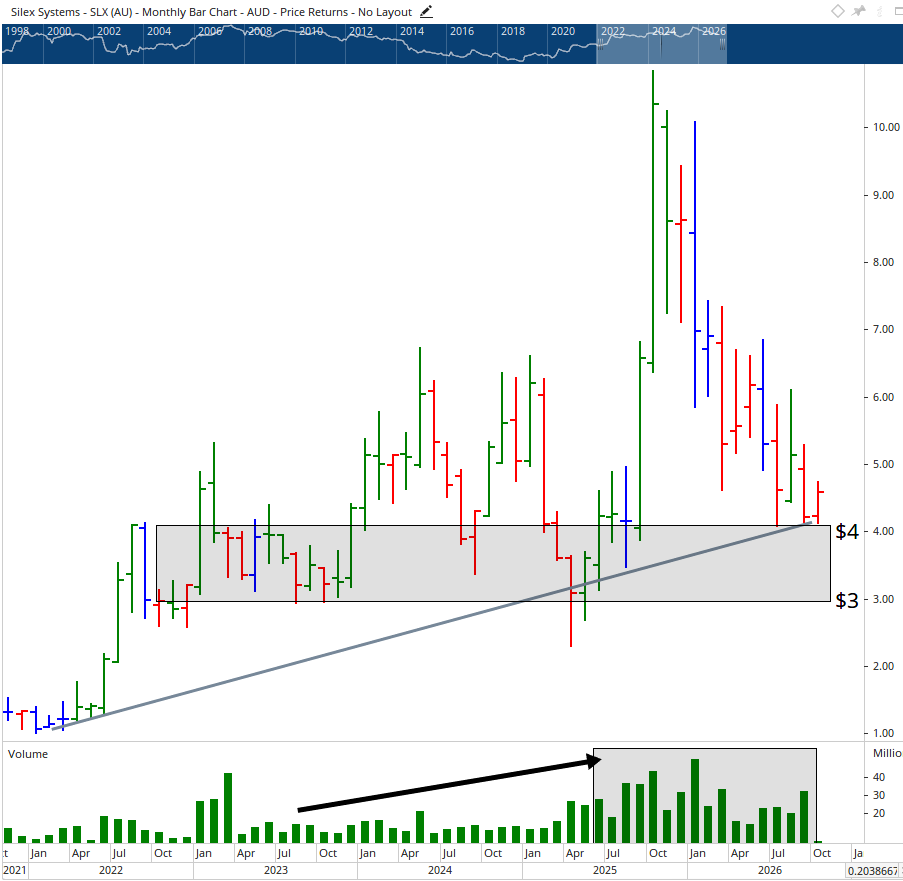
On the chart, the stock has pulled back sharply and is now testing a region where previous support and longer-term momentum intersect. We are watching the area between approximately $3.30 and $4 very closely. Selling has started to slow, and volume has increased materially around the recent low, which is often what we want to see when a market is attempting to establish support.
This is also where the differing views matter. Filip sees the possibility of a recovery towards roughly $6.50 if support holds and buying strengthens. Pedro is more cautious on the larger picture and believes the stock may still be in the early stages of a broader decline. In that scenario, a rally towards $6.50 to $7 could occur without necessarily ending the longer-term downtrend.
Both views place $4 near the centre of the decision. If Silex trades materially below that level, the bearish case gains weight. If it holds and buying continues to build, a recovery towards the $6.50 region becomes increasingly plausible.
The key lesson from Silex is that a stock can have genuine short-squeeze potential but still carry risk because the long-term trend is still bearish.
Short interest alone is never enough
The common thread across all three stocks is that a crowded short position does not automatically create an opportunity. Short sellers can be right for a very long time.
What changes the setup is evidence. We want to see the price stop falling, support begin to form, selling pressure weaken, buying volume improve, and the stock start behaving differently from the period that created the short position in the first place.
That is beginning to occur in different ways across DroneShield, Domino’s and Silex. DroneShield is pulling back into former support after a huge re-rating. Domino’s is attempting to build a base after a multi-year decline. Silex is showing early signs of support, but the larger trend still deserves respect.
The short numbers may attract attention, but the chart tells us whether anything is actually changing.
Building the skills
Short-squeeze setups highlight why traders need more than a headline or a single statistic. Understanding trend, support and resistance, volume, momentum, and the relationships between timeframes lets you judge whether the market is confirming or contradicting the underlying story.
This is also why we continually encourage traders to look at the bigger picture. A weekly chart can look constructive while a monthly or yearly chart still warns of a larger decline. Learning to combine those signals, assess probability, and structure risk lets you build a reasoned view rather than simply react to market noise.
These are the same analytical skills we teach through Wealth Within’s government-accredited Diploma of Share Trading and Investment: not how to predict every outcome with certainty, but how to bring multiple pieces of evidence together and make more informed decisions. The Short Course in Share Trading covers the first three modules of the diploma, offering an alternative pathway.
Final Thoughts
DroneShield, Domino’s and Silex are all heavily shorted for different reasons, but each is beginning to show evidence that deserves attention.
DroneShield is testing major support and attracting renewed buying. Domino’s appears to be stabilising after years of persistent selling. Silex has substantial liquidity pressure behind its short position, although the larger trend remains less convincing.