Could the AI Boom Be Too Expensive to Succeed?

By Dale Gillham
Reading Time: 6 minutes
General Advice Disclaimer
This article is for general educational purposes only and does not take into account your personal financial circumstances, objectives or needs. Before making any investment decisions, consider your individual circumstances and seek independent financial advice if necessary.
What if the biggest threat to the Artificial Intelligence (AI) boom isn't that AI fails, but that it succeeds at a price investors can no longer afford? That is the hidden financial risk behind the AI boom, and investors may be overlooking it as technology companies pour billions into the race to dominate AI.

Is AI spending becoming too expensive?
For years, the world's biggest technology companies were prized because they could grow rapidly without constantly building factories, mines or other expensive physical assets. AI is changing that.
Microsoft, Alphabet, Amazon, Meta and Oracle are pouring extraordinary sums into chips and data centres, with Reuters estimating that every additional dollar of operating cash flow between 2025 and 2027 could be matched by around $1.57 of additional investment.
We are already seeing what that can do to some of the world's biggest cash-generating businesses. Alphabet recently recorded negative free cash flow for the first time in more than two decades. Reuters expects the five technology giants combined to eventually spend more on new investment than they generate in free cash flow.
Why investors are starting to question AI valuations
As a result, public markets are beginning to ask some uncomfortable questions.
In Australia, data-centre developer Firmus Technologies has reportedly been forced to reconsider a proposed valuation of nearly $44 billion, and its ASX listing is now uncertain. That's particularly striking given its valuation was below $2 billion roughly a year ago and about 97 per cent of its contracted revenue reportedly relates to facilities that have not yet been built.
It isn't alone. SoftBank-backed US data-centre developer SB Energy has also delayed its IPO as investors scrutinise its enormous funding requirements. Meanwhile, OpenAI has ruled out a 2026 listing, citing AI safety concerns rather than investor demand.
Can AI deliver enough returns to justify the cost?
This is where I think investors may be missing the bigger risk.
AI companies need enormous computing capacity. Data centres need billions in financing. Chipmakers need those data centres to keep expanding, and technology giants need AI revenues to eventually justify all that spending.
Each part of the chain increasingly relies on the next.
That doesn't mean AI is a bubble or that the technology will fail. Demand may ultimately justify today's investment, but markets don't need AI to fail for shareholders to lose money. Expectations simply need to outrun the cash these businesses eventually produce. Let's not even entertain the idea that a lower-cost competitor enters the fray, which I believe is the biggest risk.
Ultimately, what will decide how this ends up is whether those contracts eventually generate enough cash to pay for the revolution investors have already priced in. AI may change the world and still be a terrible investment at the wrong price.
Best and worst sectors
Utilities was the best-performing sector last week, rising 3.64 per cent as investors sought more stable earnings amid rising bond yields and economic uncertainty.
Real Estate gained 3.58 per cent as buyers returned to beaten-down property stocks following an 18% fall this year, suggesting bargain hunting drove the gains despite persistently high bond yields.
Health Care rounded out the top 3, up 3.53 per cent, as investors rotated towards defensive healthcare stocks amid market volatility, with gains in Cochlear and biotech companies providing support.
At the other end of the market, Information Technology was the worst sector last week. It fell 1.97 per cent as rising global bond yields weighed on growth-stock valuations.
Materials was the second-worst sector, dropping 1 per cent as broad selling across iron ore, gold, lithium, and rare earths stocks dragged the sector lower despite some underlying commodity prices holding firm.
Financials rounded out the worst performers this week, falling 0.31 per cent as selling in heavyweight banks, including CBA, Westpac and NAB, dragged the sector lower, with elevated bond yields and concerns about further rate rises weighing on sentiment toward lenders.
Best and worst stocks
The Lottery Corporation Ltd led the ASX Top 100 last week. It climbed 6.79 per cent as it benefited from Friday’s consumer discretionary rally
Cleanaway Waste Management followed, rising 6.56 per cent following renewed progress on EQT Infrastructure's proposed takeover, with investors encouraged by the prospect of a deal.
Light & Wonder Inc rounded out the leading performers, gaining 6.36 per cent following its recent gaming product showcase and continued broker support.
At the other end, Paladin Energy was the weakest performer, falling 7.50 per cent as a broad uranium-stock sell-off erased the boost from Google’s nuclear power deal, suggesting weaker sentiment and risk appetite drove the decline.
IGO Limited followed, falling 5.74 per cent as its lithium exposure left it vulnerable to renewed weakness in Chinese lithium prices, weighing on expectations for earnings from its lithium operations.
PLS Group Limited rounded out the worst performers, falling 5.41 per cent as falling Chinese lithium carbonate futures drove selling across lithium producers, with Friday’s sharp price drop adding pressure to the stock.
All Ordinaries Index update
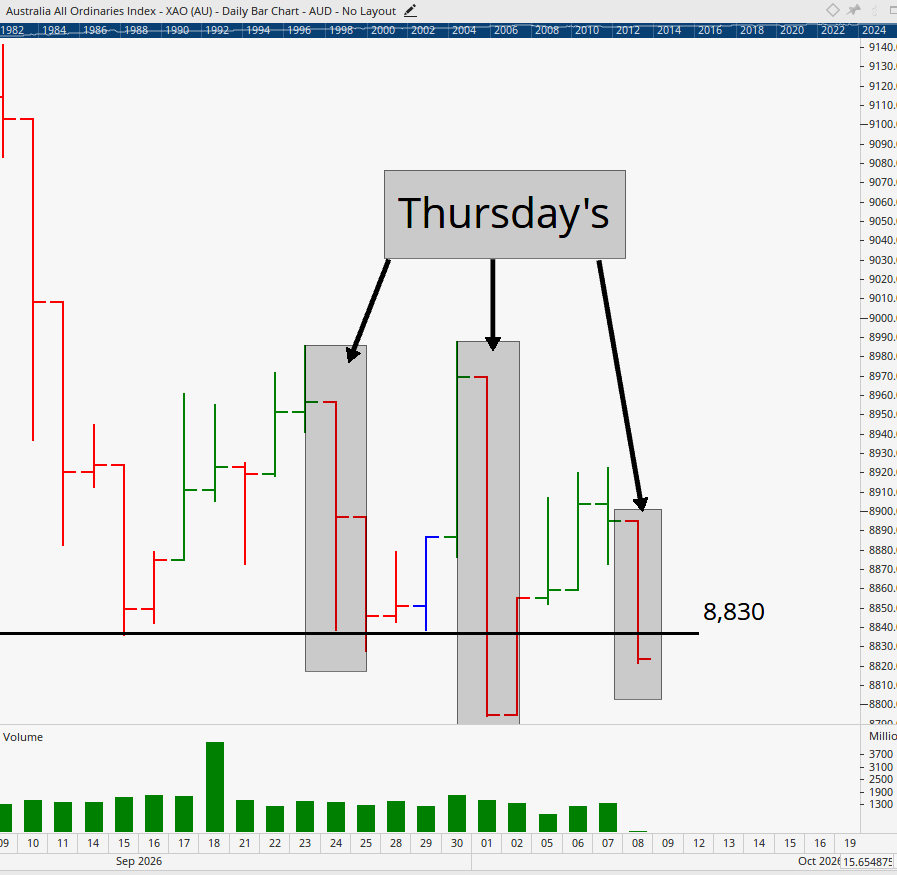
The All Ordinaries Index finished the week with buyers defending the key 8,830 level once again. After Thursday’s selling pushed the index down, Friday’s rally lifted the market back above this critical support, keeping hopes of a recovery alive and closing the week 0.26% higher
That makes three consecutive weeks of a familiar pattern: buyers push the market higher early in the week, Thursday’s sellers erase those gains, and Friday’s buyers return to hold 8,830. The repeated defence suggests buyers are still willing to step in, but they still haven't established enough control to sustain a meaningful rally.
For that to change, the next challenge is reclaiming 9,000. More importantly, I want to see the market hold above that level before I feel that a recovery is underway. Until then, the battle around 8,830 remains unresolved. A weekly close below it would increase the likelihood of a further decline towards 8,600.
Seasonally, October remains below its historical average return of around minus 0.25 per cent, although we are still early in the month and coming off a particularly bearish September. What interests me more is how long this weakness has persisted.
Following the previous two significant market peaks, the All Ordinaries established a low within four weeks. We are now approximately eight weeks into the decline from the August 2026 peak. Friday’s recovery raises the possibility that support is forming, but the length of this decline also reminds us that buyers are taking longer to regain control.
For now, investors need to remain selective. Holding 8,830 is encouraging, but we need stronger price action to confirm the next move higher. Successful investing is equally about knowing when to take profits, protect your capital and stay out of the market when the opportunities do not justify the risk.
Good luck and good trading.
Dale Gillham is the Chief Analyst at Wealth Within and the international bestselling author of How to Beat the Managed Funds by 20%. He is also the author of the award-winning book Accelerate Your Wealth—It’s Your Money, Your Choice, which is available in all good bookshops and online.