Why Discretionary Shares Are Rising Before the Economy Improves
By Dale Gillham, Fil Tortevski and Pedro Banales
Reading Time: 8 minutes
General Advice Disclaimer
This article is for general educational purposes only and does not take into account your personal financial circumstances, objectives or needs. Before making any investment decisions, consider your individual circumstances and seek independent financial advice if necessary.
If households are under pressure, why are consumer discretionary shares starting to recover? The answer may tell investors more about the next opportunity than another gloomy economic headline. Markets look ahead, and the best time to investigate an unloved stock is often before its recovery becomes obvious.
On this week’s Australian Stock Market Show, chief analyst Dale Gillham, senior analyst Filip Tortevski and analyst Pedro Banales explored whether discretionary shares are anticipating relief from high fuel costs and interest rates. We focus on five companies with potential recovery opportunities, the evidence still needed before buying, and the risk that an improved outlook fails to materialise.
Could cheaper oil change the outlook for Australian shares?
Consumer discretionary shares had rebounded roughly 7–8% from recent lows in our analysis, despite difficult trading conditions. The ABS August household spending figures show total spending was flat in seasonally adjusted current price terms. Within that total, clothing and footwear, household furnishings, and recreation spending declined.
One possible explanation for individuals' buying is an expectation that fuel costs could ease. Donald Trump has pointed to lower oil prices after the 3 November US midterm elections. That is a scenario to assess, rather than a promise investors can rely on. The midterms determine congressional seats, not the presidency, and an election result alone cannot resolve the conflict with Iran.
The RBA’s analysis of energy prices estimates that a 10% rise in domestic fuel prices adds a little over 0.3 percentage points to headline inflation over one or two quarters. Lower fuel costs could ease pressure on households and improve interest rate expectations. However, crude oil and Australian pump prices don't move in lockstep.
The potential beneficiaries extend beyond retailers. Lower diesel costs could help materials companies, while easing inflation and lower bond yields could support technology valuations. Our chart comparison showed periods when technology shares and oil moved in opposite directions, but the relationship is imperfect. Price still needs to confirm the investment case.
Five discretionary stocks worth investigating
Flight Centre: Early signs of a base
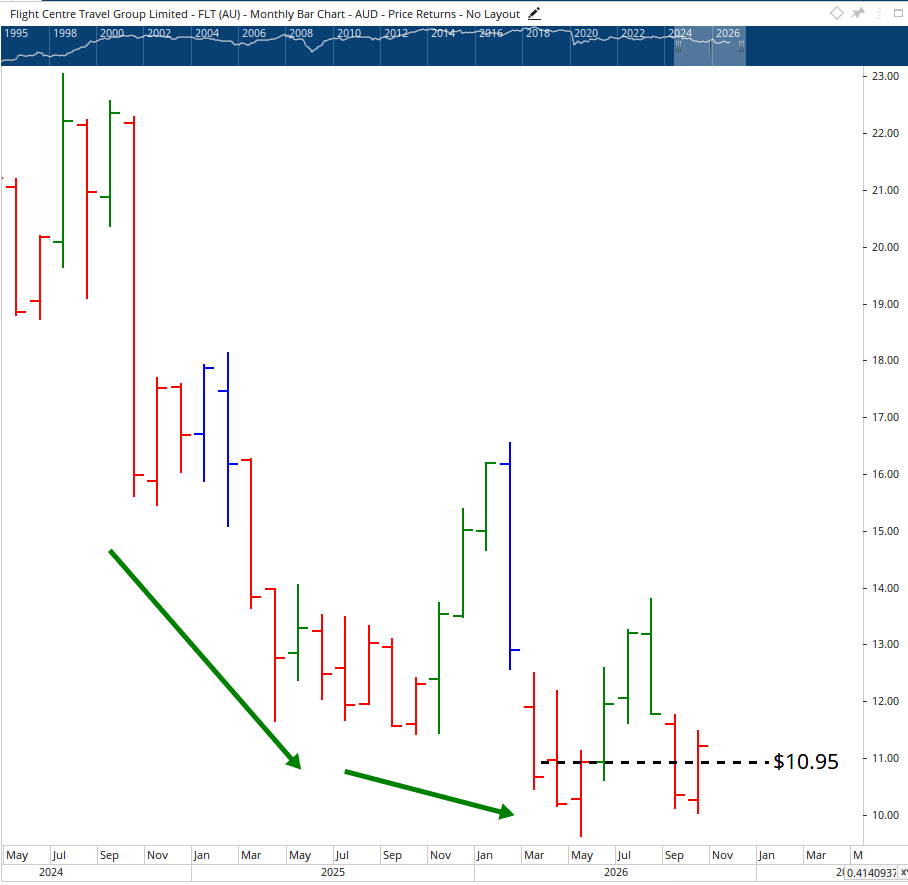
Flight Centre Travel Group (ASX: FLT) provides a direct example of the cost of geopolitical disruption. Its FY26 results announcement identified an approximately $60 million hit to fourth-quarter leisure profit from Middle East disruption. A lasting resolution could remove a measurable earnings headwind.
Our chart analysis showed selling easing and some buying emerging around $10.95. The monthly chart remained indecisive, but a possible base was developing. That makes Flight Centre worth watching for a reversal, rather than dismissing it because of its past performance. The opportunity depends on identifying a genuine change in direction; an apparently low price is insufficient.
Harvey Norman: Earnings growth meets a falling share price
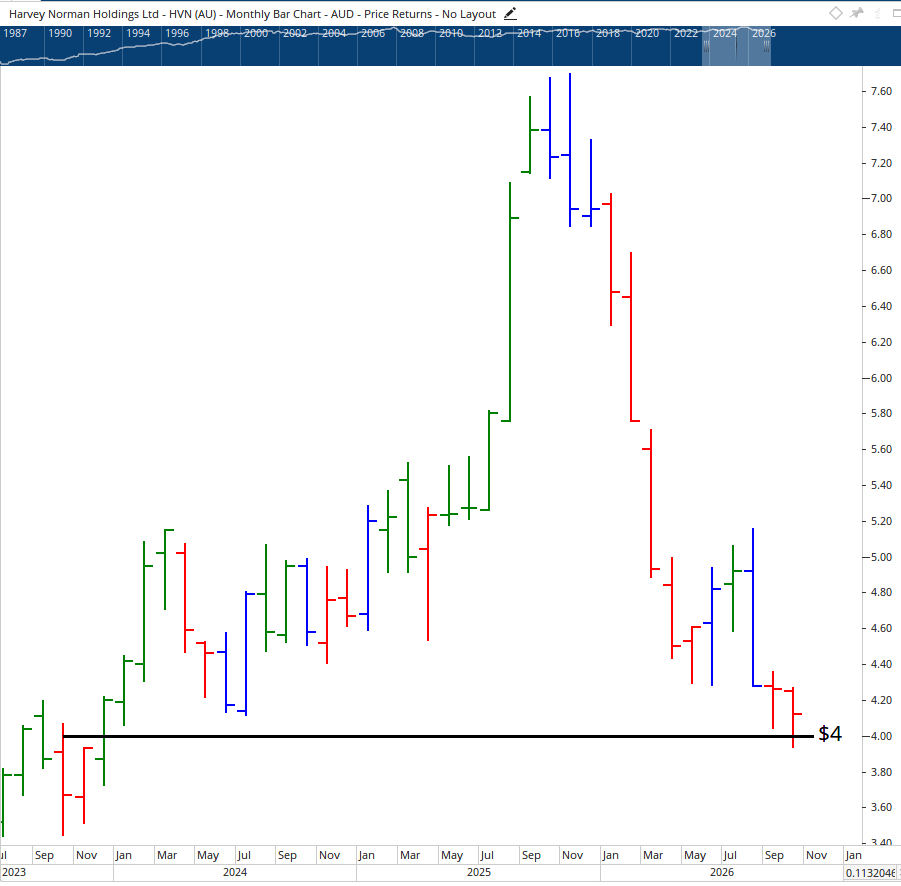
Harvey Norman Holdings (ASX: HVN) illustrates why business results and share prices need separate analysis. FY26 reported profit after tax and non-controlling interests rose 2%, while the comparable adjusted measure rose 8.6%. Yet the shares had fallen heavily, by around 36% year to date at the time of our analysis.
The $4 area has repeatedly mattered historically, with price around $4.10 in the analysis. That is a reason to prepare a strategy, not buy automatically. The stock was still falling, and attractive fundamentals did not establish a reversal. Waiting until a recovery dominates the headlines can mean missing its early stages, but buying too soon exposes investors to further losses.
Kogan: A familiar floor needs stronger buying
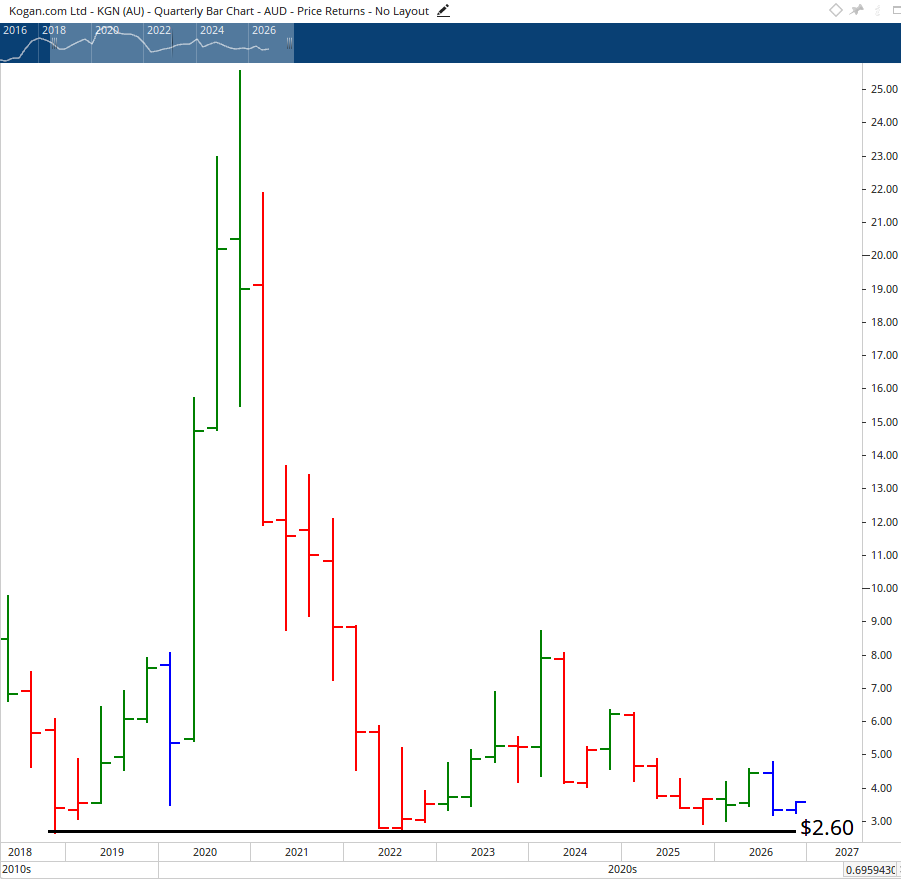
Online retailer Kogan.com (ASX: KGN) returned to statutory profitability in FY26, but its shares continued to struggle. Our analysis identified $2.60–$3 as an important support area, with $2.60 the immediate reference and approximately $5 acting as a ceiling.
Previous rebounds from around the lower boundary produced substantial percentage moves, including roughly 160% and 68%. Those are historical examples, not targets for the next recovery. Recent heavy selling on volume means we can't assume a repeat. The weekly chart needs to show whether buyers can regain control. Stronger household spending could provide a catalyst alongside the company’s operational recovery.
Super Retail Group: Buyers are showing more conviction
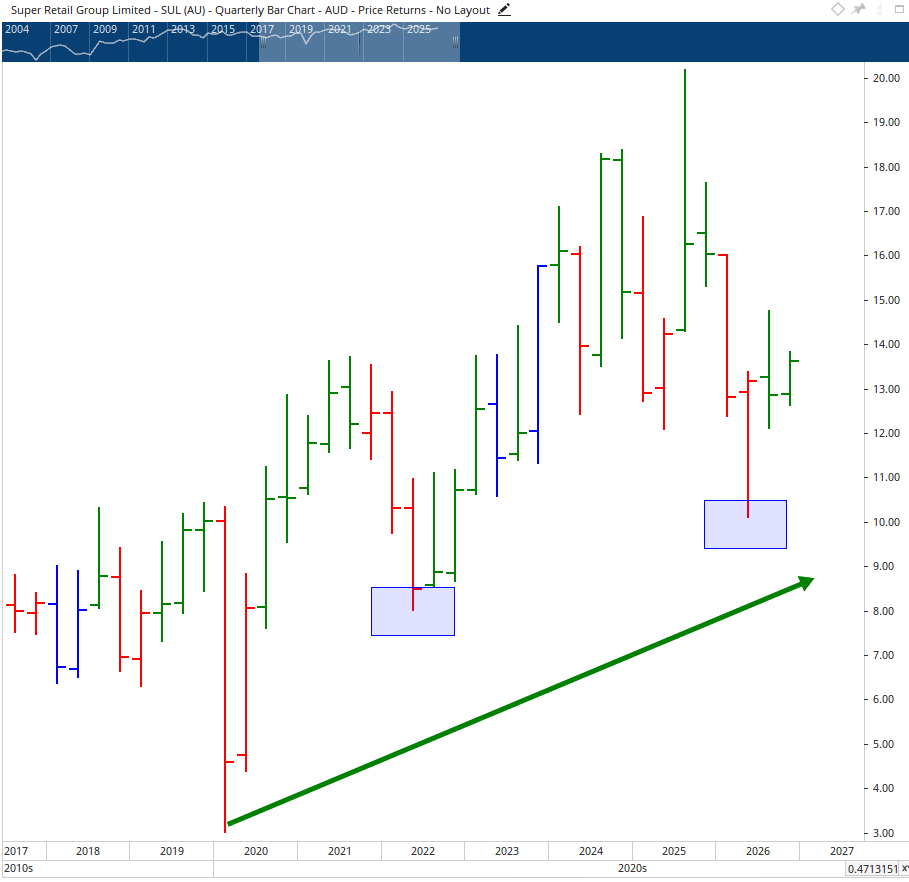
Super Retail Group (ASX: SUL), which owns Supercheap Auto, Rebel, BCF and Macpac, posted higher FY26 sales but lower overall profitability. Softer demand, operating costs, and investment in major group projects all shape the earnings picture. Lower fuel costs and improved household spending could help, but margins still need attention.
Its longer-term chart showed a history of higher bases through difficult economic periods. More recently, buying in July, an attempted sell-off in September and renewed buyer resistance during October made this one of the more interesting setups in our analysis. Those observations are the first part of a strategy. Investors still need an entry trigger, an assessment of upside and clear exit rules.
Premier Investments: A rebound is not yet a confirmed bottom
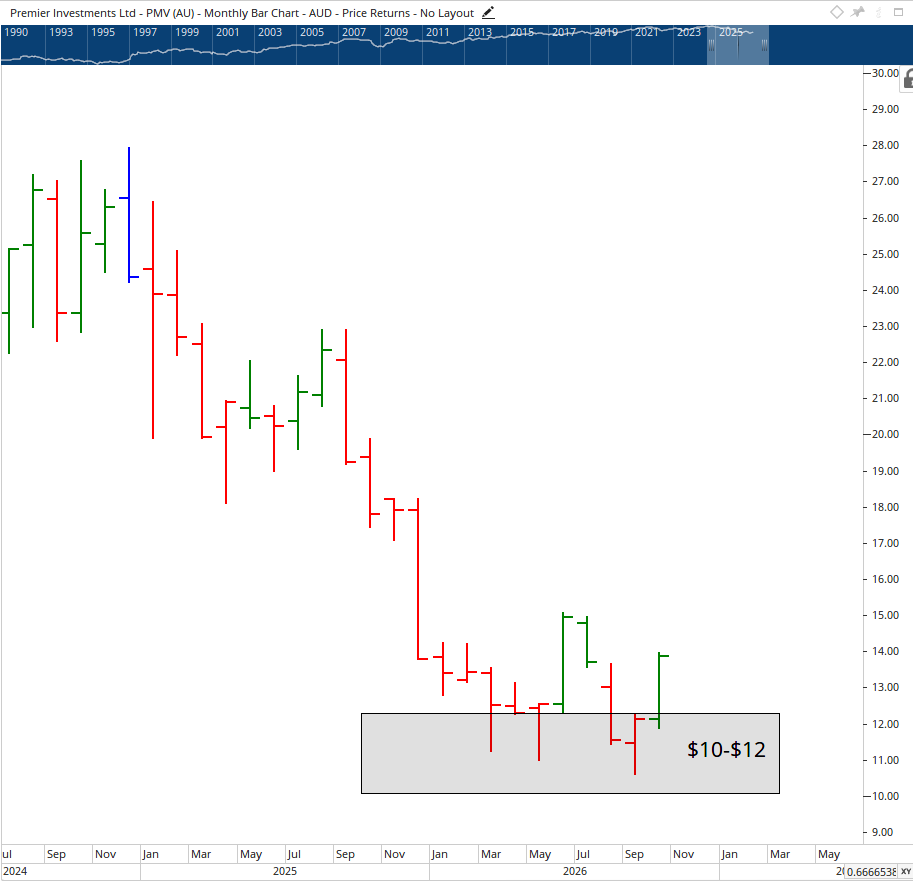
Premier Investments (ASX: PMV), whose retail brands include Peter Alexander and Smiggle, faces the same question: will households regain spending power? Its FY26 results show weaker underlying retail earnings in a challenging discretionary environment.
Unlike Super Retail Group, Premier had broken well below the simple momentum reference used in our analysis. However, the $10–$12 area has historically attracted substantial buying and selling, making it a zone where buyers could return. A roughly 22% rebound from the low was encouraging, but it needed further confirmation on the weekly chart. It could be the beginning of a longer-term uptrend; the bottom was not yet established.
Trending topic: Could further rate rises do too much damage?
The risk to the recovery case is that monetary tightening continues while the economy weakens. Commonwealth Bank chief economist Luke Yeaman has warned that further increases could push Australia into recession. The bank’s assessment of policy lags highlights that the full effects of this year’s four rate rises have yet to flow through.
September ABS figures put seasonally adjusted unemployment at 4.7%, with employment falling by 39,300. Employment conditions, including underemployment and access to desired working hours, deserve attention because they affect household spending capacity. AI’s potential impact on hiring remains uncertain, and those monthly figures do not explain it.
The RBA must also prevent inflation from becoming entrenched. Higher rates work through more than mortgage repayments: they can support the Australian dollar and reduce the local cost of imports, including fuel. But currency appreciation is not guaranteed, and a stronger dollar can make life harder for exporters.
Our concern is the policy trade-off. Interest rates cannot directly repair disrupted oil supply, while tightening can weaken demand and employment. For investors, that means testing the recovery case against both inflation and labour-market evidence, rather than assuming weaker growth guarantees an immediate rate cut.
Hot stock of the week: Recce Pharmaceuticals
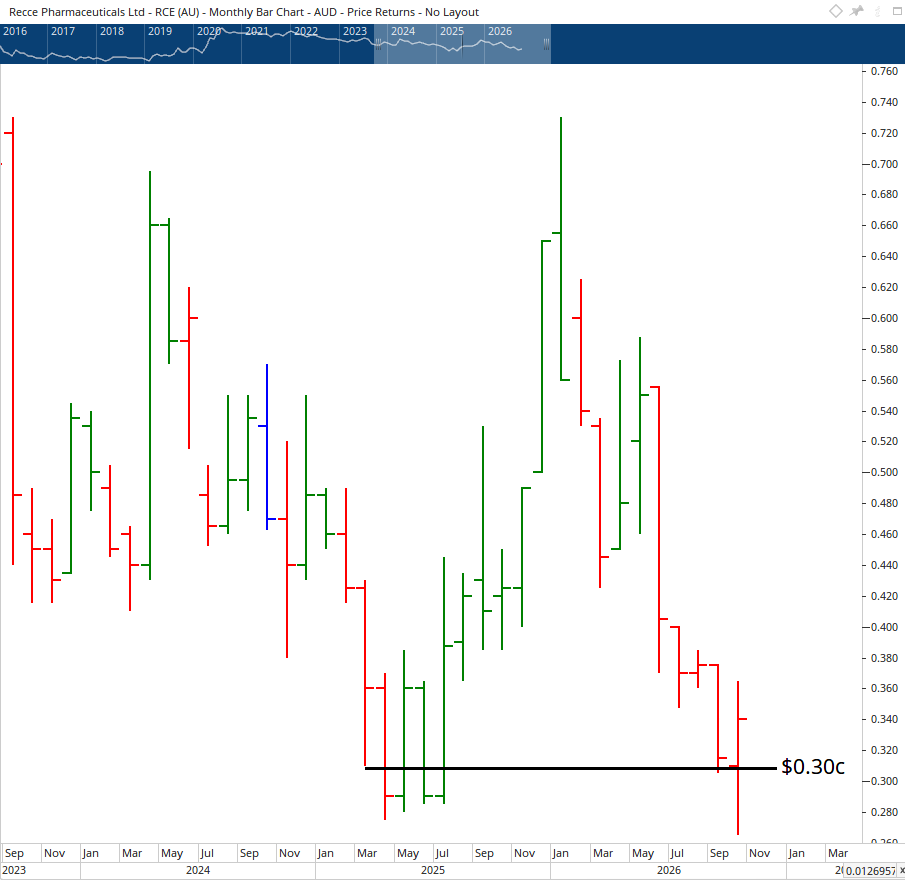
Recce Pharmaceuticals (ASX: RCE), a developer of synthetic anti-infectives, attracted attention following its 20 October clinical trial update. The company reported encouraging clinical outcomes and safety observations in blinded data from its Indonesian Phase 3 diabetic foot infection trial. The company submitted a dataset covering 75 patients for independent review.
The independent committee will examine unblinded results by treatment group, with recommendations expected as soon as mid-November. Until that comparison is available, the update does not establish that the treatment outperformed placebo. It is a trial milestone, not product approval.
On the chart, the bounce came from around 30 cents, an important historical level. A similar move in May 2025 was followed by a retest and a roughly 120% rise, illustrating the potential size of such moves without predicting a repeat. Recce remained in a long-term downtrend. More strength is needed before treating the bounce as a sustained recovery, so jumping in early is risky.
Build a strategy before the recovery becomes obvious
These opportunities share a common lesson: being early to investigate is valuable; being early to buy is not automatically profitable. A falling stock can offer substantial upside and still keep falling. Your plan needs to define what confirms an entry, what invalidates it and how you will manage the position.
Wealth Within’s Diploma of Share Trading and Investment (11398NAT) develops the skills to combine business analysis with price behaviour, test strategies and manage risk. The aim is to replace emotional decisions with rules you understand and can apply consistently.
Looking towards year-end, Pedro’s constructive view rests partly on All Ordinaries support around 8,800 and the prospect of stronger seasonal trading. Filip is more conditional: relief in oil and renewed buying in materials would strengthen the outlook; without them, the market could remain under pressure. Seasonality offers context, not certainty.
The question is whether buyers keep supporting these shares while the business outlook catches up. Watch the follow-through, prepare your rules and let the evidence determine when a possible recovery becomes a trade worth taking.
Final thoughts: Is the recovery in ASX discretionary stocks sustainable?
The recovery in consumer discretionary shares highlights an important lesson for traders: the share market often moves before economic conditions improve. However, a rising share price does not necessarily mean a sustained recovery is underway.
With uncertainty surrounding oil prices, interest rates and employment, traders need to understand price movements, recognise potential turning points and have a clear trading plan before committing their capital.
At Wealth Within, we have been teaching people how to trade the share market since 2002. Our government-accredited trading education focuses on proven strategies, technical analysis, risk management and developing the confidence to make informed trading decisions.
If you would like to learn more about Wealth Within and our approach to trading, visit our About Us page or explore our trading courses. Alternatively, you can start with Dale Gillham's bestselling book, How to Beat the Managed Funds by 20%, which introduces practical techniques for buying and selling shares, managing risk and building a share portfolio.