FBR, Micro-X and Li-S Energy Have Big Ideas. Are Their Shares Ready to Rise?

By Fil Tortevski and Pedro Banales
Reading Time: 6 minutes
General Advice Disclaimer
This article is for general educational purposes only and does not take into account your personal financial circumstances, objectives or needs. Before making any investment decisions, consider your individual circumstances and seek independent financial advice if necessary.
A robot that welds industrial steel, a miniature scanner that could help diagnose strokes before patients reach a hospital, and lighter batteries for military drones. Each is a compelling business story. The harder question for investors is whether the share price supports it and whether now is the time to commit capital.
On this week’s Hot Stock Tips Show, Wealth Within senior analyst Filip Tortevski and analyst Pedro Banales examined FBR, Micro-X and Li-S Energy. All three have developments worth following, but their charts show different stages of recovery.
The distinction matters: buying an exciting idea too early can tie up your money while the company works toward commercial success.
Engineering progress and investment timing are different tests
Across robotics, medical imaging and battery technology, a technical milestone can open a large potential market. It does not establish a repeatable sales pipeline or tell investors when the shares will begin a sustained rise. The business may progress while its share price falls or moves sideways.
Our approach is to assess the commercial development alongside the behaviour of buyers and sellers. Is demand strengthening? Does selling weaken after a rally? Are higher lows emerging, and can the shares break through an important price level? Those questions help separate an early sign of interest from a more convincing change in direction.
FBR needs sustained buying to support its Mantis milestone
FBR Limited (ASX: FBR), known for its bricklaying robotics, is applying its technology to heavy industrial welding through Mantis. The potential applications include shipbuilding, mining and defence manufacturing.
Its October Mantis acceptance-testing announcement confirmed that the robot had passed factory acceptance testing and independent weld-quality inspections. That removed the key technical condition on its first A$990,000 purchase order. The commercial question now is whether one successful machine can become repeatable sales across those industries.
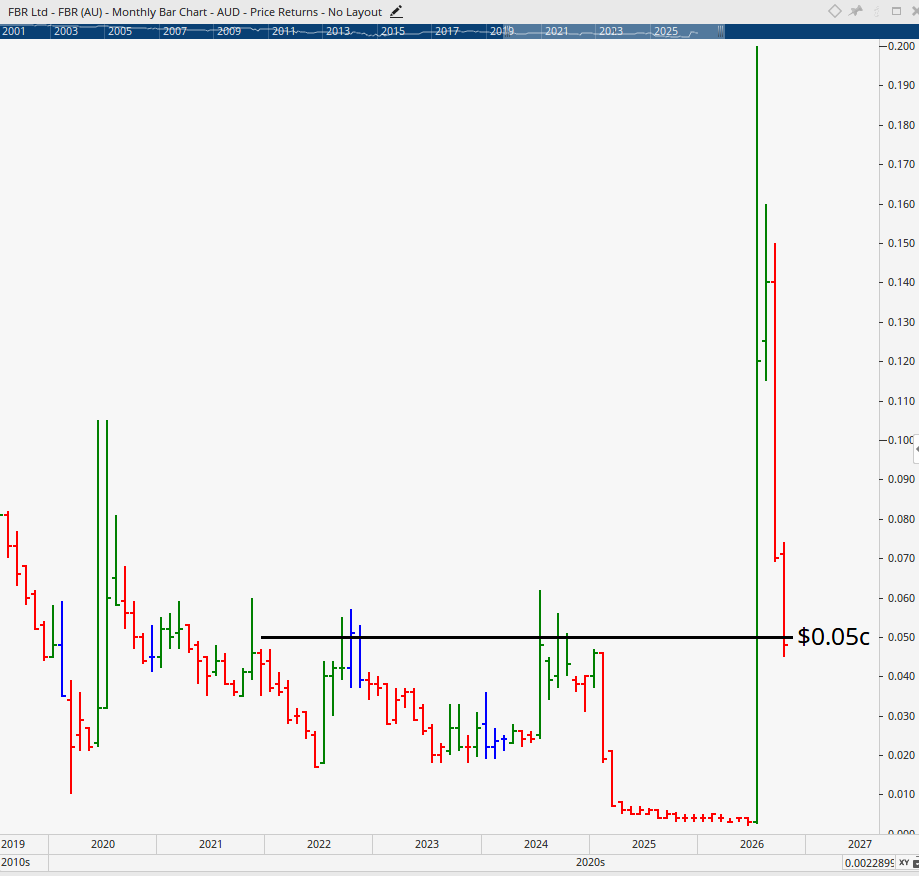
The chart requires care. FBR has experienced long periods of thin trading, interrupted by sharp bursts of activity. A sudden rise in a lightly traded share can look exciting without demonstrating lasting demand. The recent change in the character of its price bars is worth watching, but it has not yet established the buying strength we would want before becoming more confident.
Comparisons also need to account for FBR’s 50-for-1 share consolidation. Consolidating shares changes the number held and the corresponding price per share. That mechanical adjustment isn't an investment gain and shouldn't be confused with a genuine increase in demand.
Right now, around 5 cents is an important area to defend, with 4.6–4.7 cents also forming part of the support assessment. Holding that area and rising again would make the shares more interesting, provided the buying follows through rather than fading as it has during earlier rallies.
The previous selling area around 14 cents is another point to watch if a recovery develops. For now, FBR belongs on the watchlist. A prolonged uptrend would give investors further opportunities to assess an entry without needing to buy the first speculative jump.
Micro-X shows early interest but still needs a reversal
Micro-X Limited (ASX: MX1) is developing miniature CT scanners using carbon nanotube technology. Its stroke-imaging project aims to bring scanning closer to patients, with potential future use in ambulances. That could change where and how emergency imaging is performed, but clinical validation and commercialisation remain important hurdles.
The company’s 3 June human-imaging announcement confirmed that its Head CT technology had acquired its first patient images at Royal Melbourne Hospital. This marked the start of a pilot study, rather than the completion of clinical validation. A separate US Department of Homeland Security baggage-scanner contract extension in September also demonstrates activity beyond the medical-imaging project.
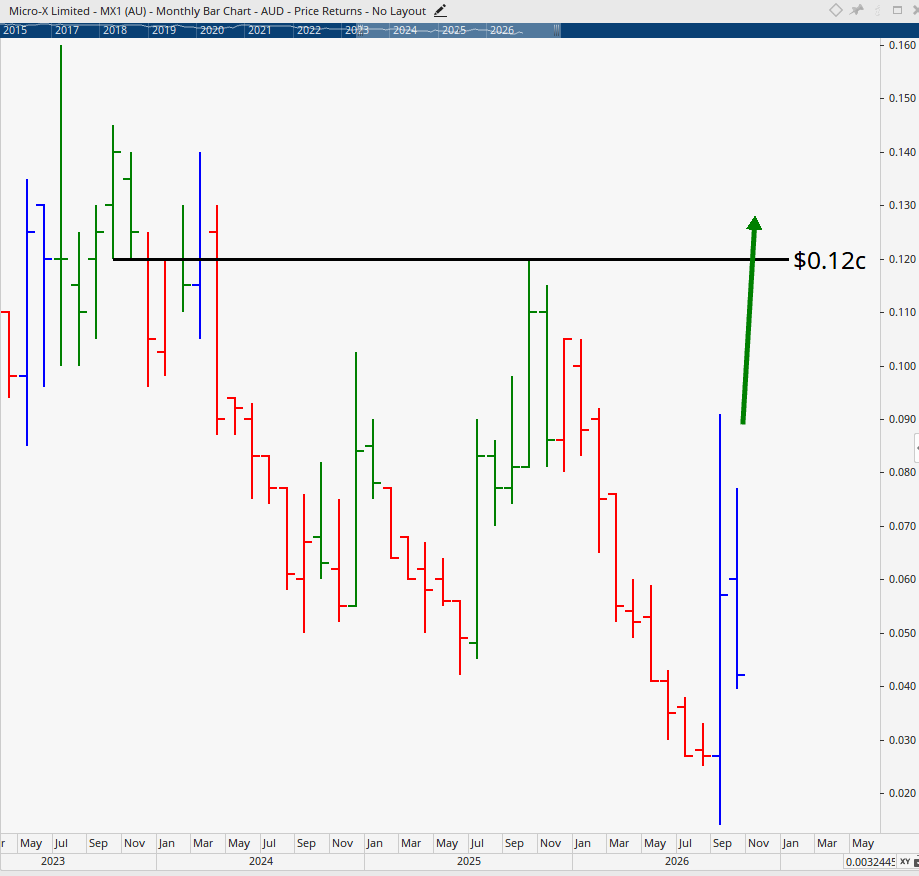
The price chart nevertheless remains in a long-term downtrend. Stronger buying and a marked increase in September volume are encouraging first signs, but what happens after that buying is critical. If sellers regain control and shares retreat toward their lows, the initial demand has not yet produced a durable reversal.
Our immediate area of interest is around 3.5–4 cents, particularly whether fresh buyers emerge there. September’s price surge also attracted an ASX price query, while director buying adds context. Neither event, by itself, confirms that the shares are ready for a sustained advance.
For stronger upside confirmation, the analysis focused first on approximately 12.5 cents and then the broader 12–14 cent area. These are reference levels for assessing a developing recovery, rather than a single buy instruction. The nearer-term test remains how price behaves through the current selling phase.
Waiting can feel expensive when an early rally has already delivered a large percentage gain. However, buying near a low can also leave capital sitting in a sideways stock for years. Giving up some of the first move may be worthwhile if it provides stronger evidence that a trend is developing. Micro-X needs that additional confirmation.
Li-S Energy has a more developed base
Li-S Energy Limited (ASX: LIS) is developing lithium-sulphur batteries designed to deliver more energy at lower weight than conventional lithium-ion batteries. For drones, that could mean longer flight times, greater range, or more capacity for other equipment.
The company has delivered its first cells to the US Army for evaluation. Its October collaboration with Safesky Systems also targets battery integration into tactical drones. These steps move toward potential commercial use, but evaluation and collaboration still need to translate into orders.
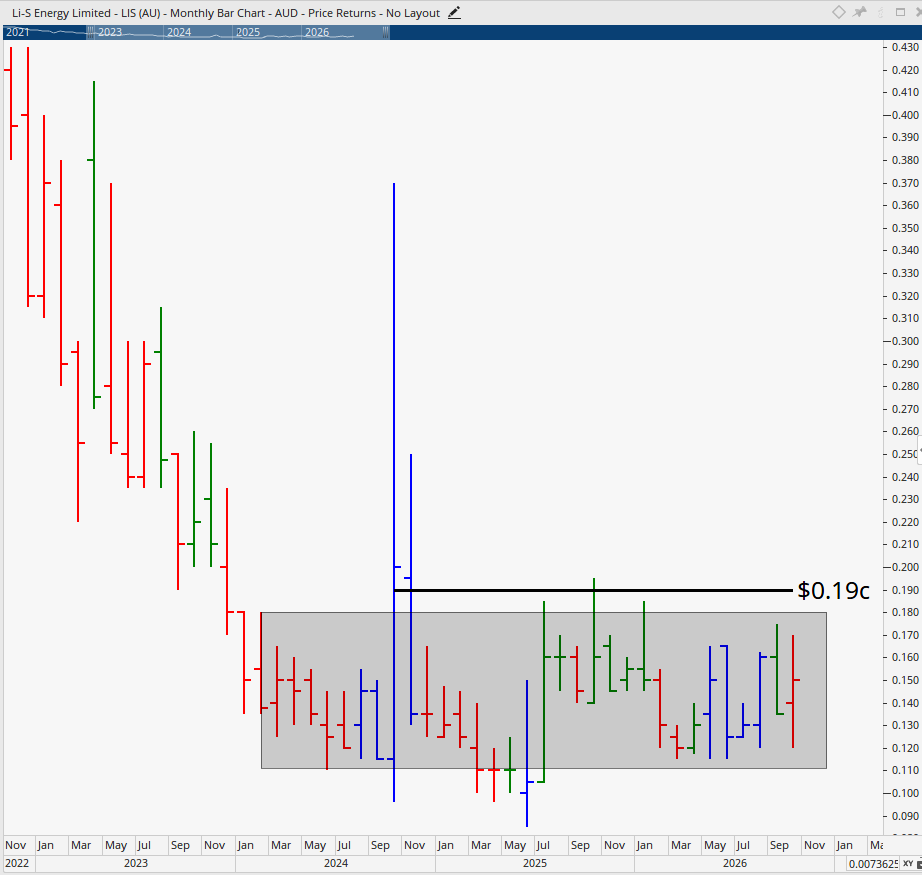
Of the three charts, Li-S Energy presents the more developed basing pattern in our assessment. After a substantial decline following listing, successive higher bases have emerged through 2025 and 2026.
Buying around significant lows and the absence of a return to the earlier low near 9 cents make the structure worth following. Around 10 cents is an important support reference.
The key upside area is around 19–20 cents. A monthly close above 20 cents would be a significant development, opening the possibility of a move toward 36 cents. A further breakthrough above 36 cents would strengthen the longer-term recovery case.
The more ambitious scenarios discussed extend toward $1 and eventually the earlier trading area around $1.96, but they depend on substantial further progress. They are not immediate targets or assured outcomes.
The weekly chart has not yet confirmed an imminent breakout. The stock could remain in its range longer than investors expect. Watch for stronger price movement supported by increased volume, and apply a defined entry rule rather than assuming a promising base must immediately produce a rally.
Education helps turn a watchlist into a decision
The common risk is falling in love with the technology and overlooking what the investment is doing. Thin trading, brief speculative rallies and long sideways trends can all complicate an otherwise persuasive business case. You need to assess price, volume, and timeframe together.
This is why learning to analyse shares matters. Recognising a potential turning point is a skill to develop, alongside knowing what would confirm an entry or prompt an exit. Wealth Within’s Diploma of Share Trading and Investment (11398NAT) helps investors develop a structured approach to those decisions, rather than relying on enthusiasm for a company’s story.
Dale Gillham’s bestselling book, How to Beat the Managed Funds by 20%, also provides practical strategies for analysing shares, identifying trading opportunities and managing risk to make more informed decisions in the share market.
FBR needs to defend support and attract sustained buying. Micro-X needs to show that its recent demand can survive the next selling phase. Li-S Energy needs to turn its more developed base into a confirmed breakout. Each offers something to investigate. The investment decision should follow evidence that the market is beginning to support the opportunity.