How to Build a Diversified Portfolio

By Dale Gillham
Reading Time: 12 minutes
General Advice Disclaimer
This article is for general educational purposes only and does not take into account your personal financial circumstances, objectives or needs. Before making any investment decisions, consider your individual circumstances and seek independent financial advice if necessary.
Building a diversified share portfolio is key to managing risk and achieving investment success when trading over the medium to long term.
However, many investors mistakenly believe that the more shares they own, the better diversified their portfolio will be, regardless of which companies they hold.

While spreading your capital across different companies can reduce risk, holding too many stocks can make your portfolio harder to manage without necessarily improving your returns.
The key to successful portfolio diversification is understanding how many stocks to hold, how to select quality companies, and how to balance risk without unnecessarily limiting growth opportunities.
In this article, we’ll explore the research behind portfolio diversification, why the benefits diminish as you add more stocks and how to build a manageable portfolio that supports your financial goals over the medium to long term.
What is portfolio diversification, and why is it important?
We've all heard the saying, "Don't put all your eggs in one basket". There is a good reason for this. If you invest all your money in one company and its share price falls significantly, your entire portfolio suffers.
By spreading your investments across different companies and sectors, you can reduce the impact that any one investment has on your overall portfolio. However, there comes a point where adding more stocks provides diminishing benefits in reducing risk.
Holding too many stocks can also make your portfolio more difficult to manage and may limit your ability to take advantage of opportunities in companies you believe have strong growth potential.
The aim is to achieve an appropriate level of diversification without unnecessarily spreading your capital across too many investments.
Building a diversified portfolio
To build a diversified share portfolio, you first need to understand the two main types of risk that affect your investments: market risk and specific risk.
While diversification can reduce the risks associated with individual companies, it cannot eliminate the risks that affect the broader share market. This distinction matters because it helps explain why holding more stocks doesn't necessarily make your portfolio safer.
Let's look at each type of risk and how it affects your portfolio.
Market risk exposure in a diversified portfolio
An investor who chooses to invest in a particular market is exposed to the risks inherent in that market, also known as systematic risk.
These include broader economic and political factors such as inflation, interest rates, political events and commodity price movements that can affect the share market as a whole, as shown in the table below.
Market risk cannot be eliminated simply by holding more stocks, regardless of how diversified your portfolio becomes.
| Market risk factor | How it affects the share market |
|---|---|
| Interest rates | Rising interest rates can increase borrowing costs for businesses and consumers, potentially reducing company profits and share prices. |
| Inflation | Higher inflation can increase business costs and reduce consumer spending, placing pressure on company earnings. |
| Political events | Government policy changes, elections and geopolitical events can create uncertainty and affect investor confidence. |
| Commodity prices | Changes in oil, metals and other commodity prices can affect company costs, earnings and market performance. |
| Currency movements | Exchange rate fluctuations can affect the profitability of companies that import or export goods and services. |
Market risk is only one component of overall portfolio risk. Investors must also consider specific risk, which relates to individual companies.
Specific risk exposure in a diversified portfolio
Diversifying across different companies can reduce specific risk because not all companies respond to economic conditions in the same way.
The table below provides examples of the specific risk factors affecting individual companies.
For example, if one major bank performs poorly because of conditions affecting the banking sector, other banks may face similar difficulties but to varying degrees.
However, companies in other sectors, such as healthcare or consumer staples, may be affected differently.
This is why selecting stocks from different sectors can provide greater diversification benefits than simply holding more stocks within the same sector.
| Specific risk factor | How it affects individual companies |
|---|---|
| Poor company earnings | Lower-than-expected profits can prompt investors to reassess a company's value, causing the share price to fall. |
| Management decisions | Poor strategic or financial decisions can reduce profitability and negatively affect the company's performance. |
| Product failure | An unsuccessful product launch or product recall can reduce revenue and damage a company's reputation. |
| Sector disruption | New technologies, competitors or changing consumer preferences can threaten a company's market position. |
| Financial difficulties | Excessive debt or declining cash flow can weaken a company's financial position and increase the risk of failure. |
Can holding stocks in the same sector benefit your portfolio?
While diversifying into different stocks across sectors can reduce specific risk, the inverse of this argument also applies. If several companies within the same sector are rising in price, why wouldn't you want to benefit from those returns?
Take Australia's four major banks, for example. If all four were trending higher, holding these stocks could deliver capital growth and dividend income. Diversifying away from these companies simply to spread your investments across different sectors could mean missing out on some of those returns.
If all the stocks in your portfolio are in profit, how much risk do you think you are exposing yourself to? The answer is very little because you can sell all or part of your portfolio at any time and get the initial capital back after costs.
In other words, the more a stock's price increases compared to what you paid for it, the less risk you are taking with your capital.
What if stocks in the same sector start to fall?
Now, I can hear some of you saying, “But if I am holding the big four banks, what happens if they all crash in price?”
While it is uncommon for all four major banks to fall sharply at the same time, it can happen, as they did during the global financial crisis. This is why it‘s important to have clear rules for managing your investments.
My point is that diversification shouldn't mean avoiding opportunities in strong-performing sectors just to spread your risk across different stocks.
If several quality companies in the same sector are trending higher, holding those stocks may offer better capital growth opportunities than investing in weaker-performing companies purely for diversification.
The key is to understand the risks associated with the companies you own and actively manage your portfolio so you can take advantage of rising share prices while limiting potential losses.
How many stocks should you hold in a diversified portfolio?
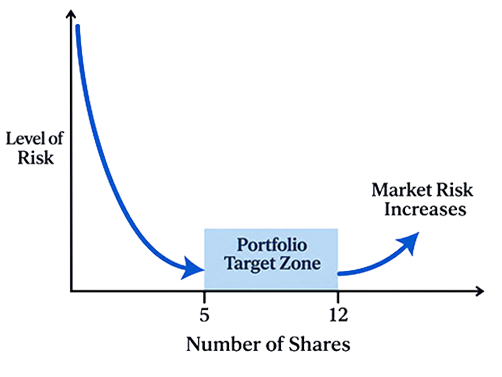
As I explain in my bestselling book, How to Beat the Managed Funds by 20%, one of my four golden rules for managing your trading capital is to hold between 5 and 12 stocks in your portfolio.
The aim is to achieve an appropriate level of diversification to manage risk without holding so many stocks that your portfolio becomes difficult to monitor and manage. The table below outlines my recommended number of holdings for active traders versus investors.
| Portfolio approach | Recommended holdings | Main consideration |
|---|---|---|
| Active trader | 5–8 stocks | A concentrated portfolio requiring effective management of specific risk |
| Active investor | 8–12 stocks | Broader diversification while maintaining a manageable portfolio |
,br>
The following risk diversification curve illustrates how adding stocks to a portfolio initially reduces specific risk, but the benefits diminish as the number of holdings increases.
What is the justification for holding a concentrated portfolio?
In my experience, many investors hold far too many stocks in their portfolios, often 30 or more, believing that spreading their money across many companies will reduce risk and improve returns.
In my presentations, I often tell people that about one-third of their stocks are rising, one-third are trading sideways, and one-third are falling. Almost every time, people nod in agreement, and afterwards many come up and tell me this is exactly what is happening in their portfolios.
The problem is that holding too many stocks can make it difficult to identify which investments are performing well and which are holding back your portfolio. It also takes more time, knowledge, and effort to research, monitor and manage a larger number of companies.
This is why I believe investors should focus on building a manageable portfolio of carefully selected stocks rather than continually adding holdings in the belief that doing so will automatically improve returns or reduce risk.
What does the research say about portfolio diversification?
Research has long demonstrated that much of the reduction in specific risk occurs when the first several stocks are added to a portfolio.
In 1968, John Evans and Stephen Archer published a study in The Journal of Finance examining the relationship between the number of stocks held and portfolio risk.
Their research found that much of the benefit of diversification could be achieved with a relatively small portfolio, with further risk reductions becoming progressively smaller as more stocks were added.
This became one of the most cited papers in finance textbooks. They concluded that a passive investor only needs to hold between 10 and 15 stocks for a portfolio to be well-diversified.
More recent research published by the CFA Institute in 2021 provides further insight. The researchers found that the average volatility of a 10-stock large-cap portfolio was approximately 20%, compared with 17% for a 40-stock portfolio.
| Number of large-cap stocks | Average portfolio volatility |
|---|---|
| 10 stocks | 20% |
| 40 stocks | 17% |
| Difference | 3 percentage points |
In other words, adding another 30 stocks reduced volatility by just three percentage points. For an individual, that additional reduction must be weighed against the time, effort, and complexity of researching and managing another 30 positions.
This is why I advocate holding between 5 and 12 carefully selected stocks rather than continually adding more companies in the belief that doing so will automatically improve returns or reduce risk.
As Simon Hoyle wrote in a 2003 article: you don't get twice the diversification benefit from holding 20 stocks as you do from holding 10, and you certainly don't get ten times the benefit from holding 100 stocks rather than 10.
Selecting stocks for a diversified portfolio
Now that you understand how many stocks to hold in a diversified portfolio, the next step is to select stocks that are likely to trend higher in price.
In my experience, one of the best ways to manage risk when building a portfolio is to focus on large-cap, blue-chip companies, particularly those within the top 150 stocks on the Australian Securities Exchange (ASX) by market capitalisation.
What are the benefits of investing in large-cap stocks?
These companies are generally more established and highly liquid, meaning there is usually sufficient buying and selling activity to enter and exit positions without significantly affecting the share price.
Reliable financial information is also readily available, making it easier to research and monitor their performance.
Unfortunately, many newcomers to the stock market mistakenly believe that buying cheap stocks is the best way to achieve higher returns. The attraction is understandable because they can purchase far more shares in a company trading at $0.50 than one trading at $20.
Buying cheap stocks doesn’t necessarily mean you’re getting a bargain
I've lost count of how many people have told me they bought a stock simply because it was cheap. But the number of shares you own doesn't determine how much profit you'll make. What matters is the percentage return on the capital invested.
For example, if you invest $1,000 in a stock trading at $0.50, you'll own 2,000 shares. Invest the same amount in a stock trading at $20, and you'll own 50 shares. If both rise by 10%, you'll make the same $100 profit before costs.
| Stock A | Stock B | |
|---|---|---|
| Share price | $0.50 | $20.00 |
| Capital invested | $1,000 | $1,000 |
| Number of shares | 2,000 | 50 |
| Share price after a 10% rise | $0.55 | $22.00 |
| Profit | $100 | $100 |
The difference is the likelihood of each stock achieving that return and the risks involved.
In my experience, established blue-chip companies with strong fundamentals and rising share prices generally provide more reliable trading opportunities than speculative stocks bought simply because their prices appear cheap.
The objective is to buy quality stocks that are likely to trend higher in price, not simply to own more shares because they are cheaper.
Why large-cap stocks are easier to manage
One advantage of focusing on highly liquid, blue-chip stocks is that you don't need to watch the market constantly.
When you first enter a trade, you don’t know anything for certain, except maybe how you'll manage it as it unfolds. Once the stock is in profit, you only need to review your portfolio once a week, preferably after the market closes on Friday, to see whether any have triggered your exit rules.
While large-cap stocks can still fall sharply, their higher liquidity makes them easier to manage than many smaller companies.
The potential for long-term returns from large-cap stocks
Research also demonstrates the potential for substantial long-term returns from individual Australian companies. A CommSec study published in 2023 examined the performance of Australia's 30 largest listed companies over the previous decade.
Aristocrat Leisure delivered total returns exceeding 972%, while Northern Star Resources returned 871%. Mineral Resources, ResMed and Fortescue Metals Group were also among the top five performers.
This reinforces why I advocate selecting a concentrated portfolio of quality companies with the potential to trend higher in price, rather than simply buying a large number of stocks.
The objective is to identify stronger-performing companies likely to trend higher before entering a position, and to actively manage those investments to capitalise on opportunities for capital growth and potential income.
Managing risk in a concentrated portfolio
Selecting quality stocks is only one part of building a successful portfolio. You also need to apply sound money management and risk management strategies to protect your capital and manage potential losses.
Risk management involves using strategies such as stop losses to limit potential losses and protect profits as share prices rise. Money management, on the other hand, determines how much capital you allocate to each position.
One of my golden rules for managing your trading capital is to never allocate more than 20% of your total share portfolio to any one stock. This helps prevent a significant decline in a single investment from excessively impacting your overall portfolio.
Regardless of how carefully you select your stocks, some will fall in value. By combining appropriate diversification with sound money management and risk management rules, you can reduce your exposure to individual stock losses while maintaining opportunities for capital growth.
To sum up
In my experience, diversifying a share portfolio isn't about owning as many stocks as possible. It's about selecting a manageable number of quality companies likely to trend higher in price.
When you combine disciplined stock selection and active portfolio management, this approach can help you manage risk while pursuing stronger returns over time.
Dale Gillham is one of Australia's most respected share market educators, with over 30 years of experience in banking, financial planning, share market education and professional trading.
He is also a bestselling author and is passionate about helping Australians develop the knowledge and skills to manage their investments through Australia's only government-accredited Diploma of Share Trading and Investment.