How to Manage Risk and Position Sizing in Trading: The Kelly Criterion

By Fil Tortevski and Pedro Banales
Reading Time: 13 minutes
Markets have a habit of making risk management seem unnecessary just before it becomes essential. When share prices rise, speculative stocks run hot, and traders make money with seemingly little effort, attention naturally shifts to finding the next opportunity. They start thinking about what to buy rather than how to manage risk by determining their position size when buying shares or using leverage to trade. That distinction matters.
Understanding how much capital to allocate to a trade is a fundamental part of trading risk management and can be just as important as choosing the trade itself. In this article, we look at why position sizing can help to determine whether a profitable trading strategy succeeds or fails and how these principles explain how to manage the risk vs reward in trading. You will also discover why managing your level of risk in a trade and the amount of capital you commit should work together if you want to protect and grow your portfolio.
We also investigate the Kelly Criterion, one of the oldest ideas in modern money management, and provide an interesting perspective on why this strategy could mean you are still taking on too much risk.
Why risk becomes dangerous in strong markets
Risk tends to receive the least attention when confidence is at its highest. During powerful bull markets, investors see other people making money and naturally want a bigger piece of the action, so positions become larger, leverage increases and strategies that have recently performed well are assumed to continue working. Recent events in South Korea show how quickly this behaviour can increase risk, as enthusiasm for semiconductor and AI-related stocks combines with significant retail participation and the use of leveraged products.
When semiconductor shares came under pressure, the risks associated with leverage became apparent. Using leverage can contribute to forced selling and margin calls. Suppose you have $100,000 and borrow additional money to increase your market exposure. If the value of those investments falls far enough, your broker may require you to deposit more money into the account and, if you cannot provide the additional capital, positions can be closed. You may still believe the investment will eventually recover, but that no longer matters because your position has become too large relative to the capital supporting it.
Being right is useless if you cannot remain in the market long enough for your thesis to play out.
Conviction is not the same as risk management
The same principle applies to retail investors. The recent problems surrounding Leopold Aschenbrenner's Situational Awareness fund illustrate how concentration and leverage can become dangerous even when an investor has an apparently strong thesis. The fund was heavily positioned around the continued expansion of AI infrastructure and, when those trades moved sharply against it, losses escalated, and positions reportedly had to be sold to meet lender requirements.
This was not simply a question of whether the long-term AI thesis was right or wrong; the immediate problem was that the portfolio structure left insufficient room for the market to move against the positions. Conviction should determine whether an opportunity deserves investigation, but it should never replace risk management.
You can have excellent research and a compelling view about where a share price is eventually heading, yet if your position is so large that a normal correction forces you out, your research becomes irrelevant. As a trader or investor, you are ultimately a money manager whose priority is to ensure your capital survives long enough to trade another day.
Strategy and the problem with concentration
Strategy, the company closely associated with Michael Saylor and its enormous Bitcoin treasury, offers another useful example of why liquidity matters. In early July, Strategy sold 3,588 Bitcoin for approximately US$216 million, with the proceeds used to fund preferred-stock dividend payments and replenish its US dollar reserve. The sale did not mean Strategy had abandoned its long-term Bitcoin strategy, and the company continued to hold more than 843,000 Bitcoin after the transaction, but it demonstrates that even a highly committed investment strategy must operate within the realities of cash flow, liquidity and financial obligations.
An asset can have tremendous long-term potential, but if too much capital is concentrated in that asset and cash is required elsewhere, an investor may have to sell regardless of whether the timing is attractive. Diversification does not mean owning dozens of stocks simply for the sake of owning them; it means avoiding a situation where one incorrect decision can cause damage to the entire portfolio. The objective is survival first and growth second.

Protecting your capital is what provides you with the opportunity to grow it. Risk management starts with keeping enough capital intact to participate in future opportunities.
The formula that changed the question
The Kelly Criterion formula dates back to 1956, and Bell Labs scientist John L. Kelly Jr. Kelly's original work was not designed as a share trading system; his research concerned information transmitted through noisy communication channels, and the mathematical principle was subsequently recognised as being applicable to gambling and investment decisions.
What made Kelly's work so interesting was that it changed the question. Investors usually ask what they should buy, whereas Kelly effectively asked how much they should bet. The Kelly Criterion attempts to determine the proportion of available capital that should be committed when there is a measurable probability of success: bet too little and capital grows more slowly than it potentially could, but bet too much and normal losing streaks can cause a lot of damage. Somewhere between those extremes is a position size that balances the opportunity for growth against the probability of ruin.
A good trading strategy can still lose money
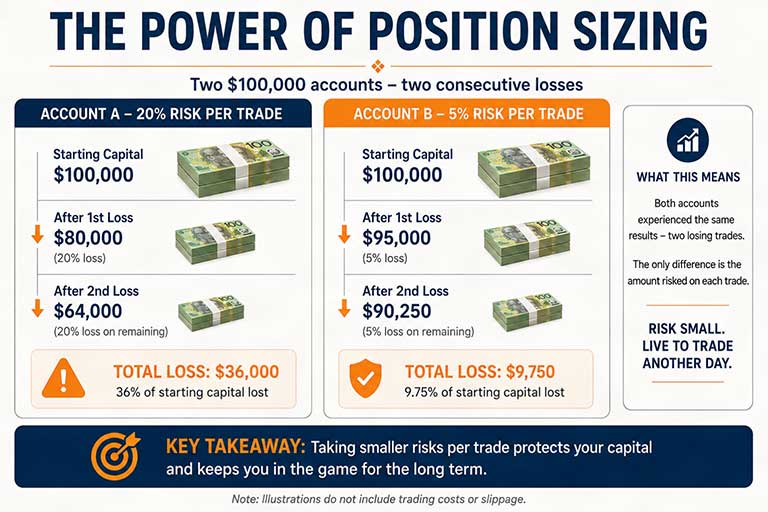
Consider two traders with identical $100,000 accounts using the same trading strategy. The strategy wins 60 per cent of the time and, on average, winning trades make twice as much as losing trades lose, so on paper the strategy has a favourable probability of success and risk-to-reward ratio. The traders even take exactly the same trades; the only difference is how much they risk.
Trader A is extremely confident and risks 20 per cent of their total trading capital on each trade. If the first two trades result in losses, the account falls from $100,000 to $80,000 and then to $64,000, a 36 per cent loss from the starting value. Recovering from $64,000 to $100,000 then requires a return of more than 56 per cent. Nothing was necessarily wrong with the strategy because a system that wins 60 per cent of the time can experience two consecutive losses; the problem was position sizing.
Trader B uses a much smaller fraction of their total capital, risking 5 per cent on each trade. The same two losses take the account from $100,000 to $95,000 and then to $90,250, leaving more than 90 per cent of the original capital available and enough capacity to continue executing the strategy when winning trades arrive. Same account, same trades, and same strategy, but a completely different risk profile.
How much of your total capital are you risking?
One of the things I always consider when managing risk is how much I am actually risking relative to my total trading capital. It is not enough to simply look at the dollar value of the position. You need to understand how much you could lose if the trade moves against you and what percentage that represents of your total capital.
By limiting the amount you risk on any one trade to a small percentage of your total capital, you reduce the impact of a losing trade on your portfolio and retain sufficient capital for future opportunities.
Can full kelly still be too aggressive?
The Kelly Criterion calculates a proportion of available capital to allocate based on the probability of success and the relationship between potential gains and losses. Using the full allocation calculated by the Kelly Criterion is known as Full Kelly. While this may represent the mathematically calculated position size, using the full amount can be aggressive because the calculation depends heavily on having reliable information about the probability of success.
A trader may believe a strategy wins 60 per cent of the time, but the quality of that estimate depends on the sample, the market conditions in which the results occurred and whether the average wins and losses genuinely represent live trading.
Understanding the probability of success requires the right data, a properly developed strategy, and appropriate backtesting rather than assuming a recent run of success proves the strategy works. Even professional traders and investors can leave a buffer for estimation errors, which is one reason fractional Kelly approaches, such as half Kelly or quarter Kelly, are often considered.
Rather than allocating the full amount calculated under Full Kelly, fractional Kelly reduces that allocation to provide a greater margin for error. Financial markets are not coin tosses with fixed probabilities; conditions change, and estimates can be wrong, so aggressively sizing positions around an overstated probability of success can do considerable damage.
How position sizing relates to how we manage risk
Our philosophy on position sizing forms part of a broader approach to managing risk.
- Risk management deals with managing the risk within the trade, including the use of stop losses to minimise losses and exit strategies to protect profits.
- Money management deals with how much of your total capital you expose to risk, including position sizing and the rule that no more than 2 per cent of your total capital should be at risk on any one trade. You can only determine your position size once you know how much capital you are prepared to risk based on the stop loss you set. If the risk is higher than 2 per cent, you may need to reduce your stop loss.
Before asking how much you can make, ask how much you can afford not to lose, because protecting your capital is what gives you the opportunity to continually grow it. To learn how we apply money management and risk management techniques, get Dale Gillham's award-winning book 'Accelerate Your Wealth'.
How risk should influence your position size
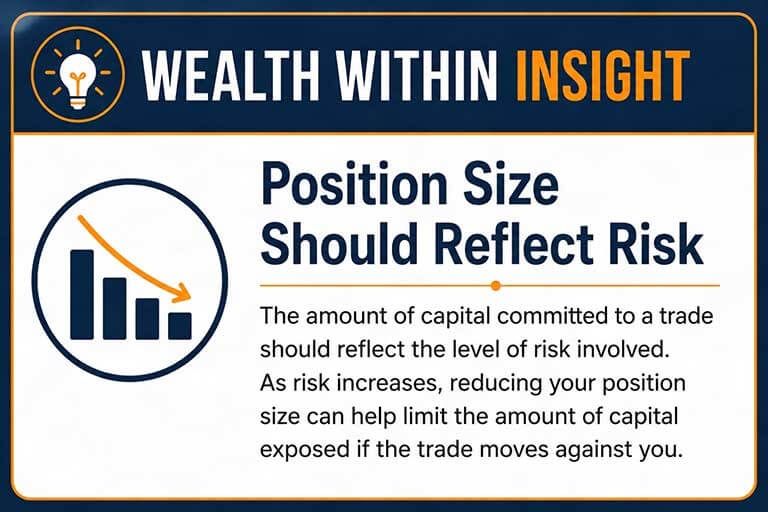
In practical terms, a trader needs a systematic approach and the skill to determine whether an opportunity is higher or lower risk and consider the potential reward relative to that risk. Consider a quality company that has already fallen 60 per cent. There may be substantial upside if it recovers, but buying simply because the share price has fallen is higher risk. A trader may therefore choose to allocate only a fraction of their position size and consider increasing it if a later opportunity satisfies their trading rules and presents a lower level of risk.
The same principle applies when considering the liquidity, volatility and speculative nature of a stock. A company outside the top 200 may receive a smaller allocation than a larger, more liquid stock because the risk characteristics are different. The objective is not to avoid every high-risk opportunity; it is to recognise the risk and ensure that the amount of capital exposed reflects it. To understand my broader position-sizing framework, read the Four Golden Rules to Investing in Shares, which explains how position sizing fits within a portfolio and risk management strategy.
Your position size should reflect the opportunity
Thinking this way also solves a common problem traders face. Many wait for the perfect setup only to watch the share price move without them, but the alternative is not to abandon their rules and chase the stock. It's to develop clearly defined entry rules; understand the historical probability associated with those rules and know how much capital each type of opportunity warrants. A higher-risk entry receives less capital, while an entry that satisfies trading rules with a higher historical probability of success can justify a different position size within the trader's overall risk profile.
The same principle applies to speculative shares. A smaller company outside the major indices with lower liquidity and higher volatility should not necessarily receive the same dollar allocation as a large, liquid blue-chip company. The potential percentage return may be greater, but so is the risk, and position sizing should reflect that difference.
Common risk and position sizing mistakes
The examples in this article highlight some common mistakes that can turn a sound trading idea into a damaging trade. These include using excessive leverage, committing too much capital to one position, allowing confidence in an investment to override risk management and increasing your exposure simply because an asset has fallen in value. The problem is not always choosing the wrong stock. A good opportunity can still lead to a significant loss if you place too much capital at risk.
Another mistake is assuming that because a strategy has performed well recently, it will continue to do so. A sound trading strategy needs to be systematic, tested and understood before you decide how much capital to commit. Increasing your position size does not improve the strategy; it simply increases your potential loss if the trade moves against you.
Key lessons for traders and investors
Successful trading is not primarily about finding winning stocks because even a good strategy will experience losing trades. The practical challenge is making sure those losses remain manageable so you can continue trading when the next opportunity arrives. That is why the Kelly discussion matters: it shifts the focus from simply asking whether an opportunity looks attractive to considering how much capital should be allocated to the trade based on the level of risk involved.
Why risk management starts with better skills
Position sizing is only one part of managing money in the market. Traders also need a structured process for analysing opportunities, understanding market behaviour and applying their rules consistently, because a position-sizing formula cannot compensate for a strategy that has not been properly developed or tested.
For those wanting a comprehensive pathway to trading the share market, the Diploma of Share Trading and Investment includes everything in the Short Course in Share Trading, in addition to analysing price, pattern and time. This complete trading approach can help you improve your risk/reward return so you can improve your trading results with confidence.
The objective of education shouldn’t be to make you dependent on someone else’s stock tips. It should be to give you the knowledge to make your own informed decisions with confidence.
Final thoughts
The Kelly Criterion has endured because it addresses a question traders can easily overlook: not simply whether an opportunity is worth taking, but how much capital should be committed to it. The examples show what can happen when leverage, concentration and conviction overwhelm that question, while the practical lesson remains the same: understand the probability associated with your strategy, recognise the risk in the opportunity and allocate capital accordingly.
You are not simply a trader or investor; you are a money manager. Protecting the capital you have today is what allows you to participate in the opportunities that come tomorrow.
FAQ
What is the Kelly Criterion in trading?
The Kelly Criterion is a mathematical approach to deciding how much capital to allocate when there is a measurable probability of success and a known relationship between potential gains and losses. It is used primarily to explain why position size matters.
Why is position sizing important in trading?
A good win/loss rate does not remove losing streaks. If too much capital is exposed on each trade, a normal sequence of losses can create a large drawdown and make recovery much harder, even when the underlying strategy continues to perform according to its tested probability of success.
Why does position sizing matter if a trading strategy has a good win rate?
Even a good trading strategy will have losing trades. If you risk too much capital on each trade, several losses in a row can significantly reduce your trading capital and make it harder to recover. Good position sizing helps keep those losses manageable.
Should every trade have the same position size?
No. Treating every opportunity as identical ignores differences in the level of risk, the trading rules being applied, their historical probability of success, volatility, liquidity and how speculative the stock is. These factors can all influence how much capital is appropriate to allocate to a stock.
Disclaimer
This article contains general information and educational market commentary only. It does not take into account your objectives, financial situation or needs and should not be treated as personal financial advice or as a recommendation to buy, sell or hold any financial product.