Been Made Redundant? Could Trading Be Your Next Career?

By Dale Gillham
Reading Time: 6 minutes
General Advice Disclaimer
This article is for general educational purposes only and does not take into account your personal financial circumstances, objectives or needs. Before making any investment decisions, consider your individual circumstances and seek independent financial advice if necessary.
Job security is becoming a growing concern for Australians as some of the country's biggest employers restructure, cut costs and adapt to new technology. Canva recently announced changes affecting 1,271 positions, or 22 per cent of its workforce, following slowing growth and technological change.

Meanwhile, NAB plans to cut up to 2,500 roles as it simplifies operations, while Qantas is preparing to shed 850 Australian jobs as it outsources corporate functions to Accenture, including work moving overseas.
However, could losing your job also be an opportunity to take greater control of your financial future?
For some, redundancy may motivate you to explore trading the share market. The attraction is understandable. Working independently, managing your own time and potentially earning an income from your skills rather than relying on an employer can be incredibly appealing.
What does it take to become a successful trader?
But there's a big difference between wanting to become a trader and knowing how to become one.
Think about it. If you wanted to become an accountant, electrician or engineer, you wouldn't expect to master the profession by watching a few videos or attending a weekend seminar. You would invest in proper education, develop practical skills and gain experience.
Approach trading with the same mindset.
One of the biggest misconceptions about trading is that success comes from finding the right stock or discovering a secret strategy. In reality, trading requires understanding market behaviour, managing risk, developing a proven strategy and learning to control your emotions.
These are skills that can be taught and developed through structured education and practice.
Why competency-based education builds confidence
Many Australians don't realise that government-accredited trading education is available, including the nationally recognised Diploma of Share Trading and Investment offered by Wealth Within.
Much like studying at university or TAFE, this provides a structured pathway to developing practical knowledge rather than relying on trial and error with your hard-earned money.
Of course, education alone doesn't guarantee success. Before relying on trading for income, you need a tested strategy, demonstrated consistency and sufficient financial reserves to cover your living expenses independently of your trading capital.
The good news is you don't need to give up everything to begin. You can develop your trading skills while working or exploring other career opportunities.
So, if you've recently been made redundant, don't view trading as a quick fix. See it as a potential new direction worth exploring seriously because sometimes, an unexpected career change can open the door to something much bigger, and like any worthwhile career, it starts with the right education.
Best and worst sectors
Information Technology was the best-performing sector last week, rising 2.18 per cent as a strong rebound in US semiconductor and AI stocks reignited buying across Australian technology companies.
Industrials followed, gaining 2.02 per cent as Monadelphous reaffirmed its revenue guidance while Qantas surged on restructuring news and falling oil prices.
Energy rounded out the top 3, up 1.53 per cent, as renewed Middle East supply fears lifted oil, gas and coal prices late in the week, supporting producers’ earnings expectations. Attacks on Saudi energy infrastructure and disruptions in the Strait of Hormuz helped drive the rebound.
At the other end of the market, Consumer Staples was the worst sector last week. It fell 0.85 per cent as it attempted to challenge the all-time high, with short-term profit-taking likely the play.
Consumer Discretionary was the second-worst sector, down 0.27 per cent, as Eagers Automotive dragged on the sector and concerns over higher interest rates persisted.
Communication Services rounded out the worst performers last week, down 0.07 per cent, with Superloop contributing to the weakness after its update revealed weaker wholesale subscriber numbers and higher planned capital spending.
Best and worst stocks
Xero Ltd led the ASX Top 100 last week, climbing 8.75 per cent after reporting strong revenue growth, upgrading its earnings outlook and announcing a share buyback.
Lynas Rare Earths followed, rising 7.15 per cent amid renewed investor interest in critical minerals and rare earth producers.
IGO Limited rounded out the leading performers, gaining 4.84 per cent as Monday’s Nova update provided a clear catalyst: final nickel production beat guidance by 7%, while cash costs came in 8% below the lower end of guidance, prompting a 4.8% share-price jump that day.
At the other end, Dyno Nobel Ltd was the worst performer, falling 12.57 per cent as weaker cash flow, rising debt and disappointing earnings guidance unsettled investors.
Eagers Automotive followed, falling 6.47 per cent as weaker profit margins and challenging vehicle sales conditions continued to pressure the stock.
Life360 rounded out the worst performers, falling 5.30 per cent after its latest quarterly results failed to sustain investor confidence despite strong revenue and subscriber growth.
All-Ordinaries Index update
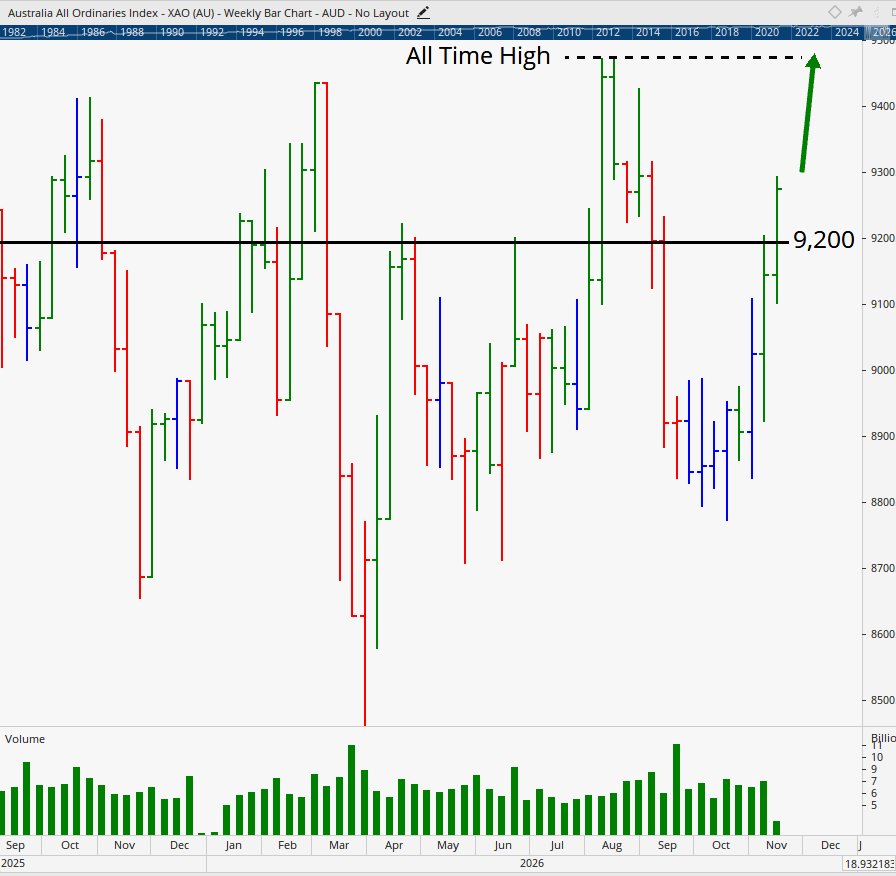
The All Ordinaries Index surged and closed above 9,200 last week, setting a milestone not seen since January this year. In reaching the milestone, the index marked its third consecutive week of gains, bringing the market within just a couple of percentage points of its all-time high.
The big question now is whether we will see a new record before the end of the year, and at this stage, it is looking increasingly likely.
Some interesting developments are unfolding globally that could work in our favour. As AI-related trades unwind overseas, capital is beginning to rotate into other assets, and the Australian market is looking increasingly attractive.
Many of our larger companies are trading on price-to-earnings ratios below 20, around the historical average for our market, while several sectors have already experienced significant selloffs. Materials is one example, while technology has become the new flavour of the month, rising almost 15% so far this month.
We are seeing a clear rotation of money between sectors, and investors need to pay attention. Markets rarely move in a straight line, and opportunities can shift quickly.
Those who recognise these changes early may be better positioned to benefit, while those who wait for the headlines to confirm the move risk becoming spectators.
With the All Ordinaries now approaching another test of its all-time high, this could be the fourth attempt that finally breaks through. The momentum is building, and the ingredients for a strong finish to the year are falling into place. Buckle up!
For now, good luck and good trading.
Dale Gillham is the chief analyst at Wealth Within and the international bestselling author of How to Beat the Managed Funds by 20%. He is also the author of the bestselling and award-winning book Accelerate Your Wealth—It’s Your Money, Your Choice, which is available in all good bookstores and online.