How to Trade Stocks: Learn the Skills to Trade the Share Market

By Dale Gillham
Reading Time: 22 minutes
Learning how to trade stocks is about far more than opening a brokerage account and clicking the buy button. Anyone can buy shares, but knowing what to buy, when to buy, how much to invest and when to sell requires knowledge, skill and a proven process.

This is where stock trading, particularly for beginners, can become challenging. When markets are rising, and stories about the latest winning stock are everywhere, making money can look easy. Over more than 30 years in the market, I’ve seen many people discover there is a significant difference between knowing something about the stock market and having the knowledge and skill to apply it successfully.
If you want to learn stock trading on the Australian Securities Exchange (ASX), this article will take you beyond simply buying and selling shares. You’ll learn how markets move, why trends matter, how to identify opportunities, the role of fundamental and technical analysis, how to manage risk vs reward and why your own psychology can have such a significant influence on your results.
Trading is a skill you can learn
One principle I have reinforced throughout my career is that trading is a skill that can be learned. Like any professional skill, however, becoming proficient takes education, practical experience and the discipline to consistently apply what you know.
How frequently you trade or how much money you have does not make you a proficient trader. What matters is the process you use to make decisions, your ability to follow a proven set of rules and how effectively you manage both your capital and your emotions.
This distinction is particularly important when you’re starting out. You don’t need to know everything about the stock market before you begin learning, but you do need to understand that successful trading is not built on tips, predictions or finding the next hot stock. Learning to trade takes time because you need to understand how the market works and then gain experience over time to apply that knowledge.
What is stock trading?
Stock trading is the process of buying and selling shares in publicly listed companies with the aim of profiting from movements in their share price. When you buy shares, you become a part-owner of that company, and your total return can come from capital gains as the stock rises, dividends as companies distribute their profits or a combination of both.
In Australia, most listed shares are bought and sold on the ASX through a broker. Your broker gives you access to the market and executes your orders, but it doesn’t tell you whether a stock represents a good buying opportunity or if the market is trending in your favour or when you should sell. Those decisions sit with you.
This is an important distinction. Beginners tend to spend a lot of time comparing brokers, brokerage fees and trading platforms before they have learned how to make a sound trading decision. While these things matter, particularly when you have less money to invest, your knowledge, strategy and ability to manage risk will have a much greater influence on your results.
If you want to understand the mechanics of choosing a broker, opening a trading account and placing your first order, read How to Buy ASX Shares: Definitive Guide.

How does stock trading work?
Every transaction in the stock market requires a buyer and a seller. Buyers bid for shares at prices they are prepared to pay, while sellers offer shares at prices they are prepared to accept. When buyers are prepared to pay increasingly higher prices, prices can rise. Similarly, when sellers accept progressively lower prices, they can fall.
What makes this interesting to a trader or investor is what sits behind those decisions, because understanding why prices move is a key part of learning how to trade stocks.
Company results, economic conditions, interest rates and expectations about the future can all influence whether people buy or sell. So can fear, greed, confidence and uncertainty. Ultimately, those decisions are reflected in the price of the stock.
That’s why I have long described the stock market as an emotional barometer. A price chart is more than a collection of numbers. It is a visual representation of the collective decisions of everyone participating in that market.
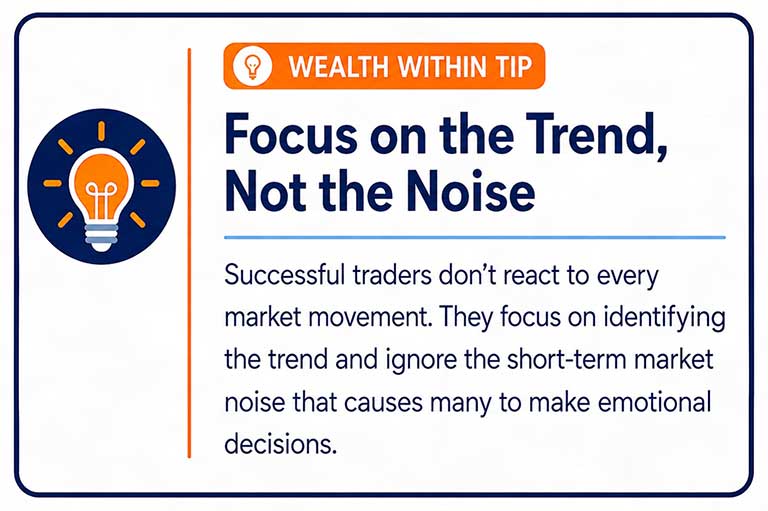
Rather than trying to predict every announcement or react to every headline, a skilled trader learns to analyse how and why the market or stock price is trending up, down or sideways. The objective isn’t to predict the future with certainty; it’s to recognise when the probability is sufficiently in your favour to act according to your trading rules. That starts with understanding the trend.
Why the market trend matters
All stocks and markets move in trends. Prices rise and fall as buyers and sellers compete, creating a series of movements that can develop into an overall rising, falling or sideways trend.
Understanding the trend matters because you want to put the probabilities in your favour rather than fight against what the market is doing.
If a stock is falling or moving sideways, your capital can remain tied up while you wait and hope for something to change. In contrast, identifying stocks that are trending up provides the opportunity to put your capital to work in assets that are moving in the right direction.
This is why I don’t believe a trader should define their strategy by deciding in advance how long they should hold a stock or at what price they should get in; the market doesn’t know this information.
Instead, your trading rules and the trend you’re attempting to capture should determine when you buy, how you manage the trade and eventually when you sell the position.
So, rather than asking “How long should I hold a stock?”, a better question is: "What type of trend am I trying to capture?”
Trading vs investing: What’s the difference?
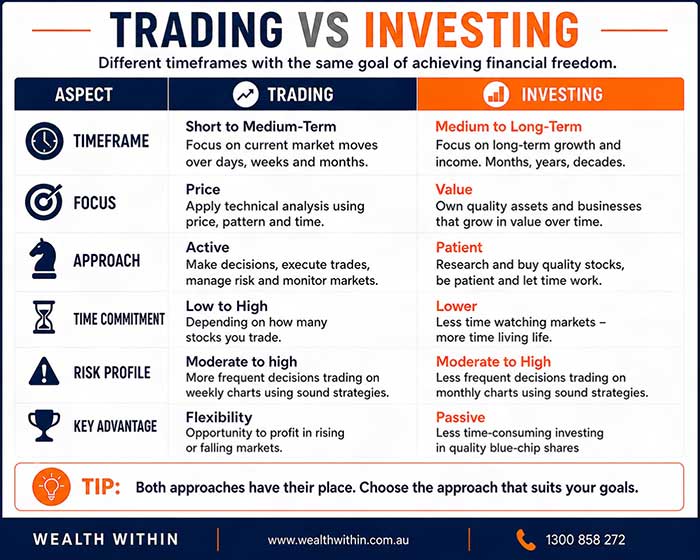
Trading and investing both involve buying shares with the aim of growing your wealth, but they generally focus on different market trends and involve different levels of activity.
I generally define short-term trends as up to three months, medium-term trends as three to 18 months, and longer-term trends as 18 months or more. These timeframes help provide context, but they shouldn’t become arbitrary holding periods.
A trader generally focuses on the short- to medium-term market movements that occur over weeks or months to capture capital gains and, where applicable, income from dividends. They use price charts and technical-analysis techniques to analyse price, pattern and time to decide whether they should buy, sell or hold a stock.
An Investor generally holds shares over the medium to longer term, and looks for quality businesses that can deliver capital growth and income. Deciding whether you want to trade or invest comes down to the time you have available and the goals you want to achieve.
Many people successfully use both. You might invest in quality shares to build wealth over the longer term while also trading selected opportunities to take advantage of short- to medium-term trends.
The mistake is allowing one approach to become the other because a position hasn’t behaved as expected. A medium-term trade should not suddenly become a long-term investment simply because the share price falls. That’s why, regardless of the trend you are trading, you should always apply an exit strategy before you enter a trade to ensure you minimise losses or to lock in profits.
Which trading style should you choose?
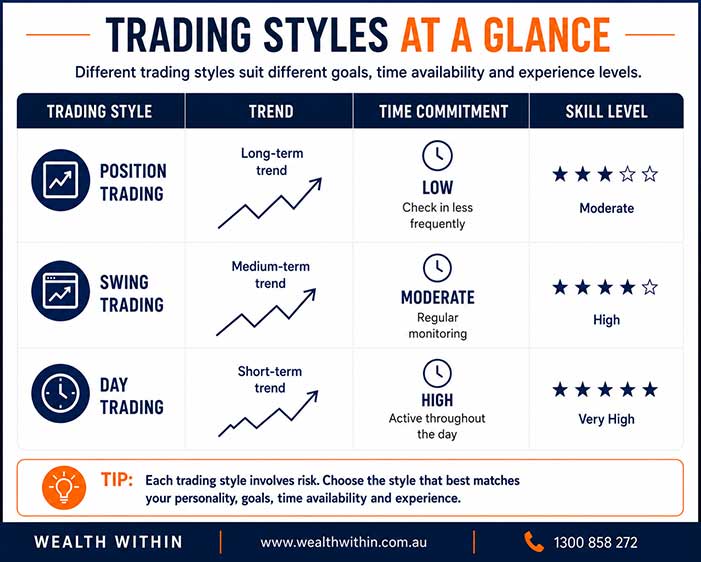
There are many ways to trade the stock market, but the trading style you choose should be based on the type of market trend you want to capture, not how long you plan to hold a stock. Generally, the shorter the trend you trade, the greater level of knowledge, skill and discipline you require because shorter trends can move more quickly, particularly if you day trade.
Position trading
Position trading aims to capture larger market trends, with a position potentially held for months while that trend remains intact. One advantage is that you don’t need to watch every small daily movement. You have more time to analyse the market and make decisions, which can make position trading more practical for people with careers, businesses, or family commitments.
The important point is that the calendar doesn’t decide when you sell; your trading rules do. A position may last longer or shorter than you originally expected depending on how the market unfolds.
Swing trading
Swing trading focuses on capturing shorter market swings, generally over days, weeks, or months, depending on the volatility of the stock. Because these movements occur more quickly, the trader needs a higher level of skill in analysing changes in market behaviour, and typically reviews their positions more frequently.
That still doesn’t mean reacting to every daily fluctuation. You need to know which trend you are trading and distinguish meaningful changes from market noise.
What about day trading?
Day trading involves opening and closing positions within the same trading day. It receives enormous attention online because it looks fast and exciting, but it requires significant screen time, quick decisions and a high level of technical skill and emotional discipline.
What skills do you need to trade stocks?
Learning the terminology is useful, but knowing what a trend, chart or P/E ratio is doesn’t automatically make you a trader. Competence comes from understanding how the different pieces fit together and being able to apply them consistently when your own money is involved.
Six areas that deserve particular attention include fundamental analysis, technical analysis, risk management, money management, trading psychology and a written trading plan.
Fundamental analysis: Knowing what to buy
Fundamental analysis examines the underlying business to help determine whether a stock is worth considering. This can involve looking at areas such as the company’s earnings, financial position, dividends and value relative to other companies and the broader market.
You don’t need to become an accountant to understand fundamental analysis. The purpose is to develop a process that helps you separate quality businesses from stocks that may be attracting attention for all the wrong reasons. The principle to remember is simple:
Fundamental analysis tells you what to buy. That doesn’t mean a fundamentally strong company should be bought at any price or at any time.
A great business can still have a falling share price, and buying it simply because you like the company can leave your capital tied up for months or years. That’s where technical analysis becomes important.
Technical analysis: Knowing when to buy
If fundamental analysis tells you what to buy, technical analysis tells you when to buy.
Technical analysis involves studying price charts to understand how price moves in relation to the decisions of the buyers and sellers. By identifying which way the trend is moving, up, down or sideways, you can determine whether it's the right time to enter a trade.
When trading the stock market, I prefer classical technical analysis because it teaches you to analyse price directly rather than relying on computer-generated indicators. Indicators, such as, a MACD and RSI use historical price data to generate signals, which means they can lag the market.
For more than 30 years, I have used and refined classical technical-analysis techniques, including Dow Theory, Gann Trend Theory, Gann Swing Theory, Gann’s Counter Trend Theory and Trendlines, or combinations of these techniques together with risk management strategies that protect your downside risk and your profits.
Classical techniques teach you how to interpret price, pattern and time to give you a deeper understanding of what the stock or market is doing and allow you to make your own trading decisions.
I consider these leading techniques because they analyse price action directly to identify changes in market direction as it happens. These techniques provide earlier signals that the trend may be starting, continuing or changing direction, which gives you the opportunity to act on what the market is telling you.
When you combine technical analysis with fundamental analysis, you can focus on fundamentally sound companies and then use the price chart to determine whether the timing supports your decision to enter a trade.
Money management: Determine your position size
One of the biggest changes in thinking that occurs as people become more experienced in the market is that they stop asking only: “How much can I make?” and start asking: “How much am I prepared to risk?”
You will have losing trades; even I have them. Every experienced trader has had them, and you will have them too. Losing trades are not evidence that a strategy doesn’t work; they are part of participating in a market where outcomes can never be known with certainty. The danger is allowing one losing trade to do serious damage to your portfolio.
This is why money management needs to be considered before you enter a trade. You need to understand how much capital you are committing, the risk you are taking, and what needs to occur for you to recognise that your original analysis is no longer valid.
How much capital should you risk?
Money management determines how much capital to commit to a trade and ensures the potential loss from any individual trade does not exceed 2% of your total trading capital. This is why limiting the amount of capital you expose to any one trade is so important. Successful trading and investing is as much about controlling what you can lose as it is about pursuing what you can make.
Your money management and risk management rules need to work together. Money management determines your position size, while risk management determines where you will exit to protect your capital if the trade moves against you or when you will exit to take profits.
A larger position is not automatically better simply because the potential dollar profit is higher. Build your knowledge, skill and confidence first, then increase your position size as your knowledge and skill justify doing so.
Risk management: Protect your capital or take profits
Risk management determines how you manage a trade once you enter the market. Your exit strategy needs to account for two outcomes: protecting your capital with a stop loss if the trade moves against you or taking profits when the trade moves in your favour.
Before entering any trade, you should know where you will exit if your analysis is wrong. A stop loss gives you a predetermined point at which you accept that the trade has not performed as expected and exit before the loss becomes larger. This removes much of the emotion from deciding whether to hold or sell when a stock falls.
Risk management is equally important when a trade moves in your favour. Having a clear exit strategy allows you to manage a profitable position and determine when it’s time to take your profits from the market, such as using trend lines or Dow Theory, rather than allowing fear, greed or hope to influence your decision.
No strategy will eliminate losing trades. The objective of risk management is to keep losses small when you are wrong and allow you to take profits when you are right.
For a deeper explanation of how stop losses are used to protect trading capital, read What is a Stop Loss and Why Should You Use One?

Every trader experiences losing trades, but successful traders ensure no single loss has a significant impact on their portfolio. Protecting your capital is fundamental because you cannot control the outcome of every trade. Money management controls how much capital you expose to a trade, while risk management determines what you will do if the market moves against you or when to take profits.
Trading psychology: Learning to manage yourself
You can have a good trading strategy and still make poor decisions if you cannot manage your emotions. Fear, greed, hope and impatience influence every market because markets are made up of people with emotions, and they will also influence you.
Fear can cause you to sell a profitable position too early. Greed can convince you to take too much risk. Hope can keep you holding a losing position because you don’t want to admit your original analysis may have been wrong. Impatience can tempt you into a trade simply because you feel you should be doing something.
This is why your trading psychology needs to work in combination with your trading strategy. It affects whether you actually follow it. One of the recurring behaviours I’ve observed over decades is that people become far more emotional when they don’t know what to do next. Without clear rules, every price movement becomes a new decision.
A written strategy reduces that uncertainty because you have already decided what needs to happen before you act.

Why you need a written trading plan
A trading plan brings the different parts of your strategy together. Before you buy a stock, you should know why you are considering it, what needs to occur before you buy, how much capital you are prepared to commit, how you will manage the position and what will be the deciding factor(s) to sell.
The purpose is not to create a complicated document that sits in a drawer. It is to give you a repeatable process for making decisions.
Without a plan, every trade can become an emotional rollercoaster. When a stock rises, greed tells you to hold on for more, but when it falls, fear and hope compete over whether you should sell or wait. With a plan, you have rules to refer to.
This is particularly important when a trade moves against you. Deciding how you will respond before your money is on the line makes it much easier to remain objective. If you want to explore this in more depth, read the 5 Steps to Developing a Profitable Trading Plan.
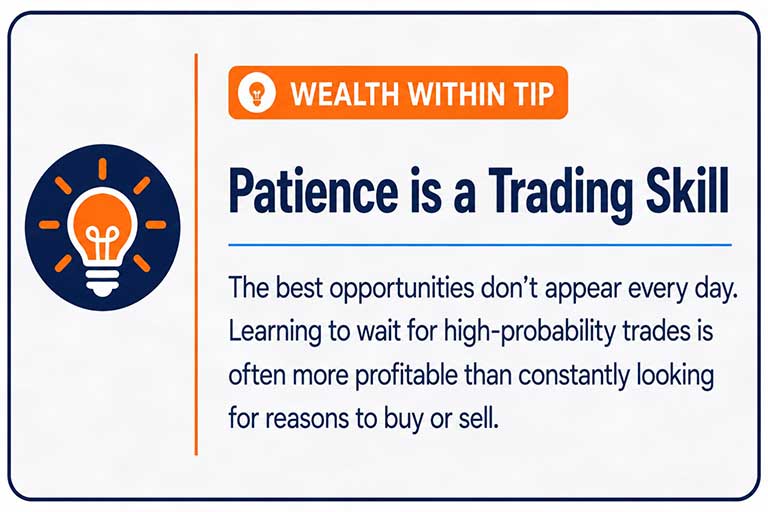
The best opportunities don’t appear every day. Learning to wait for high-probability trades is often more profitable than constantly looking for reasons to buy or sell.
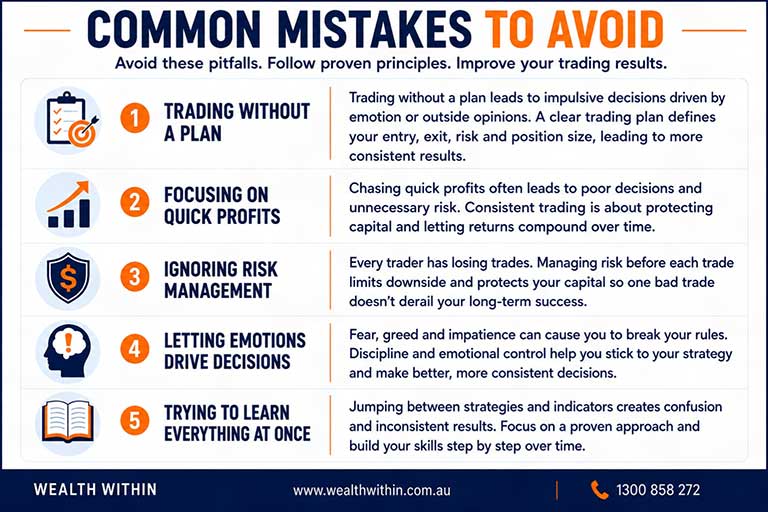
Common stock trading mistakes to avoid
Knowing what to do is only half of becoming a better, more profitable trader. You also need to recognise the behaviours that can undermine your results.
Trading without a plan
Buying because of a media headline, a tip from a friend or an emotional reaction leaves you without a consistent basis for making decisions. A clear trading plan defines your entry, exit, risk and position size before the pressure of the trade begins.
Focusing on quick profits
Stories about traders making large profits in a short period attract attention because they make trading look easy, but building wealth consistently is not about finding the next big winner. It’s about protecting your capital, managing risk and allowing your knowledge, skill and returns to develop over time.
Ignoring risk management
Every trader has losing trades. The objective is to make sure that one losing trade doesn’t have a significant impact on your portfolio. If you concentrate only on the potential profit and ignore the downside, eventually the market will teach you why risk management matters more.
Letting emotions drive decisions
Fear, greed and impatience can cause you to abandon even a sound strategy. You may sell too early, hold onto a losing trade or chase a rising stock because you are frightened of missing out. Discipline means following your rules even when your emotions are telling you to do something else.
Trying to learn everything at once
Traders often jump from one trading strategy to another, then another indicator, another expert and another social-media video. More information does not necessarily make you a better trader.
Learn proven strategies, understand why they work and build your skills step by step. Depth of knowledge is far more valuable than following someone else’s strategy, hoping it works in all market conditions. The goal in becoming a skilled trader is to develop a toolkit of techniques and strategies that work in all market conditions.
How do you start trading stocks?
If you are wondering how to start trading stocks, start with education, not with finding stocks to buy. First, learn how the share market works and understand the difference between analysing a company and analysing its share price. Learn why the trend matters and decide what type of trend you want to capture.
Then develop the skills to identify potential opportunities, which means understanding the role of both fundamental and technical analysis rather than relying on someone else to tell you what to buy.
You also need to understand money management to determine your position size and risk management to protect your capital and take profits from the market. Decide how you will manage a trade before putting your capital at risk. Finally, develop a written trading plan that brings those decisions together.
Only after you understand your process should your attention turn to how much money you want to put into the market. Starting with smaller positions while you develop your experience can reduce some of the emotional pressure, but don’t confuse investing a small amount with taking small risks. Your objective is to develop the knowledge and confidence to make sound decisions before increasing your position size.
If you still need to open a brokerage account and learn how to place an order, How to Buy ASX Shares: Definitive Guide takes you through those practical steps.
What does successful stock trading really look like?
Success in trading is not winning every trade. That expectation is unrealistic and creates exactly the wrong mindset. If you believe every trade needs to win, you are more likely to become emotionally attached to your decisions and reluctant to accept when something hasn’t worked.
A better way to think about trading is as a series of decisions made over many trades. Some will be profitable. Others will not.
What matters is whether your process gives you an edge over time, whether you consistently follow your rules and whether you manage your risk so losing trades do not prevent you from participating in future opportunities.

That is also why judging your ability on one or two trades makes little sense. A profitable trade can result from a poor decision, just as a losing trade can occur even when you followed your rules correctly. Your job is to judge the quality of your process, not simply the outcome of the last trade.
The market rewards preparation, not prediction
One of the biggest misconceptions about successful traders is that they somehow know what the market is going to do next. They don’t. The future is uncertain, which is why trading is about probabilities rather than certainty.
Your advantage comes from preparing before you act. You analyse the opportunity, understand the trend, determine your risk and know what conditions need to be present before you buy or sell. Then you let the market tell you what happens next.

How to develop your stock trading skills
An article can teach you the principles of stock trading, but there is a point where understanding definitions or watching a technique on YouTube is no longer enough. Knowing what technical analysis is, for example, is very different from knowing how to apply a technical trading rule correctly to a price chart.
The same applies to risk management, position sizing and building a complete trading plan. This is where structured education becomes valuable.
Wealth Within’s Short Course in Share Trading comprises the first three modules of the government-accredited Diploma of Share Trading and Investment and provides in-depth education in learning how to interpret and trade trends how to identify the trading rules that suit your style of trading and support your decision to enter a trade. It also covers the critical concept of risk and money management because trading the stock market is not about how much money you can make; it’s about how much you do not lose.
The objective of education shouldn’t be to make you dependent on someone else’s stock tips. It should be to give you the knowledge to make your own informed decisions with confidence.
Continue your learning with Accelerate Your Wealth
If you want to build on the principles covered in this article, my book Accelerate Your Wealth: It’s Your Money, Your Choice explores many of the foundations that have shaped my approach to the stock market over more than 30 years. It provides practical insights into developing your knowledge, understanding market trends, managing your money and risk, and building the discipline required to make more informed decisions.
Frequently asked questions about stock trading
Can beginners learn stock trading?
Yes. I’ve taught people from all walks of life how to trade, so I know it’s a skill you can learn. But learning to trade takes time. You need to understand how the market works, learn proven trading rules and gain experience applying them before worrying about how much money you can make.
Is stock trading risky?
Yes. Every time you enter a trade, there is a chance the share price will move against you, and you will lose money. Losing trades are part of trading, which is why you need rules to control how much you can lose.
Money management helps to determine your position size, so you don't expose too much of your capital to any one trade. Risk management is about knowing when to get out, either to stop a loss from becoming larger or to take your profits when the trade moves in your favour.
How long does it take to learn to trade?
You can learn basic stock-market terminology relatively quickly. Developing the knowledge, judgement and discipline required to consistently apply strategies takes longer.
Think of trading as you would any professional skill. Education gives you the foundation; experience develops your competence.
Can you make money trading stocks?
Yes, but there are no guarantees, and no trader makes money on every trade.
Consistent results come from applying a sound process across many trades, managing your risk and continually improving your knowledge and skills, not from trying to find a guaranteed winner.
What is the difference between stock trading and investing?
An experienced trader can choose to trade over the short-, medium- or longer-term trends, while investors tend to focus on medium- to longer-term trends. In either case, the goal is to grow your wealth through capital gains and dividends.
Both can play a role in building wealth. The important thing is to know which approach you are using and apply rules appropriate to the trend you want to capture.
Is technical analysis or fundamental analysis better?
They serve different purposes. Fundamental analysis tells you what to buy. Technical analysis tells you when to buy.
Rather than viewing them as competing approaches, learning how they work together can give you a more complete framework for making decisions.
What is the best way to learn stock trading?
Start with structured education that teaches you how the market works, how to analyse shares, how to manage risk and how to develop and follow a trading plan.
Avoid jumping between tips, strategies and online experts. Choose proven strategies, understand how they work and develop your experience by applying them consistently.
Final thoughts
Learning how to trade involves developing the knowledge, skills and discipline to make informed decisions in the share market. When you're ready to put that knowledge into practice, read our How to Buy ASX Shares: The Definitive Guide for the practical steps involved in getting started, including choosing a broker, opening an account and buying shares on the ASX.
After more than 30 years in the market, I still believe the best investment you can make is in developing your own knowledge and skills. The market will always present new opportunities. Your job is to make sure you have the knowledge, confidence and discipline to recognise when they appear.
Disclaimer
This article contains general information and educational market commentary only. It does not take into account your objectives, financial situation or needs and should not be treated as personal financial advice or as a recommendation to buy, sell or hold any financial product.
Any stocks, sectors, strategies or market scenarios discussed are provided for educational purposes to illustrate the concepts covered in the article and should not be considered individual investment recommendations.