Unemployment Rising: Is a Rate Hike the Answer?

By Dale Gillham
Reading Time: 7 minutes
General Advice Disclaimer
You acknowledge that the information provided by Wealth Within is intended for general use only and does not take into account your investment objectives, financial situation or advisory needs, nor does the information provided constitute investment advice. For this reason, any individual should consider the appropriateness of the information, having regards to the individual's objectives, financial or taxation situation and needs before acting on this information, and, if necessary, seek appropriate professional advice. In addition, it is important to understand that the risk of investing in the stock market is that you could lose some or all of your money. For more information please refer to our Terms and Conditions.
In February 2026, the International Monetary Fund (IMF) warned that Australia faced risks on both sides. Inflation could remain stubborn, while weaker growth could push unemployment higher. It backed an RBA that responds to the data and called for tighter control of government finances.
August’s job figures put that balancing act in sharper focus.

Australia’s unemployment rate is moving higher
The unemployment rate rose to 4.6 per cent. On the ABS trend measure, 9,300 more Australians were unemployed than in July and 58,300 more than a year ago, while full-time employment fell by 6,300 in the seasonally adjusted figures.
While the unemployment number is up, it does not mean the jobs market has collapsed yet. Total employment rose by 39,500, part-time employment increased, and hours worked were up. The ABS also cautions against reading too much into one month’s movement, but it would be just as careless to ignore the rise in unemployment.
The question now is whether Australia can bring inflation down without pushing more people out of work.
The RBA has reason to remain concerned. Its August assessment put underlying inflation at 3.6 per cent, above its 2–3 per cent target. That rules out declaring victory or assuming rate cuts are around the corner.
Would another rate hike do more harm than good?
However, it does not make another rate rise the obvious next move. Higher rates slow borrowing and spending; they cannot build homes, fill skills shortages or directly reverse an overseas energy shock. If inflation remains high while the labour market softens, the RBA needs to establish what is keeping prices up before making mortgages and business loans more expensive again.
My view is that the RBA should hold at its next meeting. Give the recent rate rises more time to work and look for evidence that August’s rise in unemployment is continuing. A further hike should require convincing signs that broad spending is still driving inflation, not simply another headline.
The government cannot leave the problem to the RBA
Most importantly, the government cannot leave this entire problem with the RBA. The IMF supported fiscal restraint alongside reforms to lift productivity and ease housing supply constraints. Those are harder tasks than calling for the central bank to be tough, but they matter if Australia wants lower inflation without relying on weaker employment to get there.
It is easy to demand another rate hike when someone else bears the cost in their mortgage repayments, their business or their job. The IMF did not tell Australia to raise rates again. It warned that policymakers must stay alert to both inflation and a weakening economy. August’s figures are a reason to take both sides of that warning seriously.
Best and worst sectors
Consumer Staples was the best-performing sector last week, rising 0.78 per cent as investors appeared to favour the steadier earnings of supermarkets and other essential goods businesses during a week of heavy selling on the broader market.
Health Care also gained slightly, up 0.09 per cent as gains in CSL, Cochlear and Fisher & Paykel helped the sector, which is also a common defensive play for investors when markets run red.
Real Estate rounded out the top 3, down 0.20 per cent, as the prospect of interest rates staying higher for longer likely weighed on listed property stocks, whose valuations and borrowing costs are sensitive to rates.
At the other end of the market, Utilities was the worst sector last week. It fell 5.23 per cent as the prospect of another RBA rate rise made dividend-paying utilities less attractive relative to cash and bonds. Investors also rotated toward growth stocks as market sentiment improved.
Communication Services was the second-worst sector, dropping 2.91 per cent as pressure on its major names increased, with Telstra facing renewed scrutiny over its emergency call network this week.
Energy rounded out the worst performers this week, falling 1.55 per cent as oil retreated on hopes of progress in Middle East diplomacy. This led to reduced earnings outlooks for producers such as Woodside and Santos.
Best and worst stocks
Ramelius Resources led the ASX Top 100 this week. It climbed 8.10 per cent as its new production outlook put FY30 gold output at 560,000 to 610,000 ounces, about 11 per cent above its previous plan.
Cochlear followed, rising 6.27 per cent as buyers continue to drive the reversal after the stock suffered one of its worst falls in history, further supported by investors seeking defensive plays amidst the heavy selloff last week.
Treasury Wines Estate rounded out the leading performers, gaining 5.24 per cent as it sold the Seppelt brand, winery and vineyards last week. The first concrete sale under its plan to cut smaller brands and focus on its premium wines, including Penfolds.
At the other end, Telix Pharmaceuticals was the weakest performer, falling 10.92 per cent. Investors sold the stock after its proposed ITM merger raised concerns about the deal's cost and dilution from issuing new shares.
Xero followed, falling 8.63 per cent as investors weighed weaker margins and Melio integration costs against high growth expectations, with elevated rates adding pressure on the valuation.
HUB24 Limited rounded out the worst performers, falling 8.16 per cent, amid renewed concern about Australian interest rate rises. Higher expected rates can put pressure on the valuations of growth stocks, including wealth platforms such as HUB24.
All Ordinaries Index update
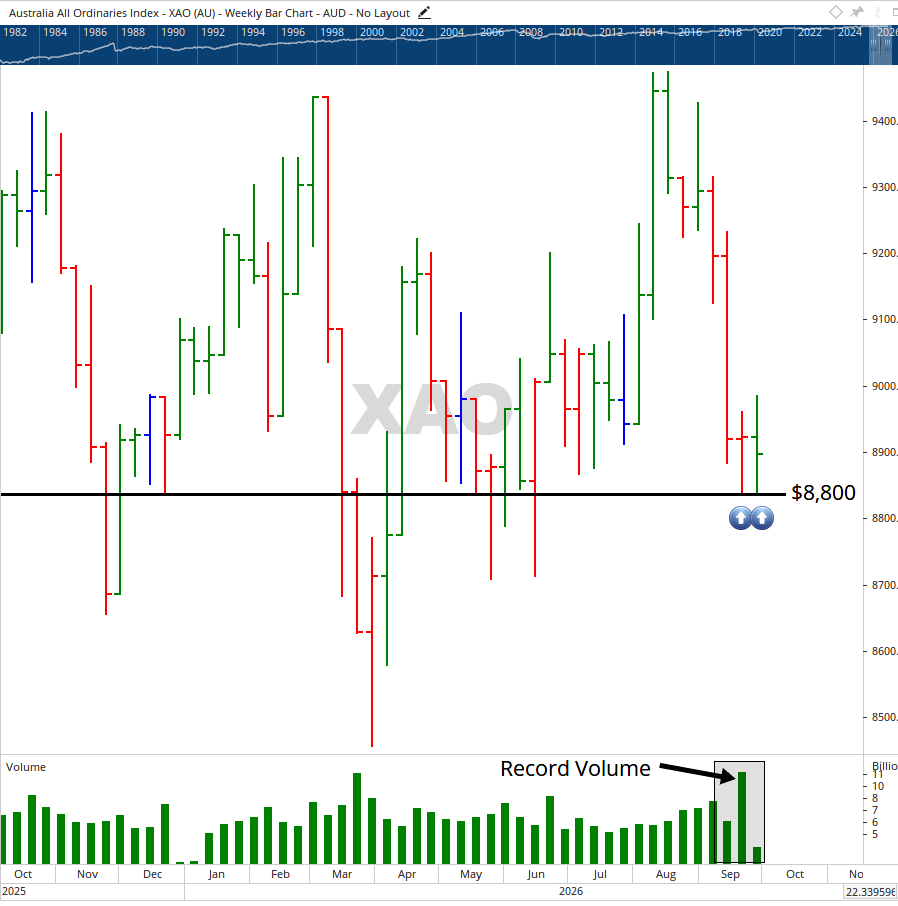
The sellers regained control of the All Ordinaries Index last week. After a promising start, the index finished the week down 0.87 per cent, but the weekly loss alone doesn’t tell the full story. What caught my attention was where buyers stepped in during the selloff, and what happened after they did.
The previous week, the All Ords fell to 8,835 points before buyers turned it around and pushed the index into positive territory. That reversal came on weekly volume of just under 11 billion. To put that into perspective, since 2000, volume has reached roughly that level on only four other occasions: shortly after the GFC low, near the March 2011 peak, at the COVID low and around the March 2026 tariff selloff low.
Each of those periods was followed by a significant market move. The catch is that those moves didn’t all go in the same direction. Heavy volume tells us a lot of shares are changing hands, but it doesn’t tell us whether buyers or sellers will come out on top. For that, we need to watch how the market behaves at the levels that matter.
Last week gave us another test. As the index fell, buyers returned at 8,837, almost exactly where they had defended the market the week before. For a brief period, it looked as though they might produce another turnaround. Instead, sellers regained control, and the index closed the week at 8,845, just above that earlier low.
That puts 8,835 firmly in the spotlight. Buyers have now defended that area twice, but the second attempt was less convincing. If the All-Ords breaks below it and sellers keep control, the heavy volume could prove to have been a warning sign, with 8,600 the next level I’ll be watching.
On the other hand, if buyers continue to hold the market around 8,835 and begin pushing the index higher, the case for a rebound gets stronger. After a week of unusually high volume, the question is simple: are buyers building a floor, or are sellers preparing for the next leg down? The market’s next move around 8,835 should give us a clearer answer.
Good luck and good trading.
Dale Gillham is the Chief Analyst at Wealth Within and the international bestselling author of How to Beat the Managed Funds by 20%. He is also the author of the award-winning book Accelerate Your Wealth—It’s Your Money, Your Choice, which is available in all good bookshops and online.
This article provides general information and education only. It does not constitute personal financial advice.