Is the AI Data Centre Boom Running Out of Power?

By Dale Gillham
Reading Time: 5 minutes
General Advice Disclaimer
This article is for general educational purposes only and does not take into account your personal financial circumstances, objectives or needs. Before making any investment decisions, consider your individual circumstances and seek independent financial advice if necessary.
The AI Data Centre boom has collided with something software cannot fix: getting the electricity connected.

NEXTDC shares plunged more than 40 per cent after delays in upgrading electricity at its Melbourne facility forced it to cut its earnings forecast. Firmus scrapped its proposed IPO, while South Korean operator Elice fell 32 per cent on debut before recovering the losses the following day.
These setbacks raise a question: is demand disappointing, or is the industry struggling to deliver enough capacity?
Australia has been here before. During the mining boom, ships queued outside Newcastle and Dalrymple Bay because export infrastructure struggled to keep pace. Customers wanted the resources, but getting them to market was another matter.
Those bottlenecks did not end the boom. Investment expanded infrastructure, and by 2010 the Reserve Bank reported higher iron ore and coal export capacity. The comparison offers a reason to remain constructive on data centres. A delayed electricity connection does not, by itself, mean demand has disappeared.
Can the AI data centre boom overcome its infrastructure bottlenecks?
The International Energy Agency expects global data-centre electricity consumption to nearly double, from 485 terawatt-hours in 2025 to 950 by 2030. Australian research forecasts consumption will nearly triple, from 5.2 terawatt-hours in FY26 to 15.8 by FY30.
But forecasts alone cannot pay the bills. Construction and financing costs can accumulate while revenue waits. The RBA has warned that debt-funded AI projects could struggle if demand disappoints or adoption takes longer than expected.
For NEXTDC, Macquarie Technology Group and Goodman Group, investors should therefore watch customer commitments and funding alongside construction milestones. Customers staying committed through delays would support the argument that revenue has been postponed. Cancellations or reduced requirements would suggest something more troubling.
I think infrastructure constraints are insufficient evidence to declare the boom is over. The mining experience shows an industry can build through bottlenecks when demand persists, although that does not guarantee every project or share price will recover.
Ships waiting offshore helped explain why Australia needed more export capacity. For data centres, the equivalent test is whether customers will still be waiting when the power finally arrives.
Best and worst sectors
Communication Services was the best-performing sector last week, rising 4.04 per cent on the back of strong gains in Telstra and TPG, with investors looking for some buy-the-dip-type opportunities.
Financials gained 4.02 per cent, as the major banks continued to rebound, while takeover interest in Challenger provided support.
Industrials rounded out the top 3, rising 2.66 per cent, driven by Cleanaway’s takeover offer, which sparked a roughly 20 per cent jump, and helped lift the sector.
At the other end of the market, Materials was the worst performing sector last week, dropping 7.69 per cent as falling gold stocks and renewed weakness in major miners weighed on the sector.
Information Technology followed, dropping 5.11 per cent as NEXTDC’s earnings downgrade compounded an ongoing global sell-off in technology and AI stocks.
Energy rounded out the worst performers last week, falling 1.49 per cent as oil pulled back and immediate Middle East escalation fears eased, pressuring energy shares later in the week.
Best and worst stocks
Cleanaway Waste Management led the ASX Top 100 this week, climbing 21.05 per cent after agreeing to an EQT takeover valuing the business at approximately $9.3 billion, including debt.
Challenger Limited followed, rising 21.02 per cent after Daiichi Life proposed an $11.80-a-share takeover, roughly 20 per cent above its previous closing price.
Pro Medicus rounded out the leading performers, gaining 12.89 per cent after securing two seven-year US contracts worth a combined $67 million with Billings Clinic–Logan Health and Virtua Health.
At the other end, NEXTDC Limited was the weakest performer, falling 38.89 per cent after delayed electricity connections at its Melbourne M3 facility forced an earnings forecast downgrade.
Telix Pharmaceuticals followed, falling 16.15 per cent after its quarterly update showed a modest sequential revenue decline, disappointing investors despite a positive full-year outlook.
Genesis Minerals rounded out the worst performers, falling 15.03 per cent on weakening gold prices, while its quarterly update showed costs near the upper end of guidance, adding to margin concerns.
All Ordinaries Index update
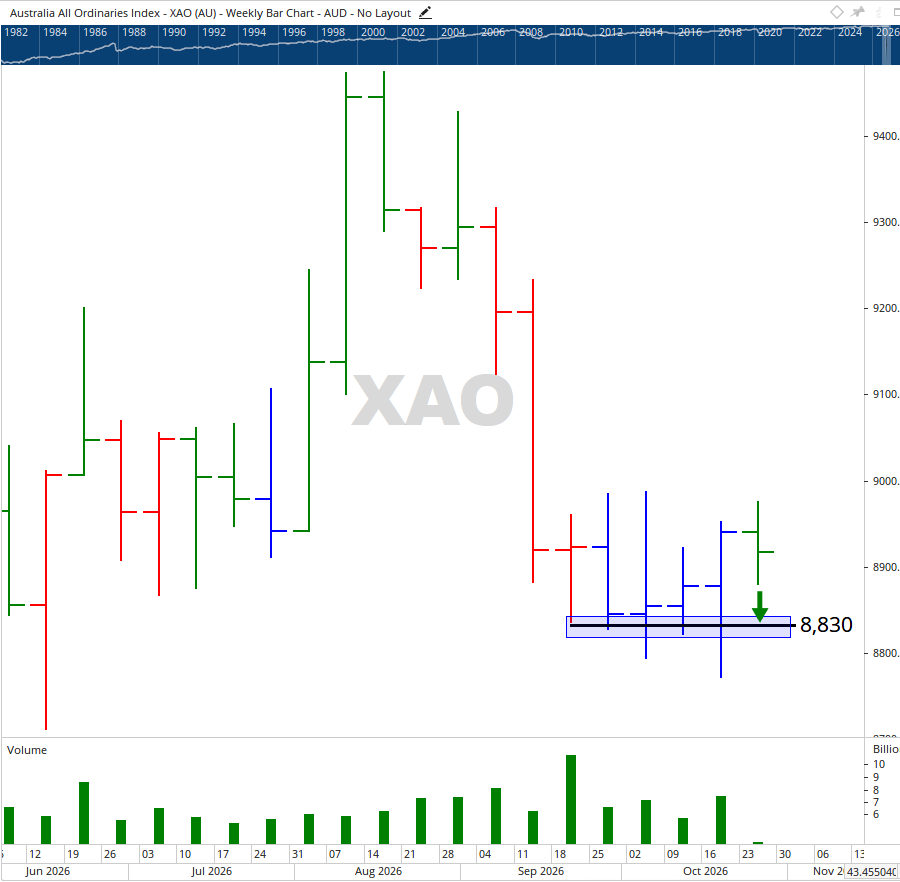
Last week, the All Ordinaries Index slipped 0.39 per cent as sellers again took control late in the week. Crucially, however, it held above 8,830. The index has spent the past month in a tight range, threatening to break higher one week and lower the next. While last week’s trading tilted the balance slightly towards further weakness, recent price action shows just how quickly that outlook can change.
However, one potentially encouraging difference stands out: this is the first week in that range that the index hasn’t retested 8,800. If the market rises from here and breaks above 9,000 points, it suggests buyers are becoming more confident and stepping in earlier, rather than waiting for another return to the lows.
Seasonality also makes the next two months worth watching. Materials typically strengthen through November and December, while Financials tend to soften in November before regaining strength in December. Given their substantial influence on the Australian market, these sectors could determine whether the index finally escapes its range.
If Materials strength is offset by Financials weakness next month, the market could remain stuck a little longer. December may offer a better opportunity for a Santa rally if both sectors begin moving in the same direction..
Good luck and good trading.
Dale Gillham is the Chief Analyst at Wealth Within and the international bestselling author of How to Beat the Managed Funds by 20%. He is also the author of the award-winning book Accelerate Your Wealth—It’s Your Money, Your Choice, which is available in all good bookshops and online.