US Midterms: Petrol, Mortgage and Super at Risk?

By Dale Gillham
Reading Time: 5 minutes
General Advice Disclaimer
This article is for general educational purposes only and does not take into account your personal financial circumstances, objectives or needs. Before making any investment decisions, consider your individual circumstances and seek independent financial advice if necessary.
Most Australians probably see America's midterm elections as a political sideshow, but the November 3rd outcome could affect global oil prices, inflation, interest rates, and even your superannuation.

Can Trump deliver lower oil prices after the US midterms?
President Donald Trump has repeatedly predicted that oil prices will tumble after the November midterm elections. He's under growing pressure to lower fuel costs, and his administration has already struck a deal to secure Russian diesel supplies to ease the squeeze on American drivers and businesses. However, the big question is whether these measures can deliver lasting relief or whether oil prices will remain hostage to the conflict with Iran.
The political stakes are significant. Historically, the president's party has lost 20 of the 23 midterm elections since 1934. If Republicans lose control of Congress, Trump could face greater scrutiny and resistance over government spending, military funding and his wider agenda. That wouldn't automatically end the Iran conflict, but it could make it politically harder to continue the campaign.
What could the midterms mean for Australia's economy and share market?
So why should Australians care? Start with your super. Australian retirement funds invest heavily overseas, particularly in American shares. In 2025, the US represented more than half of Australia's portfolio-equity holdings, and super funds were major contributors to those investments. If a shift in US policy sends American shares sharply higher or lower, that can flow through to Australian retirement balances.
The Australian share market also has potential upside. If the conflict genuinely winds down and oil prices fall, cheaper fuel could ease inflation and reduce costs for our biggest and most popular sector on the ASX, Materials. This could significantly shape the market's direction over the coming months.
Additionally, the RBA has highlighted how higher fuel prices feed directly into inflation and indirectly into the cost of producing and delivering goods. A sustained fall in energy prices could give the RBA more room to ease monetary policy, potentially supporting rate-sensitive shares and consumer spending.
Of course, cheaper oil isn't guaranteed, and lower prices caused by a global economic slump would be a very different story. But if Trump is right and the elections mark a turning point in the conflict, the benefits could extend well beyond America. For Australian investors, the question is whether we're entering another period of global uncertainty or the start of a major relief rally.
Best and worst sectors
Utilities was the best-performing sector last week, rising 4.47 per cent as gains appeared to reflect a shift towards defensive earnings and dividend income amid market uncertainty, with AGL among the stronger performers.
Healthcare gained 3.88 per cent as investors rotated into defensive healthcare businesses amid concerns about AI valuations, market volatility and slowing economic growth.
Consumer Staples rounded out the top 3, up 3.35 per cent, as defensive buying supported the sector. Woolworths was a key contributor as investors sought more reliable earnings.
At the other end of the market, Materials was the worst-performing sector last week, falling 2.31 per cent as weaker commodity prices and selling across major miners, gold stocks and lithium producers dragged the sector lower.
Real Estate followed, falling 1.73 per cent. Interest rate uncertainty kept property stocks under pressure, as investors remained concerned about borrowing costs and valuations.
Information Technology rounded out the worst performers last week, falling 1.28 per cent as a global tech sell-off and growing concerns about AI spending pressured growth stocks, with Megaport among those hit.
Best and worst stocks
WiseTech Global Limited led the ASX Top 100 last week, climbing 11.83 per cent after ASIC ended investigations into its founder and the company without enforcement action, easing investor concerns.
Bank of Queensland followed, rising 7.85 per cent as investors welcomed its full-year results, with statutory profit rising 88 per cent and the dividend maintained, despite weaker underlying cash earnings.
Treasury Wines Estate Limited rounded out the leading performers, gaining 7.65 per cent. Stronger sales momentum in China and the U.S., along with reaffirmed FY27 earnings guidance, helped restore confidence.
At the other end, PLS Group was the weakest performer, falling 14.86 per cent as weak lithium sentiment and reduced broker lithium-price forecasts weighed on the shares, despite a midweek rebound.
Paladin followed, falling 12.75 per cent as disappointing quarterly uranium production and higher costs at Langer Heinrich triggered heavy selling, despite unchanged annual guidance.
NEXTDC Limited rounded out the worst performers, falling 11.48 per cent as the broader AI and technology sell-off weighed on sentiment, while a break below $10 added to its technical weakness.
All Ordinaries Index update
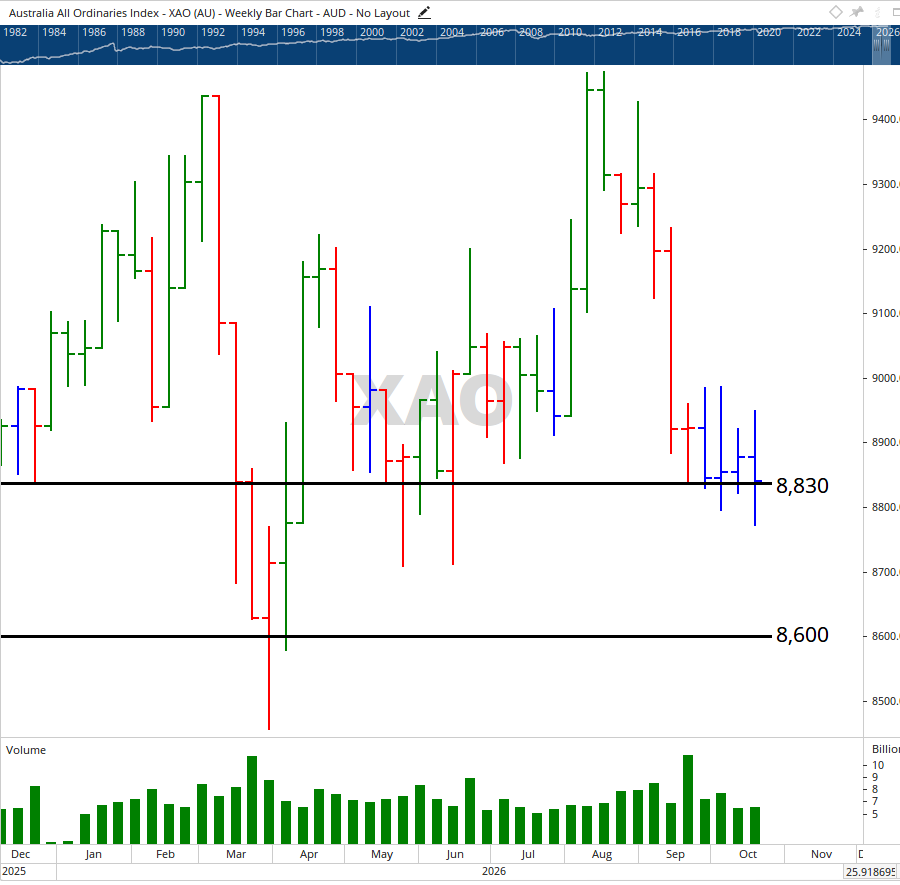
Buyers returned on the All-Ordinaries Index last week. After September’s aggressive selling, this rise feels more like a relief. The encouraging sign is that 8,830 continues to hold, although the recent price action suggests the market may be pausing rather than building a convincing recovery. If that support gives way, a move toward 8,600 remains possible.
For now, patience and preparation matter. With the market drifting sideways and conviction lacking, there is little reason to over-leverage or chase highly speculative trades. Stretched valuations among the big U.S. AI names and growing uncertainty around the sustainability of that spending boom are adding to investor caution. Locally, buyers also appear reluctant to commit without clearer signs that the market is finding its footing.
Despite the near-term risks, I still see longer-term opportunities in the Australian market. Corrections can create attractive buying opportunities, but there is no need to rush simply because prices have fallen. My focus is on identifying quality stocks, watching for stronger buying support and being ready to act when the evidence improves. Staying patient and selective now should leave investors better placed to take advantage of the next sustained move higher.
Good luck and good trading.
Dale Gillham is the Chief Analyst at Wealth Within and the international bestselling author of How to Beat the Managed Funds by 20%. He is also the author of the award-winning book Accelerate Your Wealth—It’s Your Money, Your Choice, which is available in all good bookshops and online.