Why buying and holding an ETF could be costing you money

By Dale Gillham
Reading Time: 7 minutes
General Advice Disclaimer
This article is for general educational purposes only and does not take into account your personal financial circumstances, objectives or needs. Before making any investment decisions, consider your individual circumstances and seek independent financial advice if necessary.
Imagine you bought an ETF for $100, put it away and didn't look at it again for 12 months. When you finally checked, it was still worth $100. You'd probably think the market had gone nowhere.

But what if I told you that during those 12 months, your ETF climbed to $125, then fell to $85 and eventually recovered to $100? Would you still think nothing had happened?
Now imagine another investor bought the same ETF for $100. Rather than simply holding on, they followed the trend as the price climbed to $125.
When the market turned, their trading rules told them to sell at $116.
That investor who sold made a 16 per cent profit before costs and tax, while you made nothing from the price movement.
We're excluding distributions from this example, but the point is that both investors bought the same ETF. The difference was that one had a plan for when to sell.
Of course, no trading rule will consistently get you out near the top. But having a plan can make a significant difference to your returns.
The Australian share market has been going nowhere
If you think this example is unrealistic, look at what's been happening in the Australian share market.
The All Ordinaries closed in October 2025 at 9,178 points. Fast forward to 5 November 2026, and it closed at 9,205.2 points. That's a slight rise of 0.3 per cent in just over a year.
But those two numbers don't tell the whole story.
Between February and March this year, the market fell around 8 per cent before climbing nearly 7 per cent between March and August, based on month-end closing prices.
So, while the market appeared to be going nowhere, it still saw significant price movements along the way.
And this isn't the first time we've seen this happen.
In March 2022, the All Ordinaries closed at 7,790 points before falling more than 13 per cent by the end of June. By March 2024, it had recovered to 8,154 points.
That's a gain of less than 5 per cent over two years, yet the market fell sharply and then rose almost 21 per cent from its June 2022 low.
Is buying and holding ETFs really the best strategy?
For years, investors have been told that the best way to invest in ETFs is to buy them, forget about them and let the market do the work.
But what happens when the market moves sideways for years?
Your money could be tied up in an investment that's making little progress, even though the market presents opportunities along the way.
I'm not suggesting you jump in and out of ETFs every time the market moves. That's not a strategy, and it can quickly cost you money.
What I mean is that understanding market trends and having clear rules for when to buy and sell can help you make better investment decisions.
Because it's not just what you invest in that matters. Knowing when to buy and sell can be just as important.
This is where learning to think like a trader can make a real difference.
Rather than simply buying an ETF and hoping it goes up, you can learn to recognise when the market is falling and when the trend is turning back up.
You don't need to pick the exact top or bottom to make money. And with inflation eating into the value of your money, can you really afford to ignore the opportunities the market is presenting?
So, if you're looking to develop a new skill in 2027, why not invest in your financial education?
Find a government-accredited trading course that teaches you how to read charts, identify when to buy and sell, and manage your risk.
Once you understand how to make these decisions, you'll realise ETFs aren't just investments you buy and forget. They can offer far more opportunities than you might think.
Best and worst sectors
Information Technology is the best-performing sector so far this week, rising 10.89 per cent, as falling US bond yields supported growth stocks, while NEXTDC’s sharp rebound gave the sector an extra boost.
Real Estate gained 4.78 per cent, as lower global bond yields helped support property valuations and renewed demand for listed property stocks.
Consumer Discretionary rounded out the top 3, up 4.44 per cent, as cheaper oil raised hopes of easing household cost pressures and helped retailers and other consumer stocks rally.
At the other end of the market, Energy is the worst sector so far this week. It fell 7.36 per cent as plunging oil prices weighed on producers. Hopes of Middle East diplomacy reduced the premium for supply risks.
Utilities was the second-worst sector, down 0.73 per cent, likely as investors rotated out of defensive shares and into growth sectors as confidence improved.
Financials rounded out the worst performers this week, falling 0.71 per cent, as concerns about slowing growth and household stress weighed on banks.
Best and worst stocks
NEXTDC Limited led the ASX Top 100 this week, climbing more than 67 per cent after Goodman and Digital Realty moved to acquire up to 9.9 per cent, sparking takeover speculation.
Block Inc followed, rising over 15 per cent after stronger-than-expected quarterly earnings and an upgrade to its full-year gross profit outlook.
Xero Ltd rounded out the leading performers, gaining over 14 per cent as it rode the broad technology rally. Falling US bond yields renewed investor appetite for growth stocks.
At the other end, AMP Ltd was the worst performer, falling more than 12 per cent as weaker profits at its Chinese pension investment raised earnings concerns, despite unchanged partnership guidance.
Eagers Automotive Limited followed, falling over 12 per cent after its trading update highlighted pressure on car retailing margins and tougher Australian consumer conditions.
Woodside Energy Group rounded out the worst performers, falling more than 8 per cent as plunging oil prices reduced expectations for revenue and earnings across energy producers.
All Ordinaries Index update
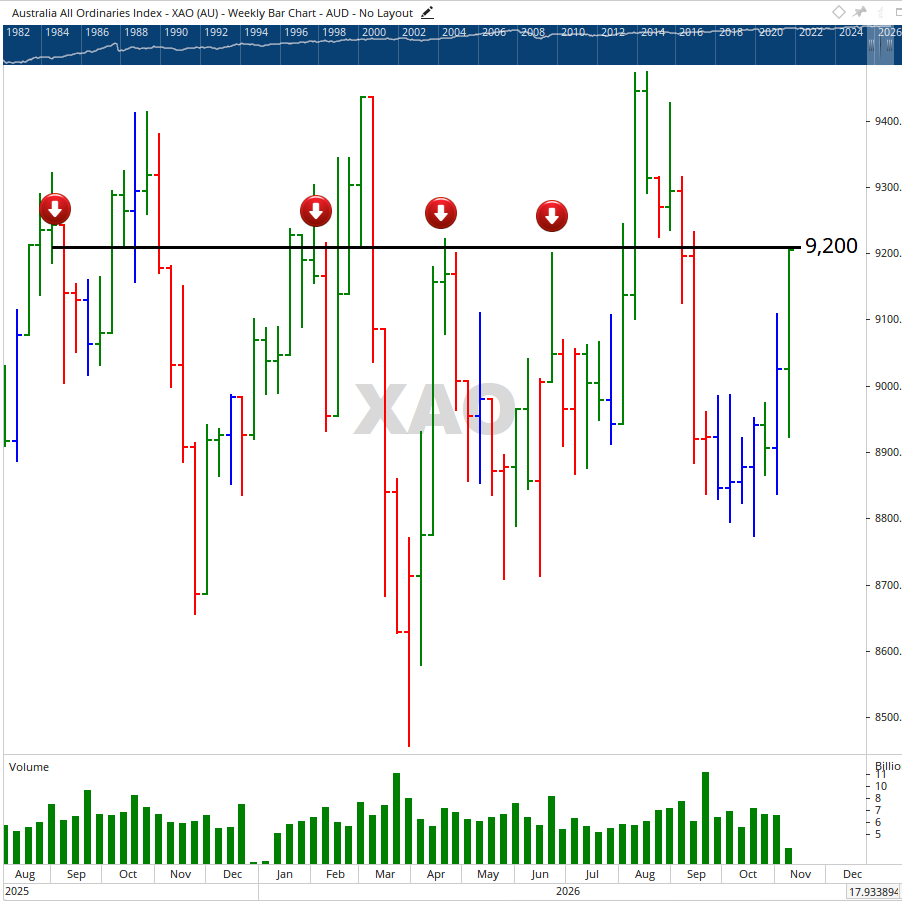
The All-Ordinaries Index roared back to life this week, gaining almost 2 per cent as at Thursday’s close to return to the all-important 9,200 level.
This level has been one of the sellers' strongest since August 2025 and stopped previous rallies in their tracks. This time, though, the market looks better placed to push through.
The latest pullback was shallower, and a clearer price pattern suggests the underlying trend is strengthening.
Opportunities are also emerging across the market, giving investors more reason to remain optimistic. With the US election result now known, another source of uncertainty has been removed.
Markets can respond positively to having a clearer picture of what lies ahead, even when investors don’t agree on the outcome.
Gold also rose alongside shares this week. While the two can move higher together, it will be interesting to see whether that strength continues and what it tells us about investor confidence.
Oil prices also plummeted after the election result, which gives us a clue about what investors believe a Democratic voice could do to the outcome of the war.
Looking ahead, the conditions are improving for a potential end-of-year rally, but buyers still need to clear 9,200.
Next week will give us a better indication of whether they have the conviction to push through or whether sellers will force another pullback.
For now, the price action is encouraging. I feel this market is getting tired of moving sideways and may finally be ready to get on with it.
Good luck and good trading.
Dale Gillham is the chief analyst at Wealth Within and the international bestselling author of How to Beat the Managed Funds by 20%. He is also the author of the award-winning book Accelerate Your Wealth—It’s Your Money, Your Choice, which is available in all good bookstores and online.