Australia's Best Companies Are Being Sold Off? Six Stocks to Watch
By Janine Cox, Fil Tortevski and Pedro Banales
Reading Time: 9 minutes
General Advice Disclaimer
You acknowledge that the information provided by Wealth Within is intended for general use only and does not take into account your investment objectives, financial situation or advisory needs, nor does the information provided constitute investment advice. For this reason, any individual should consider the appropriateness of the information, having regards to the individual's objectives, financial or taxation situation and needs before acting on this information, and, if necessary, seek appropriate professional advice. In addition, it is important to understand that the risk of investing in the stock market is that you could lose some or all of your money. For more information please refer to our Terms and Conditions.
Some of Australia's best-known companies have suffered extraordinary share price declines over the past year. Yet many remain profitable, financially sound businesses with established market positions.
So why are investors selling Australia's best companies?
And more importantly, could these falling share prices represent genuine investment opportunities, or are they warning signs of further trouble ahead?
In this week's Australian Stock Market Show, senior analysts Filip Tortevski and Janine Cox and analyst Pedro Banales examine several fundamentally sound ASX companies that are experiencing significant declines.
From established retailers to financial technology businesses and industrial manufacturers, the discussion reveals why identifying a good company is only part of successful investing. The real challenge is knowing when to buy, when to sell and when to stay out of the market altogether.
Why good companies can be poor investments
Investors often associate strong fundamentals with rising share prices. A profitable company with manageable debt and a proven business model should theoretically attract buyers.
However, share prices reflect expectations about the future, not simply a company's current financial position. A business can report strong profits yet experience a substantial sell-off if investors believe future earnings will disappoint.
Institutional investors may also withdraw capital from an entire sector, pushing down fundamentally sound companies alongside weaker businesses. This creates opportunities, but it also introduces considerable risk.
The important distinction is between a company experiencing temporary market weakness and one facing genuine deterioration in its business.
Combining fundamental analysis with technical analysis can help investors distinguish between the two. Fundamentals help assess the quality of a business, while technical analysis provides insight into price trends, market sentiment and potential turning points.
Let's examine the companies discussed in this week's show.
Lovisa Holdings (ASX: LOV): Has the sell-off gone too far?
Jewellery retailer Lovisa has experienced a significant share price decline despite continuing its international expansion.
While new stores support revenue growth, weaker comparable-store sales and the costs associated with expansion have raised concerns about future profitability. The departure of long-serving chief financial officer Chris Lauder has also introduced uncertainty.
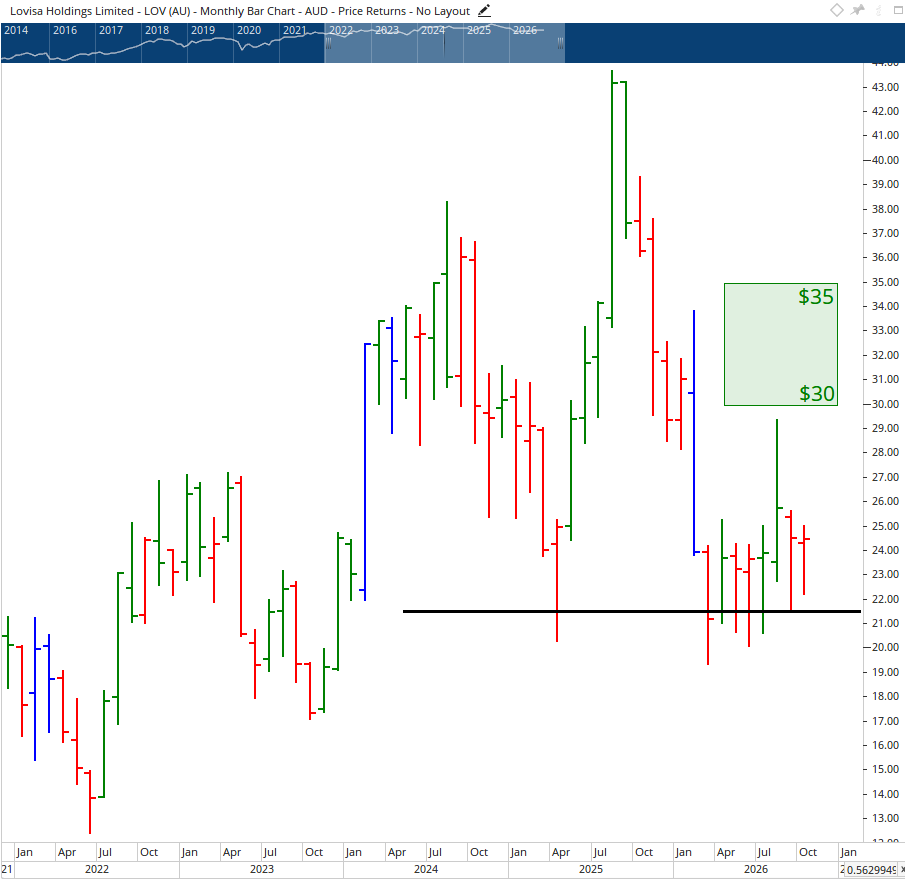
However, Lovisa's share price history demonstrates how dramatically investor sentiment can change. During the COVID-19 market collapse, its shares fell approximately 83% before recovering strongly. The current technical picture is less decisive.
Lovisa is trading near an important support area, with the possibility of a recovery towards $30 to $35 if buying momentum strengthens. However, a breakdown below recent support could expose the shares to further declines. The lesson is that even a business with a strong historical performance can experience prolonged weakness.
Investors need evidence that the selling pressure is easing rather than assuming a substantial decline automatically creates value.
HUB24 (ASX: HUB): When strong profits aren't enough
HUB24 provides one of the clearest examples of the difference between business performance and share price performance.
Despite reporting impressive earnings growth, its shares have experienced a substantial correction. The problem may be valuation rather than deteriorating business fundamentals.
High-growth companies often attract premium valuations because investors expect exceptional future performance. When expectations change, those premiums can disappear rapidly.
HUB24's financial results show strong underlying operations, with its FY26 reporting available through the company's investor announcements.
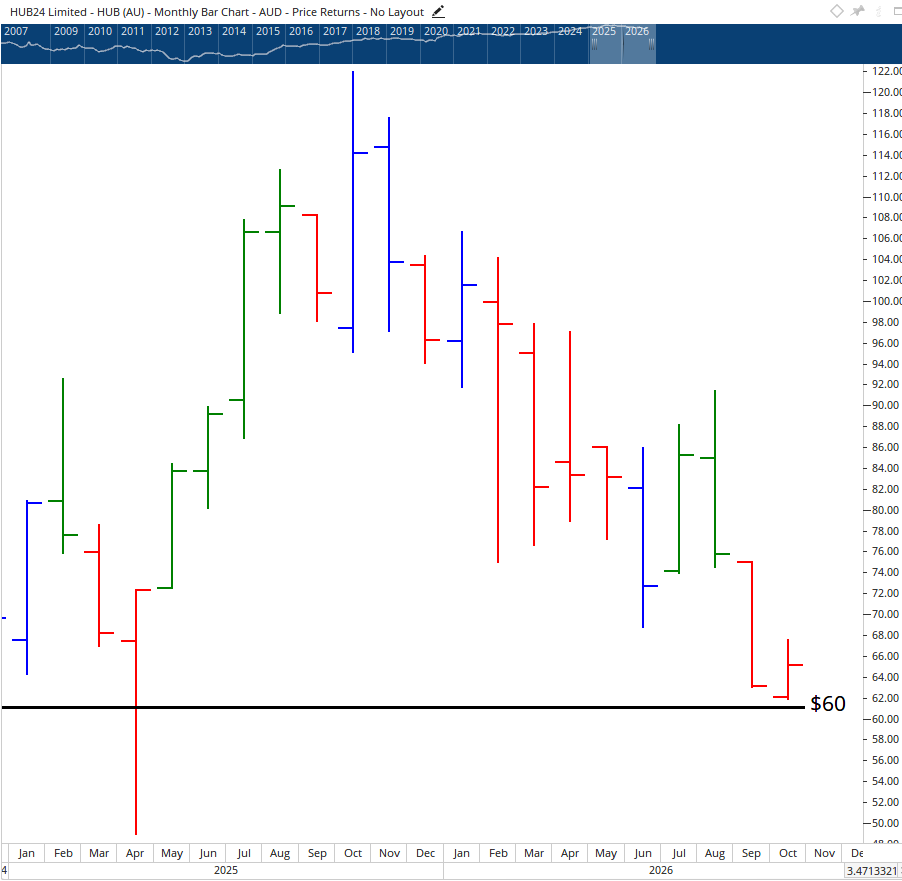
From a technical perspective, the shares have approached an important historical support area around $60. The monthly chart suggests a possible recovery, but the weekly chart presents a more cautious picture.
Bearish price patterns and increased selling volume indicate that further downside remains possible. This illustrates why strong earnings growth alone cannot determine whether a share price has reached its bottom.
ARB Corporation (ASX: ARB): A quality business facing a cyclical slowdown
ARB Corporation has experienced one of the more dramatic declines among established Australian businesses.
Its FY26 net profit reportedly fell about 5.2%, while its share price declined around 55%. The company's original equipment manufacturing revenue also weakened substantially.
These results raise questions about vehicle demand, consumer spending and the broader economic cycle. However, ARB's financial position remains an important consideration.
A business with substantial cash reserves and limited debt may be better positioned to withstand difficult trading conditions than a highly leveraged competitor.
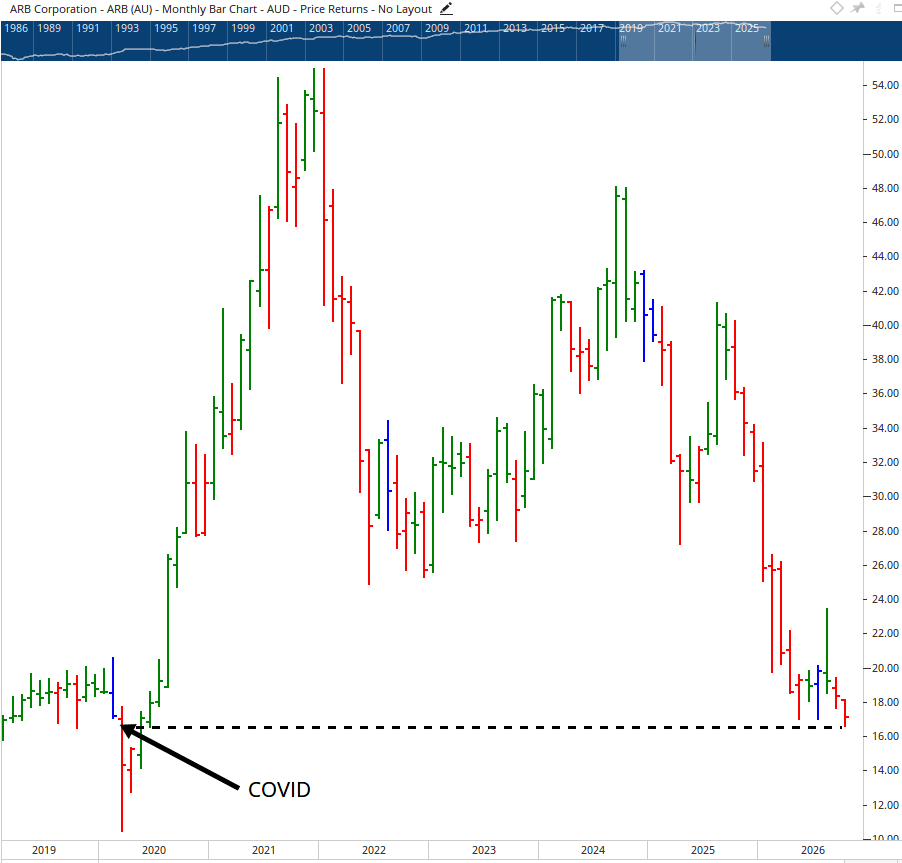
The technical picture is particularly interesting because the share price has returned towards levels last seen around the COVID-19 period. For investors who purchased near the 2021 highs, the experience demonstrates the risks of buying a quality company without considering valuation and market timing.
A strong business does not guarantee a strong investment return.
Adairs (ASX: ADH): Can its stronger businesses offset furniture weakness?
Adairs presents a different challenge.
While parts of the business have performed well, its Furniture division has deteriorated significantly. The division's earnings fell 67.6%, with sales falling further during the opening weeks of FY27. This is more than a simple valuation adjustment. It represents genuine operational weakness that management must address.
However, the broader group has benefited from stronger performance in other divisions, particularly Mocka.
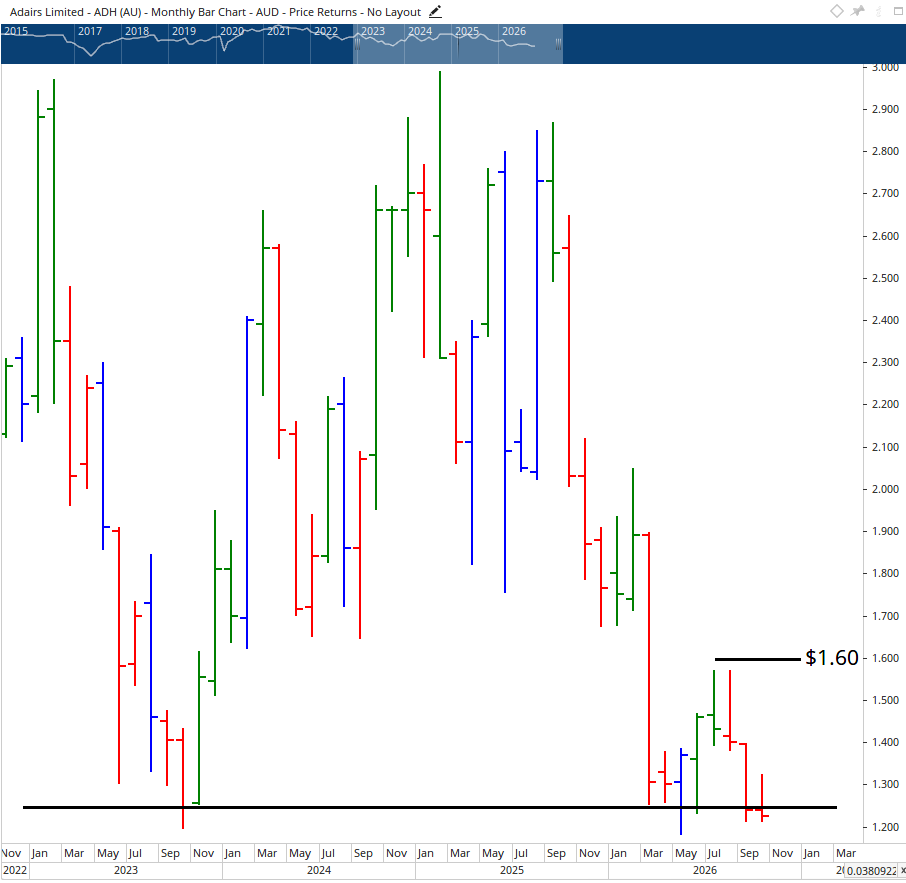
Technically, Adairs is approaching an important historical support area. The shares have spent much of their listed history trading within a broad range, creating opportunities for investors who understand how to identify changes in price direction.
A sustained move above approximately $1.60 is worth monitoring. However, the share price must demonstrate that buyers are returning before a recovery can be considered established.
Beacon Lighting (ASX: BLX): Early signs of recovery?
Beacon Lighting has also suffered a substantial share price decline, as weak household spending and pressure on the renovation market affected investor confidence.
Higher operating costs and concerns about future profitability have contributed to the weakness. However, the company's comparable-store sales improved by 7.1% during the final quarter. That improvement is encouraging, particularly as the business approaches an important retail trading period.
Nevertheless, one strong quarter does not establish a sustainable recovery. Margins remain an important consideration, especially where growth comes from business segments with different profitability characteristics.
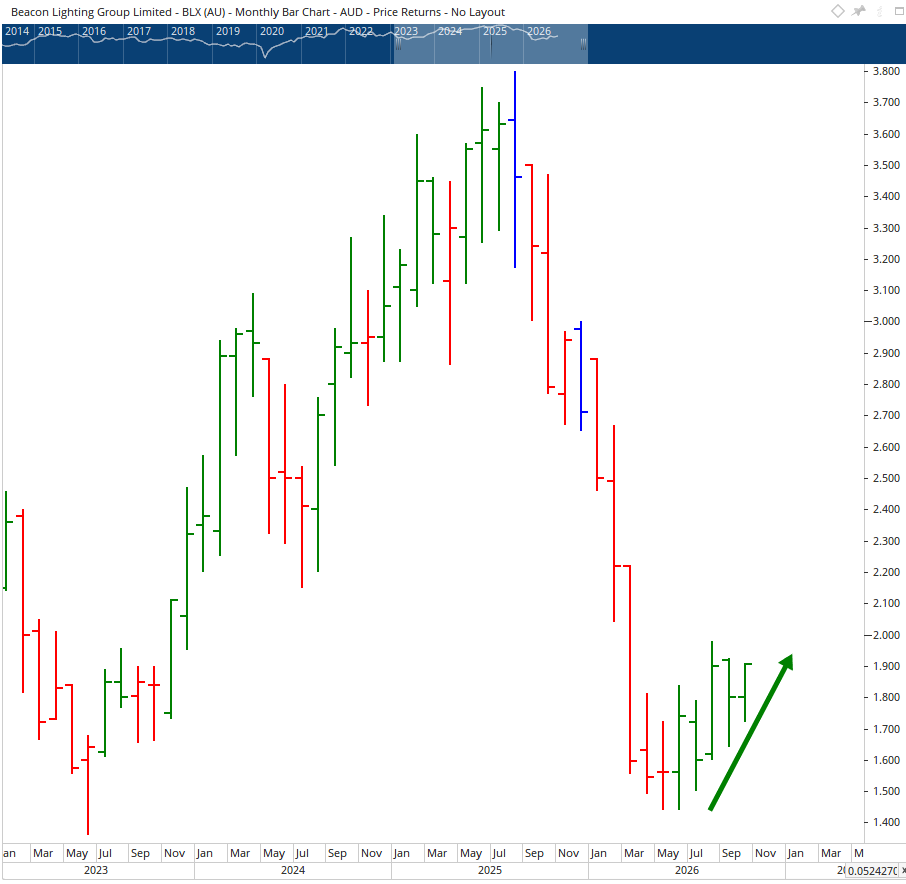
Technically, Beacon Lighting has begun to improve from its May 2026 lows. A more established upward trend would strengthen the recovery case, while renewed selling pressure could indicate that the turnaround remains incomplete.
Bisalloy Steel (ASX: BIS): Will defence spending drive a recovery?
Bisalloy Steel operates in a sector attracting considerable attention as governments increase defence expenditure.
Its specialised steel products are used in applications including military vehicles and protective armour. However, increased global defence spending does not automatically translate into higher revenue or profits for Bisalloy.
The company faces competition, operating cost pressures and exposure to broader industrial markets. Its recent earnings deterioration demonstrates these challenges.
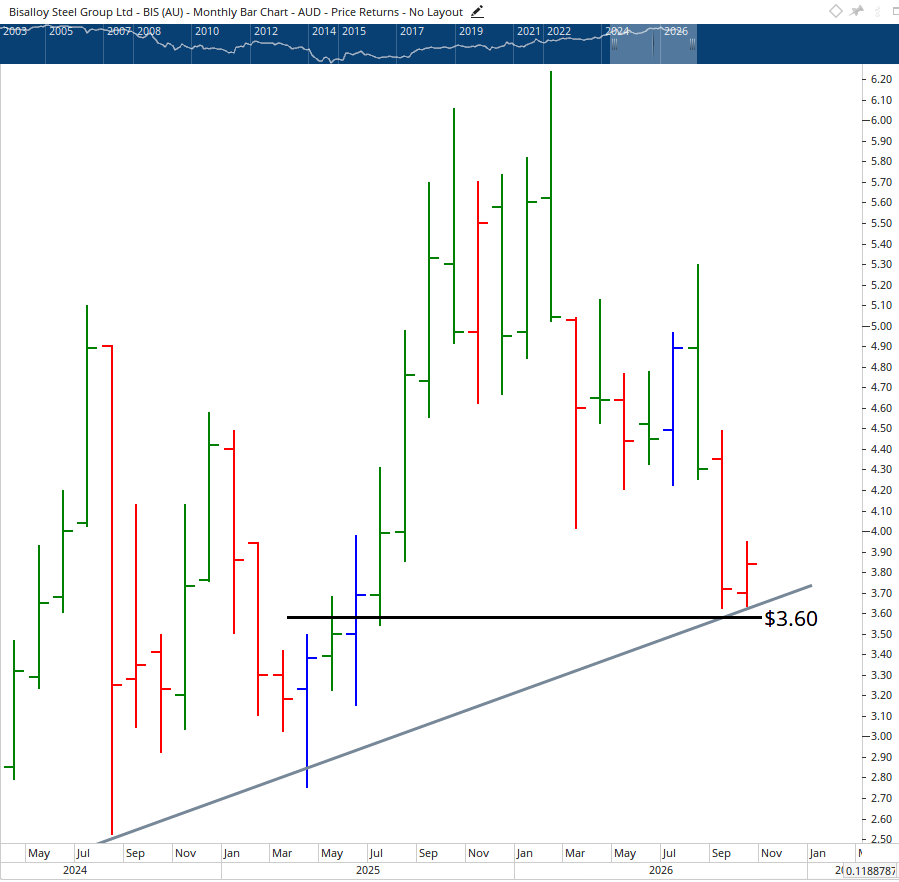
From a technical perspective, the shares are approaching an important area of historical support. A sustained recovery above approximately $4 would be encouraging, while weakness below $3.60 could increase the risk of further declines.
The analysis also identified potential resistance between $5.20 and $6. These levels illustrate how technical analysis can help investors develop a structured plan rather than relying solely on expectations about future industry growth.
Trending topic: Could Tether's security risks affect cryptocurrency markets?
This week, we examined concerns about Tether, the issuer of USDT, one of the world's largest stablecoins.
Security researchers have raised questions about the control mechanisms governing substantial amounts of USDT operating on the Tron blockchain. The concern relates to the concentration of authority within the system rather than a confirmed security breach. That distinction is important.
A potential vulnerability does not mean funds have been stolen or that a cryptocurrency collapse is inevitable. However, stablecoins play a significant role in cryptocurrency trading, providing liquidity and facilitating transactions between digital assets. A serious loss of confidence in a major stablecoin could therefore affect the broader cryptocurrency market.
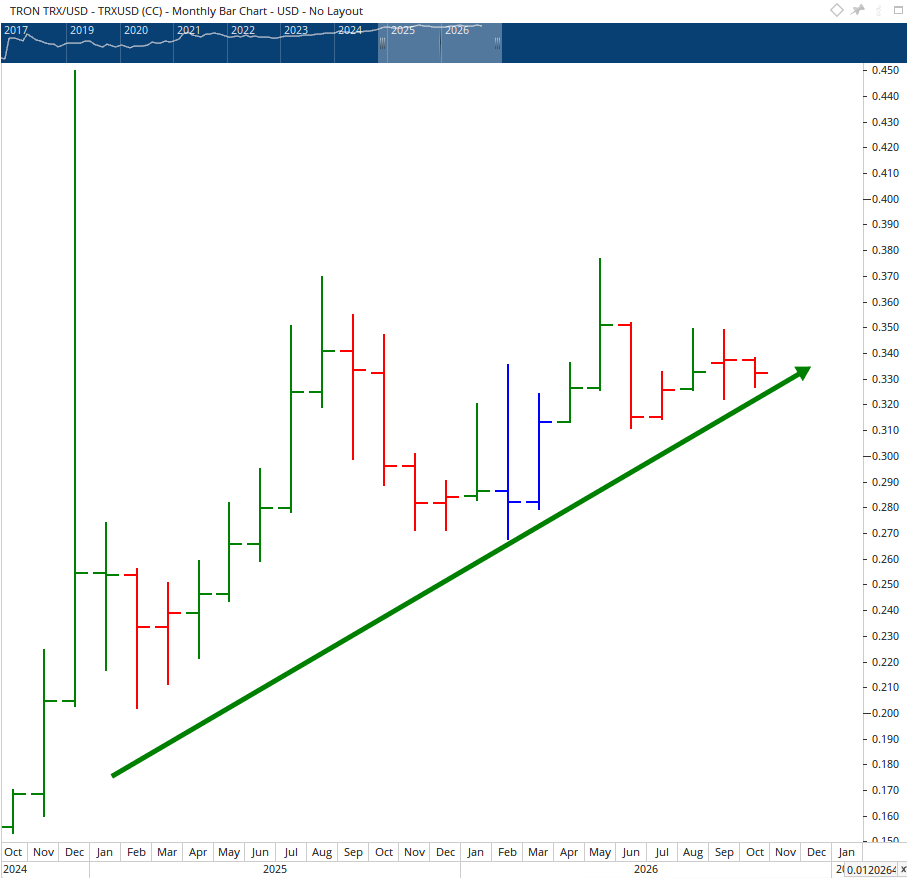
The analysts examined Tron (TRX) to assess whether its price behaviour reflected growing concern. Despite the headlines, the chart showed a relatively stable trading pattern.
The cryptocurrency had been consolidating, with identifiable support and resistance levels. A break below the June 2026 low would raise concerns, while a sustained move above recent highs could indicate renewed strength. The broader lessons apply equally to shares and cryptocurrencies.
Investors should distinguish between alarming headlines and what price behaviour actually confirms.
Hot Stock Tip: Delorean Corporation (ASX: DEL)
This week's Hot Stock Tip featured Delorean Corporation, an Australian renewable energy business developing bioenergy infrastructure. The company converts organic waste into renewable energy and provides expertise in developing bioenergy facilities.
We examined the proposed $20 million financing arrangement associated with its NSW1 project. The project aims to process approximately 120,000 tonnes of organic waste annually, producing renewable gas for industrial applications. However, financing arrangements and project milestones remain important risks that investors must consider.
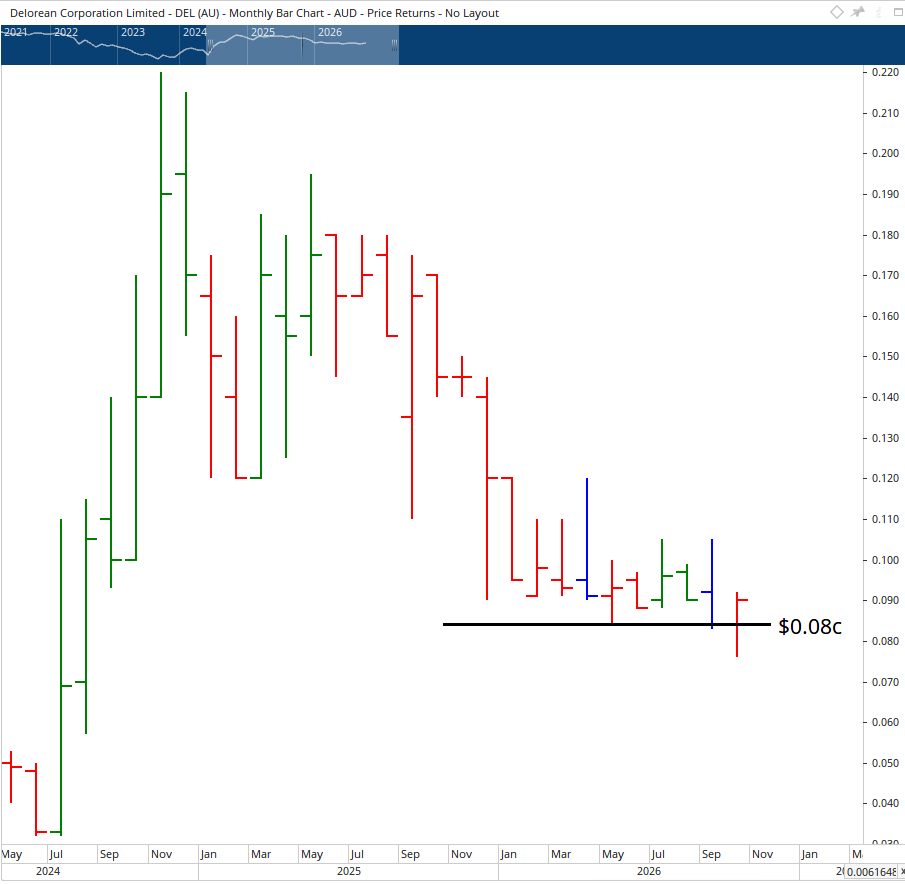
The share price has fallen substantially since the company's 2021 listing. Recent trading activity has nevertheless attracted attention, with the analysts identifying support around eight cents and signs of improving market interest. But the stock remains speculative.
While a developing technical pattern may eventually present an opportunity, investors need further confirmation before concluding that a sustainable recovery has begun.
What investors can learn from these falling ASX shares
The companies examined demonstrate an important principle: a good company is not necessarily a good investment at every price.
Some businesses experience temporary weakness because investors have become overly pessimistic. Others face genuine financial or operational challenges that may take years to resolve.
Successful investing requires more than identifying businesses with attractive fundamentals. Investors also need to understand market trends, establish clear entry and exit rules, manage position sizes and protect capital when markets move against them.
Buying simply because a share price has fallen substantially can expose investors to unnecessary risk. Equally, avoiding every company experiencing weakness may mean overlooking opportunities as market conditions improve. The difference comes down to having a disciplined, repeatable approach.
Building the skills to invest with confidence
Understanding why share prices rise and fall is one of the foundations of becoming a more knowledgeable investor.
Wealth Within's nationally recognised Diploma of Share Trading and Investment (11398NAT) teaches investors how to combine market analysis, trading strategies, risk management and investment psychology.
If you're just starting out, you may purchase Dale Gillham's bestselling book 'How to Beat the Managed Funds by 20%'. You can get the book for free; just pay shipping.
Rather than relying on predictions or market commentary, students learn to develop their own rules for identifying opportunities and managing investments.
Final thoughts
The significant declines experienced by Lovisa, HUB24, ARB, Adairs, Beacon Lighting and Bisalloy demonstrate that even established businesses are vulnerable to changing market expectations.
Some may eventually deliver strong recoveries. Others may continue falling.
The challenge is not predicting which company will recover first. It is recognising when the evidence supports taking action and having the discipline to wait when it doesn't.
As this week's Australian Stock Market Show demonstrates, understanding both the business and the share price provides a more complete picture of the opportunities and risks facing investors.
This article provides general information and education only. It does not constitute personal financial advice.