I Asked AI to Teach Me to Trade: The Answer is Shocking

By Fil Tortevski and Pedro Banales
Reading Time: 7 minutes
Everyone seems to be turning to artificial intelligence (AI) for answers these days, including people wanting to learn how to trade the stock market. But can AI teach you to trade, or could following its advice cost you far more than a proper education?
We decided to put it to the test by asking AI a straightforward question: “I am new to trading. I don't want to work anymore. I want to trade for a living. Tell me practically, including a strategy, how I can do this.”
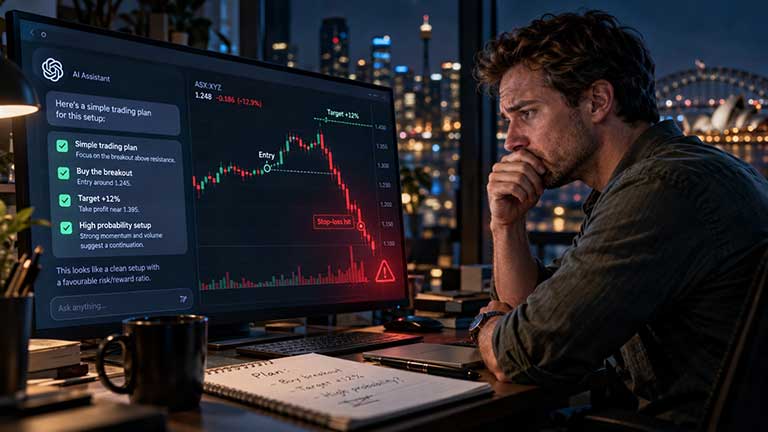
What came back was interesting. Some of the advice was sensible, particularly around risk and managing expectations. But when we examined the trading strategy itself, we found some serious problems.
And that's where things got concerning, because a beginner could easily mistake a well-written explanation for a strategy that actually works.
AI gets off to a surprisingly good start
The first thing AI told us was not to quit our jobs. Instead, it suggested proving we could trade profitably while still earning an income. We both agreed that was sensible advice.
It also referenced ASIC's findings on CFD trading losses, which showed Australian retail clients lost more than $458 million during the 2024 financial year, including $73 million in fees.
AI recommended avoiding leveraged products while learning and beginning with liquid shares, such as the ASX top 50 by market capitalisation, or exchange-traded funds (ETFs).
Again, reasonable advice. But knowing that trading involves risk is very different from knowing how to manage it.
AI then introduced the concept of trading expectancy, explaining how a strategy could be profitable even if fewer than half its trades were winners.
The mathematics made sense. The problem was that someone completely new to trading wouldn't necessarily understand how to achieve those results.
As Fil pointed out, being told your average winner should be twice your average loser doesn't explain how to identify where a share is likely to rise or fall.
Pedro agreed. AI provided plenty of information that sounded correct, but very little practical instruction on how to use it.
The trading strategy that raised serious concerns
Things became interesting when AI finally provided a strategy.
It recommended trading daily charts and looking for shares where the price was above the 200-day moving average, with the 50-day moving average also above the 200-day average.
It then suggested waiting for a pullback toward the 20-day moving average, followed by a close above the previous day's high.
The stop loss would sit below the recent swing low, with a profit target of twice the initial risk.
On paper, that sounds straightforward. In practice, Fil identified several problems.
Moving averages can show a trend's general direction, but they don't explain the structure of the price movement. They don't show how far a stock has already risen, why it's pulling back, or whether its trend is approaching exhaustion.
And they certainly don't establish where the next significant support or resistance level might be.
What concerned Fil most was that AI was effectively telling a beginner to buy after a single closing-price signal without establishing the broader market context.
Pedro raised another important issue: different markets and stocks behave differently.
A commodity such as gold doesn't necessarily behave like a property trust or a consumer discretionary stock. Yet AI applied the same moving-average rules without explaining whether they fit the instrument being traded.
That's a significant omission.
What happens when the market stops trending?
There's another problem with AI's strategy. It relies heavily on the market continuing to trend higher.
But markets don't move upwards in neat, predictable lines.
They experience corrections, consolidation periods and prolonged declines. A strategy that performs well during a strong bull market can struggle badly when conditions change.
Fil recalled speaking with a trader who had followed a similar approach for several years without understanding how severely markets and individual stocks could correct.
He was concerned that a beginner might repeatedly enter trades in sideways conditions without recognising that the market no longer suited the strategy.
You need to understand the market's structure before deciding which techniques to apply.
This is why we place such importance on learning how to trade stocks and understanding how price analysis, trading techniques and risk management work together.
A trader needs the tools to evaluate the market in front of them, rather than simply applying the same indicator settings to everything.
Why trading risk management needs more than a percentage
AI's next recommendation involved position sizing.
For a beginner with a $20,000 account, it suggested risking just 0.25 per cent on each trade, equivalent to $50.
Keeping risk small while learning certainly has merit. But Fil questioned what happens when a trader begins increasing position sizes after experiencing a few profitable months.
What if those profits came from favourable market conditions rather than a reliable trading strategy?
The trader could develop false confidence, increase their exposure and suffer substantial losses when the market changes.
Effective trading education needs to teach people how to assess the quality of a trading opportunity, the potential target, the appropriate stop loss and the probability of success.
Fil also questioned AI's fixed two-to-one reward-to-risk target. Why automatically exit at twice the initial risk if a share has the potential to travel considerably further?
Without the ability to analyse price movements and determine potential price targets, a trader could continually cut profitable trades short while allowing losing positions to run.
And as Pedro observed, that combination can become extremely damaging.
Backtesting is useful, but what exactly are you testing?
AI suggested finding 100 historical trades that matched its rules, followed by 50 paper trades recorded in a journal.
We liked the idea of testing before risking money, particularly the suggestion to take screenshots of charts at the time of each trade. Pedro explained that he keeps these in his trading plan so he can revisit his decisions and recognise details he may have missed.
But Fil questioned whether 100 examples would be meaningful if they all came from the same strong market. A strategy needs to be examined across different conditions, not simply the period when it happens to work.
AI also proposed a one-page trading plan, without adequately explaining phrases such as a “predetermined reversal condition”. A beginner might copy those words without knowing how to recognise one.
Can AI replace experienced trading education?
To its credit, AI was realistic about the capital needed to replace employment income. It noted that earning $80,000 from a $20,000 trading account would require a 400 per cent annual return before tax and expenses. It recommended learning, testing and building evidence before considering leaving work.
But the practical teaching never really arrived.
Pedro's view is that AI can help with research and explaining terminology. What it cannot provide is lived trading experience. It can describe a candlestick or moving average, but that doesn't mean a beginner knows how to combine those tools or respond when a trade goes wrong.
Fil believes the missing piece is particularly obvious in trading psychology. Fear, impatience, and overconfidence aren't solved by handing someone a list of rules. An experienced mentor can recognise those behaviours because they have encountered them in real markets.
We are not arguing that AI has no place in trading. We are questioning whether an appealing answer should be mistaken for practical competence.
Learning to trade means understanding why a strategy is appropriate, how to test it, when not to use it, and how to adjust as conditions change, as taught in the Short Course in Share Trading. That's the difference between gathering information and developing the skills and knowledge to make informed trading decisions.
As Fil put it, you wouldn't build a house on poor foundations. Your trading deserves the same care.