Sports Card Mania: Are Traders Chasing Tulips Again?

By Fil Tortevski and Pedro Banales
Reading Time: 11 minutes
Imagine paying nearly $13 million for a piece of cardboard.
It sounds ridiculous, but in August 2025, a trading card featuring basketball legends Michael Jordan and Kobe Bryant sold for an astonishing $12.93 million, setting a record for the most expensive sports card ever sold. Meanwhile, people spend hundreds, sometimes thousands, of dollars opening trading card packs, hoping to uncover the next valuable collectible.
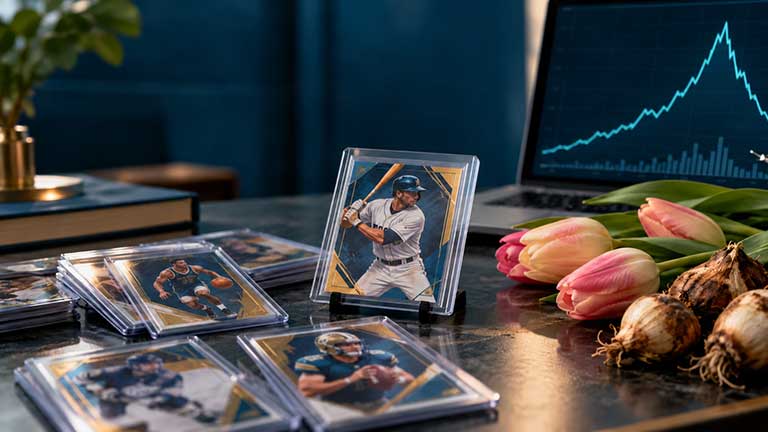
Sports card investing has become a fascinating market, but is it also becoming a dangerous speculative bubble?
According to Filip Tortevski and Pedro Banales, the extraordinary prices and excitement surrounding sports cards are beginning to resemble something that happened nearly 400 years ago: the Dutch tulip mania.
History doesn't always repeat itself, but it certainly rhymes. So, are sports cards the modern equivalent of tulips? Is there genuine investment value beneath the hype, or are people simply gambling on finding someone willing to pay more?
And for younger people trying to build wealth, could investing in trading cards mean missing out on far greater opportunities in the share market?
Why are sports cards selling for millions?
Unlike shares, sports cards don't generate earnings, pay dividends or produce cash flow. Their value largely depends on several factors, including the athlete featured, rarity, condition, grading, autographs and historical significance.
According to Sotheby's guide to trading card values, even small differences in a card's condition can dramatically affect its price. For example, a Wayne Gretzky rookie card graded 10 sold for $3.75 million, while the same card graded 9 sold for just $115,000.
Consider Michael Jordan, Kobe Bryant or baseball legend Mickey Mantle. These athletes achieved extraordinary sporting success and established reputations that have lasted across generations.
But what about today's rookie cards selling for enormous amounts before the athletes have achieved anything significant? Fil believes this is where speculation becomes dangerous.
When someone spends thousands buying a rookie card, they're effectively betting that the athlete will become one of the greatest players of all time.
What happens if that player suffers a career-ending injury, never reaches their potential or simply disappears from the spotlight?
It's like trying to spot a small company that will eventually become the world's biggest business. The potential reward might be enormous, but the probability of getting it right is another matter entirely.
Are sports cards repeating the Dutch tulip mania?
Between 1634 and 1637, the Netherlands experienced one of history's most famous speculative bubbles.
People began trading tulip bulbs at extraordinary prices, driven by expectations that someone else would pay even more. Eventually, prices collapsed in parts of the market.
Nearly four centuries later, the same questions remain relevant. Why do people willingly pay extraordinary prices for something? When does genuine demand turn into speculation? And how much of an asset's value depends on finding another buyer?
We've witnessed similar behaviour with meme stocks, cryptocurrencies, altcoins and non-fungible tokens (NFTs).
Fil points to the greater fool theory, which describes purchasing an asset at an inflated price because you expect someone else to pay more.
Imagine buying a sports card for $10,000, hoping to sell it for $15,000. The next buyer purchases it expecting $20,000. Prices can keep rising as buyers stay enthusiastic. But what happens when those buyers disappear?
There's an important distinction here. Someone purchasing a rare card because they genuinely appreciate it might happily keep it indefinitely.
The concern is with people purchasing cards purely because they expect to make money.
Is the scarcity of modern sports cards an illusion?
Scarcity is one of the biggest drivers of sports card values, but modern trading card manufacturers introduced an interesting complication.
A manufacturer might release an athlete's card limited to 99 copies, 50 copies, 10 copies or even a single one-of-one edition. Each version is technically rare. However, manufacturers can continue releasing different versions of that same athlete across multiple collections.
This raises an important question: If companies can continually manufacture new rare cards, how scarce is the overall investment opportunity? Fil compares this with share dilution.
When a company issues additional shares, existing shareholders need to consider how increasing the number of shares outstanding affects their ownership.
A new trading card release doesn't dilute an existing card's ownership, but it can compete for the same collectors' money.
If another desirable one-of-one card appears next year, will collectors still pay a premium for the previous version?
And what happens when the next generation loses interest in today's sporting heroes?
Pokémon cards demonstrate how interest in collectibles can return after years of reduced attention. Yet countless other collectibles have faded into obscurity.
For anyone treating sports cards as an investment, manufactured scarcity deserves serious consideration.
The mathematics of chasing the jackpot
Opening trading card packs can be exciting, especially when you might find something worth thousands of dollars. But the important question isn't how much the most valuable card could sell for. It's the probability of finding one.
Fil uses a hypothetical $500 sports card box to demonstrate how the odds of finding a valuable card can affect the potential return.
Drawing on his observations of the sports card market, Fil uses four hypothetical outcomes to illustrate the financial risk of chasing rare cards.
The example assumes that a $500 box could contain anything from common cards worth very little to an exceptionally rare card worth $10,000.
The figures are illustrative, not published odds for a particular product, but they show how the probability of finding a valuable card affects potential return.
How much could you really lose opening sports card packs?
Here's how those hypothetical outcomes compare.
| Cards | Probability | Resale value |
|---|---|---|
| Common cards | 75% | $30 |
| Decent cards | 20% | $150 |
| Rare hit | 4.9% | $1,000 |
| Monster hit | 0.1% | $10,000 |
To understand what these figures mean financially, we need to calculate the expected resale value. This means multiplying each outcome's probability by its potential resale value and adding the results.
- Common cards: 75% × $30 = $22.50
- Decent cards: 20% × $150 = $30.00
- Rare hit: 4.9% × $1,000 = $49.00
- Monster hit: 0.1% × $10,000 = $10.00
When we add these together, the expected resale value is $111.50 from a $500 purchase. That represents an expected loss of $388.50, or about 77.7% of the original purchase price.
This doesn't mean every buyer will lose that amount. Some might recover most of their money, while a fortunate few could make substantial profits. However, if these hypothetical probabilities accurately represented the market, the average financial outcome across many purchases would be a significant loss.
And that's before considering any additional costs involved in selling the cards.
Fil's concern is that people focus on the possibility of finding a $10,000 card without considering how unlikely that outcome is.
In this example, a 0.1 per cent probability represents just one chance in 1,000. Even buying hundreds of boxes wouldn't guarantee you'd find that valuable card.
The math matters most when someone repeatedly spends money opening packs, hoping the next purchase will deliver the big prize.
The question isn't whether it's possible to make money from sports cards. It's whether the odds of that return justify the money at risk.
What happens when sports card prices collapse?
Sports card prices don't always rise, even when the underlying collectibles remain desirable.
According to Card Ladder data discussed by Sports Collectors Daily, modern and ultra-modern sports card indices fell by more than 30 per cent during 2022.
Vintage cards performed relatively better, declining approximately 5 per cent.
The market didn't disappear, but substantial losses demonstrated how quickly prices can change when speculative demand weakens.
Fil raises another important consideration: an athlete's relevance can fade. A basketball player might be extremely popular during their career but largely forgotten by younger collectors decades later.
That creates a significant difference between sports cards and shares. A company experiencing difficult times can potentially restructure, introduce new products, improve management and return to profitability.
Why struggling companies can recover while sports cards may not
Treasury Wine Estates is a good example. The company has experienced difficulties and fallen out of favour with investors, but it remains an operating business with established wine brands, products and customers.
As Fil explains, a company in this position has opportunities to turn its fortunes around. New management could restructure the business, reduce costs, improve underperforming operations or introduce new products to strengthen its financial performance.
If those changes succeed, investor confidence could return, potentially driving the share price higher.
That's what makes the comparison with sports cards interesting. A company can change its direction and create new opportunities for growth. A retired athlete, however, cannot simply return to their sporting career and achieve another decade of success.
Once their achievements are complete, the future value of their trading cards largely depends on collectors continuing to appreciate those achievements.
Sports card investing versus the share market
Consider two 20-year-olds, each with $500 available every month.
The first spends that money opening sports card packs, hoping to uncover something worth $10,000 or even $100,000.
The second invests the same $500 each month into a diversified portfolio of shares.
Assuming the share portfolio earns an average annual return of 8 per cent, with dividends reinvested and returns compounded monthly, the difference after ten years becomes significant.
Here's how the numbers work:
- Monthly investment: $500
- Annual investment: $6,000
- Investment period: 10 years
- Total contributions: $60,000
- Assumed annual return: 8%
- Compounding frequency: Monthly
At the end of the first year, the investor has contributed $6,000, which has already started generating returns. In the following year, those contributions and accumulated returns continue growing while another $6,000 is invested.
As the portfolio grows, the investor reinvests returns, earning returns on both the original capital and previous growth.
After ten years, assuming a consistent 8 per cent annual return, the portfolio could grow to approximately $91,500 excluding fees and taxes.
Of that amount, $60,000 represents the investor's contributions, while approximately $31,500 comes from accumulated investment returns.
That's more than 50 per cent growth on the money contributed, without needing to uncover a rare sports card or predict which athlete might become the next Michael Jordan.
Of course, share market returns fluctuate, and the 8 per cent assumption is illustrative rather than guaranteed. This example also excludes fees and taxes.
The hidden cost of chasing sports card profits
Unlike shares traded on an exchange, sports cards depend on finding collectors willing to pay the asking price.
A collector might own cards with seemingly impressive valuations, but those values mean little if no buyers are willing to pay them.
This is where the opportunity cost becomes significant. While someone keeps spending money chasing rare collectibles, they may miss the chance to build a portfolio and benefit from long-term capital growth and compounding.
For anyone wanting to understand how the share market works, our guide on how to trade stocks explains the importance of building trading knowledge and using a structured approach.
The power of compounding over 40 years
The longer-term comparison becomes even more interesting when compounding enters the picture.
Imagine investing $500 every month and achieving the same hypothetical 8 per cent annual return, with earnings reinvested.
Someone starting at age 20 could accumulate approximately $1.75 million by age 60. Someone starting at age 30 could accumulate approximately $745,000 by the same age.
| Investment details | Start investing at 20 | Start investing at 30 |
|---|---|---|
| Monthly investment | $500 | $500 |
| Years invested | 40 | 30 |
| Total contributions | $240,000 | $180,000 |
| Assumed annual return | 8% | 8% |
| Portfolio value at 60 | ~$1.75 million | ~$745,000 |
Returns are hypothetical and exclude fees and taxes.
That's roughly a $1 million difference, simply because one person started ten years earlier.
According to Fil, younger people often want financial results immediately. Waiting decades to build wealth can seem unappealing, especially when housing costs keep challenging younger generations. But those extra years can make a huge difference.
Compounding starts slowly because the initial capital is relatively small. As the portfolio grows, reinvested returns build on a larger capital base to generate further growth. You can explore this principle further in our article on the laws of wealth creation.
Learning to trade can also help individuals develop the knowledge and strategies to manage their capital, rather than relying on luck or the latest market craze.
Are you investing or simply chasing hype?
There's nothing wrong with collecting sports cards because you love the sport, admire the athletes or enjoy the nostalgia.
But collecting for enjoyment is very different from using trading cards as a wealth-building strategy.
History has repeatedly shown that speculative markets can rise dramatically, then fall just as sharply. Tulips, NFTs, cryptocurrencies and sports cards might appear different, but the behaviour driving speculation can be remarkably similar.
Before spending thousands chasing the next rare card, consider what you're purchasing, why someone might pay more for it and whether that demand will exist ten or twenty years from now.
As Fil suggests, the real question isn't whether someone can make money trading sports cards. Clearly, some people can.
The real question is whether the odds of making money justify the risk, especially when that same capital could build wealth in the share market.
At Wealth Within, we believe sound trading knowledge, proven strategies, and disciplined risk management provide a more structured foundation for approaching financial markets.
If you're interested in building those skills, explore our trading courses and discover how education can help you make better-informed trading decisions. Alternatively, purchase Dale Gillham's bestselling book 'How to Beat the Managed Funds by 20%'; get the book free, just pay shipping.