What is short selling and how does it work?

By Dale Gillham
Reading Time: 12 minutes
General Advice Disclaimer
This article is for general educational purposes only and does not take into account your personal financial circumstances, objectives or needs. Before making any investment decisions, consider your individual circumstances and seek independent financial advice if necessary.
Most people enter the share market looking to make money when share prices rise. But did you know that traders can also profit when prices fall? This is called short selling.

While it can create opportunities to profit in a falling market, it can also lead to substantial losses if you don't understand the risks.
One of the biggest mistakes inexperienced traders make is assuming that because a stock has risen substantially, it must be ready to fall.
Others see a stock declining and jump into a short position without considering how much further it could fall or whether it is about to reverse.
So how does short selling work, how do you identify an opportunity, and what do you need to understand before placing a trade?
What is short selling?
Short selling, commonly referred to as shorting, is a trading strategy designed to profit from a fall in the price of a stock, market index, currency or commodity.
When you trade long, you buy shares expecting their price to rise so you can sell them later at a profit.
Short selling works in reverse. You sell first, expecting the price to fall, and then buy back at a lower price.
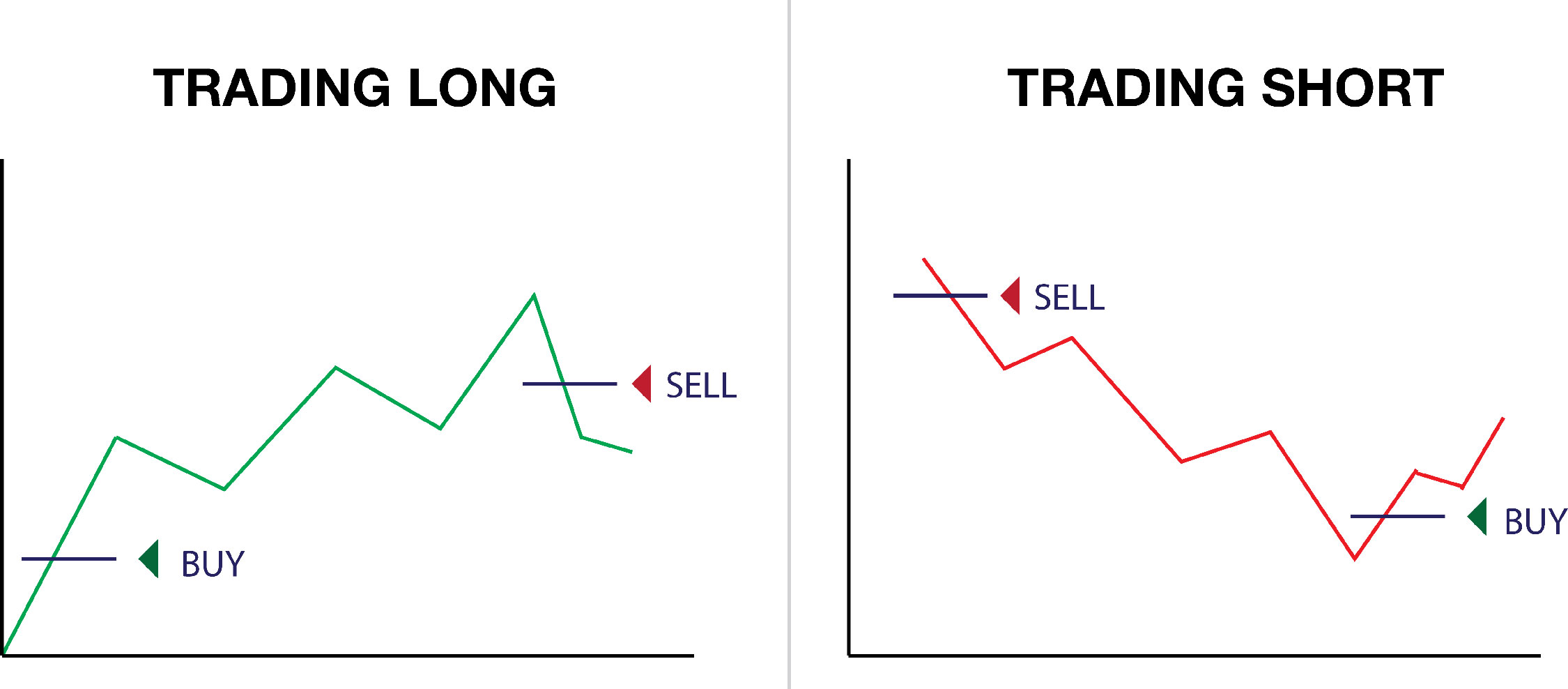
The difference is straightforward: when trading long, you want to buy low and sell high. When trading short, you want to sell high and buy low.
However, if you short a stock and its price rises instead of falling, you lose money.
The table below provides the fundamental difference between the two strategies.
| Feature | Trading long | Short selling |
|---|---|---|
| Market expectation | Share price will rise | Share price will fall |
| Entry | Buy shares | Sell first |
| Exit | Sell shares | Buy back |
| Profit occurs when | Price rises | Price falls |
| Loss occurs when | Price falls | Price rises |
| Stop loss | Below entry | Above entry |
How does short selling work?
How do you sell shares you don't own?
With a traditional covered short sale, a trader borrows shares, sells them on the market and later purchases the same number of shares to return to the lender.
In Australia, covered short selling is permitted, while naked short selling is generally prohibited.
A covered short sale is one where the trader has arranged to borrow the shares before selling them.
The broker may also require the trader to deposit cash into a margin account, which is held as security against potential losses if the share price rises.
A naked short sale is one where the trader sells shares without first borrowing them or having an arrangement in place to borrow them.
This creates an additional risk because the trader may be unable to deliver the shares to the buyer when the transaction settles.
Another method is to use a contract for difference (CFD), which allows traders to speculate on price movements without owning the underlying shares.
Unlike a traditional short sale, a CFD is a contract with the provider rather than a transaction involving borrowed shares.
CFDs require an initial margin, which is a percentage of the total position value.
For example, assume you want to open a short position equivalent to 10,000 AMP shares trading at $2.11.
The total position would be worth $21,100. If the required margin were 10 per cent, you would need $2,110 to open the position.
Although you have committed only $2,110 initially, your profits and losses are calculated on the full $21,100 position.
An example of a profitable and unprofitable short trade
Let's look at a hypothetical stock.
Assume ABC has entered a downtrend, and you open a short position of 1,500 shares at $80.86, for a total position value of $121,290.
With an assumed margin requirement of 5 per cent, your initial margin would be $6,064.50 (5% of $121,290).
Now assume the share price falls to $77.01, where you close the position.
| Calculation | Amount |
|---|---|
| Entry price | $80.86 |
| Exit price | $77.01 |
| Profit per share | $3.85 |
| Gross profit on 1,500 shares | $5,775 |
| Assumed brokerage | $100 |
| Net profit before other costs | $5,675 |
That represents a return of about 93.6 per cent on your initial margin, even though the share price fell by only 4.76 per cent.
But consider what happens if your analysis is wrong.
If the stock rises by $3.85 instead, the position incurs a $5,775 trading loss before costs, nearly wiping out your initial margin.
This illustrates why leverage can be attractive but dangerous.
A small move in the underlying share price can substantially affect your capital.
Why do traders short sell stocks?
Profiting from falling share prices
Markets move in cycles, and while most investors concentrate on rising prices, falling markets can also provide trading opportunities.
Share prices often fall faster than they rise, particularly when fear increases, and investors rush to sell.
For experienced traders, this can create opportunities to generate returns over shorter periods.
However, faster price movements also leave less room for mistakes.
Identifying a falling stock is only part of the process; knowing when to enter and exit is what matters.
Hedging an existing share portfolio
Short selling can also be used to hedge shares you already own.
For example, you may hold BHP shares for the long term but expect a temporary decline.
Rather than selling your shares, you could establish an offsetting short position.
If BHP falls, the profit from the short position could help offset the decline in the value of your shares.
However, hedging is not risk-free. You must consider financing costs, timing and when to close the hedge.
An index hedge may also behave differently from the shares you own.
How do you identify a short-selling opportunity?
Confirm the direction of the trend
Understanding market direction is one of the most important skills a trader can develop.
Many people make the mistake of concentrating on daily charts when looking for short-selling opportunities.
But the bigger picture, particularly the monthly and weekly charts, can provide a clearer understanding of the trend.
You need to distinguish between a normal correction within an uptrend, a consolidation and an established downtrend.
A stock that forms a lower peak and subsequently breaks below a previous trough may indicate increasing downward momentum.
However, one pattern alone is not enough. Traders need proven rules and an understanding of the stock's historical behaviour.
Why trying to pick the top can be dangerous
In my experience, one of the highest-risk approaches to short selling is attempting to identify the exact top of a rising market.
A stock can appear expensive and continue rising for months.
If you repeatedly attempt to short it before a reversal is confirmed, you could experience several losing trades.
Sometimes the initial fall from a peak is not the best opportunity. A stock may decline, recover temporarily and then begin a more substantial fall.
Waiting for confirmation can provide a clearer opportunity than anticipating a reversal simply because a stock has risen strongly.
Assessing the potential downside before entering
Just because a stock is falling doesn't mean it is worth shorting.
Consider a share that has already fallen substantially and is approaching an important historical support level.
Although the trend may still be down, the remaining potential decline could be relatively small.
If the stock has only another 5 per cent to fall before reaching support, but your potential loss is greater than that, is the trade worth taking?
This is why understanding risk versus reward is essential.
Before entering, assess the potential return, the probability of success, and the capital at risk.
What are the risks of short selling?
Leverage and margin calls
Leverage magnifies profits and losses because you control a position larger than the margin you initially provide.
If the market moves against you, your provider may require additional funds or close your position if you breach margin requirements.
Traditional short selling also carries theoretically unlimited loss potential because there is no ceiling on how high a share price can rise.
Australian retail CFDs have specific protections, including leverage limits, margin close-out rules and negative balance protection.
These limit certain risks but do not prevent traders from losing the funds in their CFD accounts.
Stop losses and sudden market reversals
When trading short, you generally place your stop loss above the entry price, rather than below it as you would when trading long.
Setting the stop too close can result in an early exit from normal price fluctuations. Setting it too far away may expose too much capital.
You also need to recognise that markets can reverse suddenly.
A stop loss does not guarantee execution at your intended price, particularly when prices gap or liquidity deteriorates.
That is why you should set your exit rules before entering a trade.
Borrowing costs and dividend adjustments
Short selling involves costs that can affect your final return.
Traditional short sellers may incur stock-borrowing fees and obligations relating to dividends.
CFD positions may involve overnight financing charges or credits and dividend adjustments, depending on the provider.
It is particularly important to understand what happens when a company goes ex-dividend, as well as the potential volatility surrounding company announcements.
What to assess before short selling a stock
Before you consider a short trade, you need to ensure you assess:
- Market direction: Is the stock in a confirmed downtrend, or is it simply correcting within an uptrend?
- Price patterns: Does the chart support the expectation of further downside?
- Potential downside: How much further could the stock fall before reaching an important support level?
- Risk versus reward: Does the potential return justify the capital at risk?
- Exit strategy: Do you have clear rules for closing the position if the market moves against you?
What is a short squeeze?
How short covering can push prices higher
A short squeeze occurs when a rising share price pressures short sellers to close their positions.
Because short sellers must buy back shares to close a traditional short position, their buying can push the price higher. This may force additional short sellers to close their positions, creating a rapid upward movement.
A stock may therefore rally substantially even when its longer-term trend remains down.
What GameStop and the silver squeeze teach traders
Two events in early 2021 demonstrate how social media, herd mentality and short-selling activity can create extraordinary market volatility.
In January 2021, GameStop became the centre of a short squeeze when retail traders, encouraged by discussions on Reddit, began buying shares to challenge large hedge funds holding short positions.
As the share price surged, short sellers faced mounting losses, with some forced to close their positions.
Many inexperienced traders were caught up in the excitement and bought after much of the rise had already occurred. When the share price reversed, those who failed to exit risked substantial losses.
A similar attempt occurred in the silver market in February 2021, when social media discussions encouraged investors to buy silver and silver-backed investments to squeeze short sellers.
Silver surged to approximately US$30 an ounce, its highest level in almost eight years, before reversing sharply.
The Chicago Mercantile Exchange increased margin requirements for silver futures, adding pressure to an already volatile market.
Unlike GameStop, however, the silver event is better described as an attempted short squeeze, rather than a confirmed squeeze of the same nature.
Both events demonstrate the dangers of following the crowd without understanding market direction.
Traders caught up in the excitement often enter too late and then hold losing positions because they are reluctant to admit they were wrong.
The lesson is that knowledge, proven trading rules, and emotional control matter more than following the herd.
What does it mean when an ASX stock is heavily shorted?
When a stock has high short interest, it means a relatively large proportion of its shares has been sold short and remains subject to outstanding short positions.
This may indicate that traders expect further weakness, but it does not guarantee that the share price will fall.
Some heavily shorted stocks subsequently rise strongly, creating substantial losses for traders who positioned themselves for further declines.
In Australia, ASIC publishes aggregated short-position reports, while the ASX provides information on reported short-selling transactions.
If you own a heavily shorted stock, don't panic simply because it appears on a most-shorted list.
Look at the chart, assess the direction and continue applying your trading rules. Short interest may provide useful supporting information, but it should not be the sole reason for entering or exiting a position.
Should short selling be banned?
Short selling has long been controversial, particularly during significant market declines.
One concern is that large institutional short sellers can place additional downward pressure on share prices, potentially amplifying fear and losses among investors.
This raises questions about predatory trading practices, securities lending and whether existing regulations adequately protect individual shareholders.
ASIC has also raised concerns about what it calls activist short selling campaigns, where short sellers publish negative reports about companies while holding short positions.
While these reports can expose genuine problems, ASIC warns that misleading or unsupported claims can distort share prices, cause investors to sell below fair value and damage confidence in the market.
The debate has another side. Short sellers can help identify overvalued companies and expose questionable financial reporting.
Enron and Wirecard are examples where concerns about corporate financial information attracted scrutiny from short sellers and other market participants.
The distinction is between legitimate short selling and market manipulation.
Selling shares because you believe a company is overvalued is not the same as deliberately creating a false or misleading market.
The issue is whether short selling is being used legitimately or in ways that unfairly disadvantage other participants.
Should you consider short selling?
Before considering short selling, I strongly recommend that you first demonstrate that you can trade stocks profitably on the long side.
Ideally, you should have two to three years of experience consistently applying trading rules, managing capital and exiting positions when your analysis proves incorrect.
Short selling requires the same fundamental skills as trading long, but the speed of market declines and reversals can make mistakes considerably more expensive.
You need to understand direction, price patterns, timing, position sizing and risk management.
You also need a documented trading plan that you can follow without second-guessing your decisions.
You don't need to trade every opportunity the market presents. Sometimes the best decision is to wait.
Short selling can be a valuable strategy for experienced traders, but it is not a shortcut to profitability.
Learn to trade well first, protect your capital and only consider leverage when you have demonstrated the discipline and knowledge to manage it.
If you want to develop your trading knowledge and learn how to apply proven strategies, Dale Gillham's bestselling book, How to Beat the Managed Funds by 20%, is a great place to start.
Wealth Within's trading courses also provide the education and support to take your trading further.