Australia is Punishing Homeowners for an Energy Problem

By Dale Gillham
Reading Time: 6 minutes
General Advice Disclaimer
This article is for general educational purposes only and does not take into account your personal financial circumstances, objectives or needs. Before making any investment decisions, consider your individual circumstances and seek independent financial advice if necessary.
How does increasing your mortgage repayments bring down the price of petrol?
This is the question Australians should be asking as inflation hits 4.3 per cent and another interest rate rise enters the conversation.
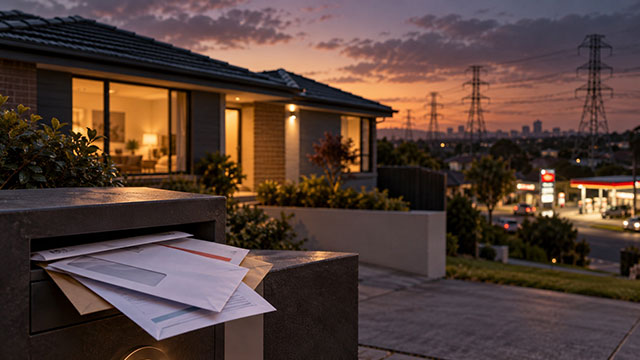
Families are already paying more to fill the car and keep the lights on. Now they could be asked to pay more on their home loan as well.
But what would another rate rise actually achieve?
Can higher interest rates really fix energy-driven inflation?
Transport costs rose 8.7 per cent over the past year, driven by higher global oil prices.
Meanwhile, some housing pressures are easing. The rising costs of building new homes in the 12 months to August 2026 has slowed from 5.4 per cent to 4.7 per cent in 12 months to September 2026. That doesn’t mean homes are getting cheaper; it means price rises are slowing.
Electricity prices jumped 12.8 per cent, largely because government rebates ended.
Increasing mortgage repayments will not bring those rebates back, just as it will not produce more oil or put extra electricity into the grid.
Higher rates can make people spend less. They can force a family to cancel a holiday, put off buying a car or stop eating out, but that family still needs to drive to work and switch the lights on.
We risk squeezing households harder without fixing the costs driving their bills higher.
If I were sitting at the Reserve Bank’s table, I would be asking why households should take another hit before we have established what another rate rise will achieve.
I would hold rates for now and watch whether higher energy costs are spreading into broader price rises.
Why is the government leaving households to pay the price?
And if I were in government, I would stop leaving the Reserve Bank to do the heavy lifting while families carry the cost. Raising rates is not the only choice available.
The government needs to show some backbone. Put reliable, affordable energy ahead of political point scoring.
Get viable projects built, remove duplicated approvals and fix the delays holding up electricity connections. Set public deadlines, name who is responsible and explain every missed target.
Australians do not need another announcement about what might happen years from now.
They need a government prepared to make difficult decisions and be accountable for delivering them.
None of this makes global oil cheaper overnight, but neither does making a family’s mortgage more expensive.
Enough is enough. It is weak leadership to keep asking households to tighten their belts while accepting excuses for slow delivery.
Families are making hard choices every week. It is time the government showed the same urgency.
Best and worst sectors
Communication Services was the best-performing sector last week, rising 4.04 per cent on strong gains in Telstra and TPG, as investors looked for buy-the-dip opportunities.
Financials gained 4.02 per cent, as the major banks continued to rebound, while takeover interest in Challenger provided support.
Industrials rounded out the top 3, rising 2.66 per cent, driven by Cleanaway’s takeover offer, which sparked a roughly 20 per cent jump, and helped lift the sector.
At the other end of the market, Materials was the worst performing sector last week, dropping 7.69 per cent as falling gold stocks and renewed weakness in major miners weighed on the sector.
Information Technology followed, dropping 5.11 per cent as NEXTDC’s earnings downgrade compounded an ongoing global sell-off in technology and AI stocks.
Energy rounded out the worst performers last week, falling 1.49 per cent as oil pulled back and immediate Middle East escalation fears eased, pressuring energy shares later in the week.
Best and worst stocks
Cleanaway Waste Management led the ASX Top 100 last week, climbing 21.05 per cent after agreeing to an EQT takeover valuing the business at approximately $9.3 billion, including debt.
Challenger Limited followed, rising 21.02 per cent after Daiichi Life proposed an $11.80-a-share takeover, roughly 20 per cent above its previous closing price.
Pro Medicus rounded out the leading performers, gaining 12.89 per cent after securing two seven-year US contracts worth a combined $67 million with Billings Clinic–Logan Health and Virtua Health.
At the other end, NEXTDC Limited was the weakest performer, falling 38.89 per cent after delayed electricity connections at its Melbourne M3 facility forced an earnings forecast downgrade.
Telix Pharmaceuticals followed, falling 16.15 per cent after its quarterly update showed a modest sequential revenue decline, disappointing investors despite a positive full-year outlook.
Genesis Minerals rounded out the worst performers, falling 15.03 per cent on the back of weakening gold prices, while its quarterly update showed costs near the upper end of guidance, adding to margin concerns.
All Ordinaries Index update
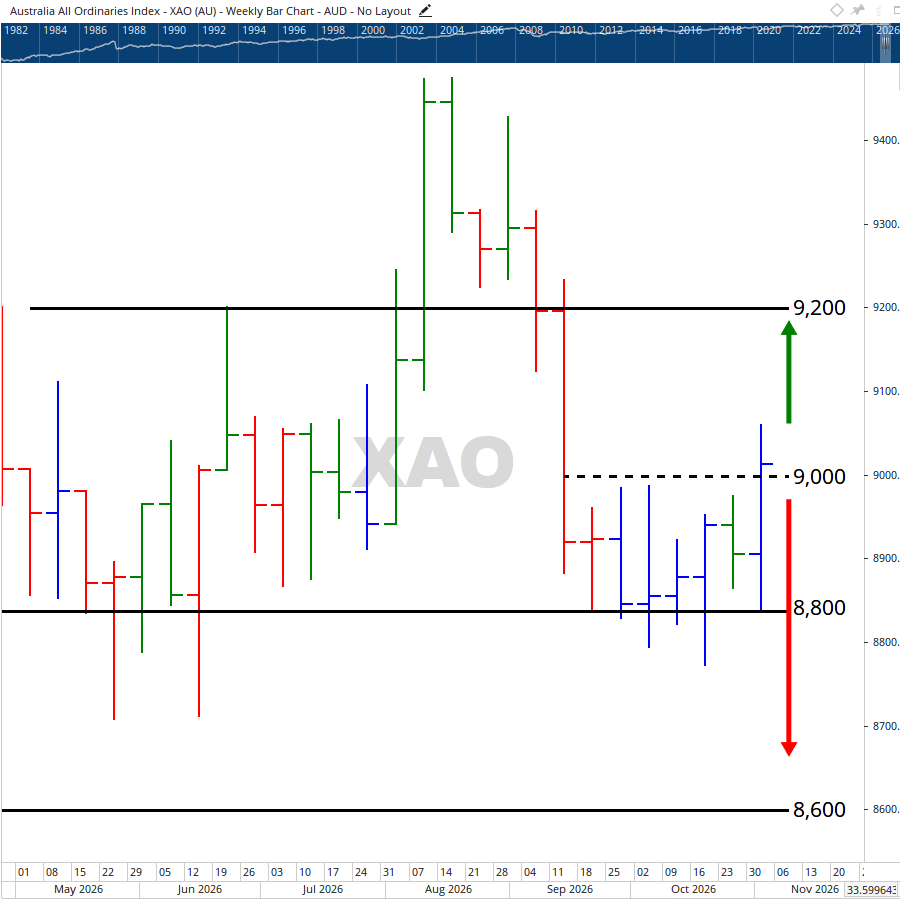
Last week, the All Ordinaries Index had its strongest week since August, rising 1.34 per cent. Materials led the charge with a sharp rebound, supported by strength in information technology, while financials held slightly positive.
That’s pushed the market back above the key 9,000-point level. The question now is, can it stay there?
If buyers maintain control, 9,200 is the next level to watch. But a sharp sell-off next week would raise the risk that this is simply a dead cat bounce, putting a fall towards 8,600 back on the table.
There’s certainly no shortage of potential triggers; with the RBA’s interest rate decision, US midterm elections and earnings from the biggest AI companies are all approaching.
One possibility is that investors have already priced in another rate rise and are looking beyond it, betting it could be the last for a while.
But rather than getting caught up in predicting the headlines, watch how the market responds.
For now, price action looks more positive. Buyers have stepped in, the market has reclaimed 9,000, and momentum has improved.
The next test is whether buyers can defend that level and build on this week’s gains. It’s too early to declare the danger is over, but after months of uncertainty, this is a welcome step in the right direction.
Good luck and good trading.
Dale Gillham is the Chief Analyst at Wealth Within and the international bestselling author of How to Beat the Managed Funds by 20%.
He is also the author of the award-winning book Accelerate Your Wealth—It’s Your Money, Your Choice, which is available in all good bookstores.