Why More Information Can Make You a Worse Investor

By Dale Gillham
Reading Time: 8 minutes
When I first started trading in the early 1990s, getting information wasn't easy.
No financial news streamed into my phone. There was no social media or YouTube. In fact, I didn't even have email.
Today, we have the opposite problem: investment information overload.

Investors have financial news 24 hours a day. They also have podcasts, newsletters, stock forums, and now AI that generates answers almost instantly.
Yet despite this explosion of information, I still see investors making many of the same mistakes I saw more than 30 years ago.
That's because having more information doesn't necessarily make you a better investor.
When more information becomes noise
One thing I've said for years is that more isn't necessarily better. If you understand what you're doing, less is often better.
Today, investors are surrounded by opinions, predictions, stock tips and endless commentary. Open your laptop or phone, and you’re immediately bombarded with financial headlines telling you what markets are doing and what you should supposedly be worried about.
For some people, that creates analysis paralysis. For others, I believe it creates something potentially more dangerous: the feeling that they know more than they actually do.
Reading articles, watching videos and asking AI questions can certainly give you information. But information isn’t the same as education, and knowledge is not the same as understanding.
You might know what a moving average is. You might recognise a trend line. You might have read about position sizing.
But can you apply those concepts correctly when your money is on the line? That's the difference.
Information can create false confidence
One of the biggest problems I see is investors confusing familiarity with competence.
You've read enough about something that it sounds familiar. You've watched someone explain a strategy. Maybe you've asked AI, and it's confirmed what you already thought.
Suddenly you feel confident. But confidence without skill can become very expensive.
Before I enter a trade, I want to understand why I'm entering. I want to know my exit before I buy. I need to understand how much capital I'm risking, what happens if I'm wrong and how I'll manage the position.
If you cannot answer those questions, consuming another 20 articles probably won't solve the real problem. You need a process.
That’s why, in my view, skill matters far more than how much information you consume.
Why investors keep making the same mistakes
Markets change. Technology changes. Access to information certainly changes.
But human behaviour doesn't change anywhere near as much.
I still see people chasing stocks after they've already risen strongly. They hold onto losing positions because they want the stock to get back to what they paid for it.
They sell profitable stocks too early because they're afraid of losing the gain.
This behaviour has a name: it’s called the disposition effect.
Researchers have found that investors are more likely to realise gains than losses. Even more interestingly, the winning investments they sold subsequently outperformed the losing investments they continued to hold.
In other words, the behaviour I continue to see isn't new. Researchers have been documenting it for decades.
Then there are investors who change strategies after a few losses. They keep looking for the next strategy because they think there's something out there that will remove uncertainty.
Others act on tips without a trading plan, or they keep trading because they believe being a trader means they should always be doing something.
It doesn't.
Trading more doesn't mean earning more
Sometimes I don't trade for quite a while. Other times I might trade several times in one week.
The market determines when opportunities arise. I don't trade because I've decided I need to make a certain amount of money that week.
There's some interesting research that supports this point.
Brad Barber and Terrance Odean analysed 66,465 US brokerage accounts between 1991 and 1996. The households that traded most actively earned an average annual return of 11.4 per cent, compared with a market return of 17.9 per cent. The researchers concluded that excessive trading imposed a significant performance penalty and identified overconfidence as one explanation for high trading activity.
That doesn't mean trading itself is the problem.
The issue is believing that more activity automatically means better results.
If your goal was to make $100,000, would it matter whether you achieved it through one trade, 10 trades or 100 trades?
I'd rather take fewer quality opportunities than trade simply because I feel I need to be doing something.
Skill gives you a filter
Here's how I sometimes explain skill.
Put me in a room without financial news, social media or market commentary. Give me the date, open, high, low, close and volume for something being traded.
It could be a stock, gold or something from another market.
I can draw the chart and analyse it without someone telling me what to think. That's skill.
And the more skill you develop, the easier it becomes to filter information.
I've spoken with people who spend 10, 12 or even 20 hours a week consuming market information.
My question is always the same: how much of that do you genuinely need?
Once you understand what matters to your decision-making process, you can cut away a huge amount of noise.
Information should support your process. It shouldn't become the process.
That's central to the way we approach education at Wealth Within. Our trading courses are designed to develop knowledge and practical skills rather than simply giving people more market information.
Social media and AI have changed the equation
The volume of information isn't the only thing that's changed. Where people get that information has changed as well.
ASIC research released in 2026 found that 63 per cent of Australians aged 18 to 28 use social media for financial information and guidance. Another 30 per cent use YouTube and 18 per cent use AI platforms.
What stood out to me even more was the level of trust.
ASIC found that 56 per cent trusted financial information from social media to some degree, 52 per cent trusted finfluencers and 64 per cent trusted AI platforms.
That matters because access to information and confidence in it are two completely different things.
ASIC Commissioner Alan Kirkland has also warned that social media algorithms are designed to drive clicks and engagement rather than promote accurate information, increasing the chance that people encounter biased or misleading content.
That's exactly why I think investors need to become better at questioning what they consume.
AI hasn't removed the need to think
I've spent considerable time testing AI on subjects such as diversification, trading education and the differences between retail traders and fund managers.
What I've found is that some answers rely heavily on mainstream assumptions. I've challenged those answers because the circumstances facing a retail trader can differ greatly from those facing a large fund manager.
So don't automatically accept an AI-generated answer simply because it sounds convincing. Question it.
Ask where the assumptions came from. Challenge the reasoning. Determine whether the answer actually applies to what you're trying to achieve.
AI can accelerate learning, but in my view, it cannot replace judgement or skill.
ASIC's own Moneysmart guidance makes a similar distinction. It says general-purpose AI tools can help with learning and research, but they also have limitations that can produce inaccurate or inappropriate suggestions.
Trade what you know, not what you think
A decision-making framework helps separate confirmation from speculation.
You may have fundamental criteria you use to filter companies. You might look at earnings per share, dividend yield, price-to-earnings ratios or debt-to-equity.
Once a company meets your criteria, you can analyse the chart, determine your entry strategy, position size and risk.
Now the information has a purpose.
What I don't want to do is buy because I've read that a company might discover something, might develop something, or potentially become the next big thing.
My approach has always been straightforward: trade what you know, not what you think.
Trade on confirmation rather than speculation.
Without a framework, information is simply another input competing for your attention.
Good investors know what matters
A capable investor doesn't need to know everything. They need to know what matters and what to do with it.
That means having rules around buying and selling, position sizing, capital management and risk. It means knowing what validates your analysis and, equally importantly, what tells you the analysis is wrong.
Good traders review their decisions. They manage capital consistently, rather than emotionally. They know why they're entering and what will cause them to exit.
And they keep learning.
I still research. I still challenge my thinking. I still look for information that might prove me wrong.
But the answer isn't simply consuming more.
It's building better skills and making sure you practise them correctly.
As I often say, perfect practice makes perfect. Practising something incorrectly simply makes you better at doing it incorrectly.
That's why practical education and feedback matter. Our Trading Mentor Course helps people establish the foundations, while the Diploma of Share Trading and Investment develops those skills much further.
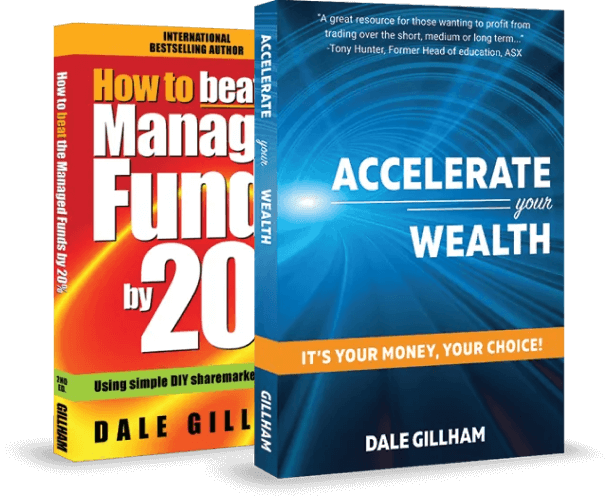
I also discuss managing risk and developing a structured approach in my bestselling book How to Beat the Managed Funds by 20%.
Because knowing about the market isn't the same as knowing how to trade it.
The investors who do well aren't necessarily the ones consuming the most information. They're the ones who can apply what they know consistently and confidently.
And with the amount of information coming at us every day, knowing what to ignore may now be just as valuable as knowing what to pay attention to.