Does Age Really Affect Your Success as a Trader?

By Fil Tortevski and Pedro Banales
Reading Time: 9 minutes
General Advice Disclaimer
This article is for general educational purposes only and does not take into account your personal financial circumstances, objectives or needs. Before making any investment decisions, consider your individual circumstances and seek independent financial advice if necessary.
It’s an interesting question because age can influence how we approach the market. Younger traders generally have more time to learn, make mistakes and gain experience. Those who start later may have less time, but they often bring greater patience, discipline and life experience to their decisions.

Our conclusion is that there is no single perfect age to enter the market. Every stage of life comes with advantages and disadvantages. What matters more is whether you learn properly, develop a sound process and choose a trading approach that suits your circumstances.
Why age matters differently for investors and traders
When it comes to long-term investing, the earlier you start, the better. That is because your money has more time to benefit from compounding.
To illustrate this, we considered a hypothetical investment of $10,000 earning 8 per cent a year, with no additional contributions. If the money were invested at 18 and left until age 65, it would grow to approximately $373,000. Starting at 25 would produce around $217,000, while starting at 35 would result in approximately $100,000.
Of course, this is a deliberately simple example. Markets do not deliver the same return every year. However, it clearly demonstrates the advantage of time. The earlier you begin investing, the longer your capital can compound.
Why is trading different?
Trading is different because having more time does not automatically make someone a better trader.
A young trader may be energetic, adaptable and keen to learn, but they may not yet have the judgement or market experience required to make consistently sound decisions. Someone who starts later may have fewer years ahead of them, but they may also approach risk with greater patience and restraint.
This is why we cannot answer the question by simply nominating one age. We first need to consider what type of market activity we are talking about and what someone brings to it.
Why does the age of 53 stand out?
One of the major studies discussed in the podcast was The Age of Reason: Financial Decisions Over the Life Cycle.
The researchers examined financial behaviour across ten credit markets and found a U-shaped relationship between age and financial mistakes. In other words, younger and older adults tended to make more mistakes, while fees and interest payments were lowest at approximately 53 years of age. Why might this happen?
Experience generally increases as we get older. We make more financial decisions, learn from our mistakes and live through different economic conditions. At the same time, cognitive performance can eventually begin to decline. Around our 50s, we may reach a point where we have accumulated considerable experience while retaining a strong ability to process information and make decisions.
What the Study Does and Does Not Prove
That makes 53 an interesting age, but we need to be careful about what the research actually tells us.
The study did not examine traders specifically, so it does not prove that traders reach their peak at 53. What it does provide is a useful way of thinking about the relationship between experience, cognitive ability and financial decision-making.
Your 50s may be a sweet spot. By this stage, many people have gained valuable life and financial experience, while their ability to apply that knowledge remains strong. However, this does not mean someone in their 20s, 30s or even their 70s cannot become a successful trader.
Being in the market does not automatically make you better
It is easy to assume that the longer someone trades, the better they will become. Unfortunately, experience does not work that way.
Some people genuinely improve over time. They review their decisions, recognise weaknesses, and change their strategy or behaviour. Others continue repeating the same mistakes. Some eventually decide trading isn't right for them and leave the market altogether.
This creates an interesting problem when researchers study trading performance. If they examine only those who continue trading, the results may suggest that experience leads to improvement. In reality, some of the poorest performers may have already stopped.
Simply spending ten years in the market does not guarantee that you have developed ten years of useful experience. You may have repeated the same poor habits ten times.
When Trading Experience Becomes Valuable
Experience becomes valuable when it leads to improvement. Perhaps you refine your strategy, strengthen your risk management, adjust your position sizing or become more selective about the trades you take. You may also become better at recognising the role your emotions play in your decisions.
Market conditions can also disguise a weak approach. During a strong bull market, traders can make money despite having a poor process. It is often only when conditions change that the weaknesses in their approach become clear.
The real question, then, is not how long you have been watching the market. It is what you have learned during that time and whether your decision-making has improved.
What the research tells us about day trading
The strongest warning from the research relates to day trading.
The Cross-Section of Speculator Skill: Evidence from Day Trading examined day traders on the Taiwan Stock Exchange. It found that fewer than 1 per cent could earn positive abnormal returns predictably and reliably after fees.
Fees matter, especially for day traders. They frequently enter and exit the market to capture small price movements, while commissions and other trading costs continue to accumulate.
We also discussed a separate study titled Day Trading for a Living, which examined people who began day trading Brazilian equity futures between 2013 and 2015.
Does day trading improve outcomes?
Among those who continued for more than 300 trading days, 97 per cent lost money. Only 1.1 per cent earned more than Brazil’s minimum wage, while approximately 0.5 per cent earned more than the starting salary of a bank teller.
We do not know the level of education, knowledge or skill each person brought to the market. Even so, the findings challenge the popular idea that spending more time in front of a screen will eventually turn someone into a successful trader.
There is no credible evidence that a particular age gives someone an advantage in day trading. The much more important finding is that trading intraday is exceptionally difficult to do consistently.
Starting young gives you time, but use it well
Your late teens and 20s can be an excellent time to begin learning about the market. You have decades ahead to develop your skills, experience different market conditions, and recover from setbacks.
However, starting young is only an advantage if you use that time wisely.
The internet gives aspiring traders access to an enormous amount of information, but much of it is disconnected or contradictory. Someone may watch one video, follow an influencer, try a new strategy and then abandon it when it does not produce an immediate result.
They can end up knowing a little about many different approaches without developing a clear understanding of how the market works.
Young people also face something of a paradox. They generally have a greater capacity to accept long-term market volatility because they have more time to recover. Yet they may also be more attracted to short-term speculation, leverage, and other risks that can cause significant damage to their capital.
The aim is not to avoid risk altogether because risk is part of participating in the market. The aim is to understand the difference between taking measured risk and repeatedly placing yourself in a position where one mistake could cause serious harm.
How to Turn Time into a Trading Skill
A structured education provides a framework for evaluating information and learning from mistakes. You can begin by understanding the market and its participants, then learn how to read charts, study price and volume, and eventually apply appropriate trading techniques.
When a loss exposes a weakness, ask what it is telling you. Was there a gap in your knowledge? Did you ignore part of your process? Did emotion influence the decision? Identifying and correcting those gaps is how experience turns into genuine development.
Starting later can also be an advantage
There is no specific age at which someone becomes too old to learn to trade.
Research suggests that cognitive ability can change as we age, which may eventually make accumulated knowledge more difficult to apply. However, that does not mean age alone determines whether someone can learn or trade successfully.
People who begin later in life often bring valuable qualities from their careers and personal experiences. Someone from an engineering or business background, for example, may already have strong problem-solving skills, discipline and an ability to follow a process.
These qualities can transfer well into trading.
Pedro recalled that his oldest student began learning in her mid-80s and continued sending him her market analysis. What stood out was her desire to remain mentally active and continue learning.
That example does not suggest everyone should begin trading in their 80s. It simply demonstrates why we should not assume that someone is too old to learn. A mature beginner may not have as much time as someone in their 20s, but they may bring patience, perspective, and a more measured attitude toward risk.
What is the best age for different market approaches?
The most favourable age depends partly on what you want to achieve.
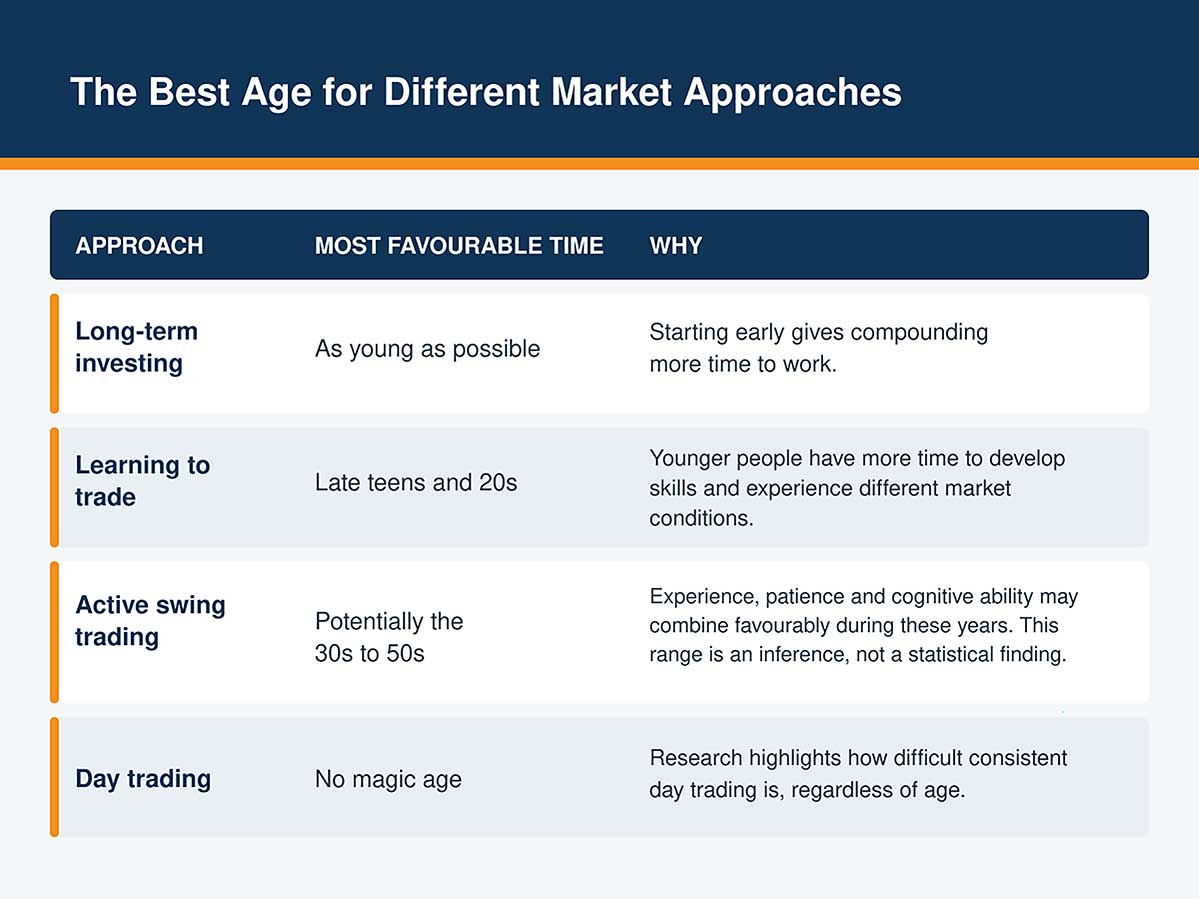
These age ranges should not be treated as rules. Someone may begin learning in their 40s, 50s or later and still become a capable trader. Likewise, beginning in your 20s does not guarantee success.
Your age may shape the advantages you bring to the market, but it does not replace knowledge, skill or discipline.
There are three clocks, not one perfect age
Rather than searching for one perfect age, we think it is more useful to consider three different clocks.
The first is the compounding clock. This rewards people who begin investing early because their money has more time to grow.
The second is the experience clock. This rewards years of proper learning, thoughtful practice and exposure to different market conditions.
The third is the cognition clock. This reminds us that our ability to absorb information, make decisions and apply our knowledge can change over time.
These clocks do not all peak at the same age
A young trader has time on their side, while someone starting later may bring greater experience, patience and perspective. People in their 50s may benefit from a particularly strong combination of accumulated knowledge and cognitive ability, but that doesn't make 53 the perfect age for every trader.
Ultimately, your age is only one part of the equation. The more important questions are whether you are getting the right education, reviewing your mistakes, and becoming a better decision-maker.
That is what gives you the best chance of improving your results, regardless of when you begin.
Continue learning
Explore more episodes on the Talking Wealth Podcast.
For structured, accredited education, see the Diploma of Share Trading and Investment.
Learn more about Wealth Within.