Buying Stocks for Income: A Safer ASX Income Strategy

By Janine Cox
Reading Time: 11 minutes
General Advice Disclaimer
This article is for general educational purposes only and does not take into account your personal financial circumstances, objectives or needs. Before making any investment decisions, consider your individual circumstances and seek independent financial advice if necessary.
Income has a reassuring sound to it. A company pays a dividend, the cash lands in your account, and it feels like you're being rewarded simply for buying ASX stocks for income. But that sense of security can be misleading. A high dividend yield doesn't always signal a healthy business; it can be a warning sign.
Companies with falling prices often appear to offer attractive yields, but if profits are under pressure, those dividends or distributions may not be sustainable. That feeling is rarely a problem while markets are rising, but it becomes a serious problem when conditions change.
An investor may continue receiving dividends while their capital reduces in a severe market downturn, where dividends can fall by 20%, 30% or more, or be suspended altogether. Chasing income without considering the strength of the underlying investment can leave investors caught in a dividend trap.
That's why an income strategy cannot be judged by the dividend yield alone. This article explores how to build a safer income strategy when buying ASX stocks for income by looking beyond the dividend yield and focusing on capital preservation, risk management and long-term returns.
The Problem with Chasing Dividends
Dividend investing can make people fixed in their thinking. You buy a company because it pays an attractive dividend. The payment arrives once or twice a year, and after a while, you become reluctant to sell because you do not want to give up the income.
The share price may be falling, but the dividend becomes the reason to keep holding. That can leave you exposed. During the COVID pandemic, many companies reduced or suspended dividends. For many investors, that was something they never believed would happen until it did during the Global Financial Crisis (GFC). Prior to the GFC, the assumption had been that the income was dependable.
A dividend is not guaranteed. It depends on earnings, cash flow, debt, capital requirements and decisions made by management or regulators. This is why an income strategy still needs rules for managing the capital. You do not need to sell every time a share has a bad week, but you do need to recognise when an ordinary decline is becoming something more serious. Without an exit strategy, your shares are simply bobbing around like a cork in the ocean
Why Large ASX Shares Can Work for an Income Strategy
One advantage of buying larger ASX companies, such as the top 50 stocks on the Australian Securities Exchange (ASX), is liquidity. There are generally enough buyers and sellers for an investor to enter or exit without having a major impact on the price. That matters when market conditions change.
With the right rules, an investor may be able to leave a position before it turns into the kind of free fall experienced during the GFC, when the broader market declined by approximately 55%. That does not mean every loss can be avoided.
Stocks may fall 10% or 15% from their high before a stop loss is triggered. An investor holding for dividends may find companies yielding somewhere around 4% to 8%, potentially with full or partial franking credits. However, once the yield becomes unusually high, you should ask why.
Has the share price already fallen sharply? Does the market expect the dividend to reduce? Is the company taking on more risk? A high yield can be attractive, but it can also be a warning sign that the payment may not be sustainable.
Capital Growth Can Also Create Income
Most people hear "investing for income" and immediately think about dividends. But there is another way to approach it. Capital growth can be converted into income. Suppose you are investing in large, liquid companies, and the price rises strongly over the following year. During that period, you may also receive dividends.
When your rules indicate that the trend has changed, you sell the shares, set aside money for capital gains tax and place the remaining profit into cash. That money can then be drawn down as income. It is no less useful because it came from capital growth rather than a dividend. In some cases, the capital gain may be many times larger than the income paid by the company over the same period.
Personally, I do not see a twice-yearly dividend as a complete income strategy. I see it as the shareholder's portion of the company's profits, but the capital gains still matter.
BHP Shows Why Income Does Not Have to Mean Dividends Alone
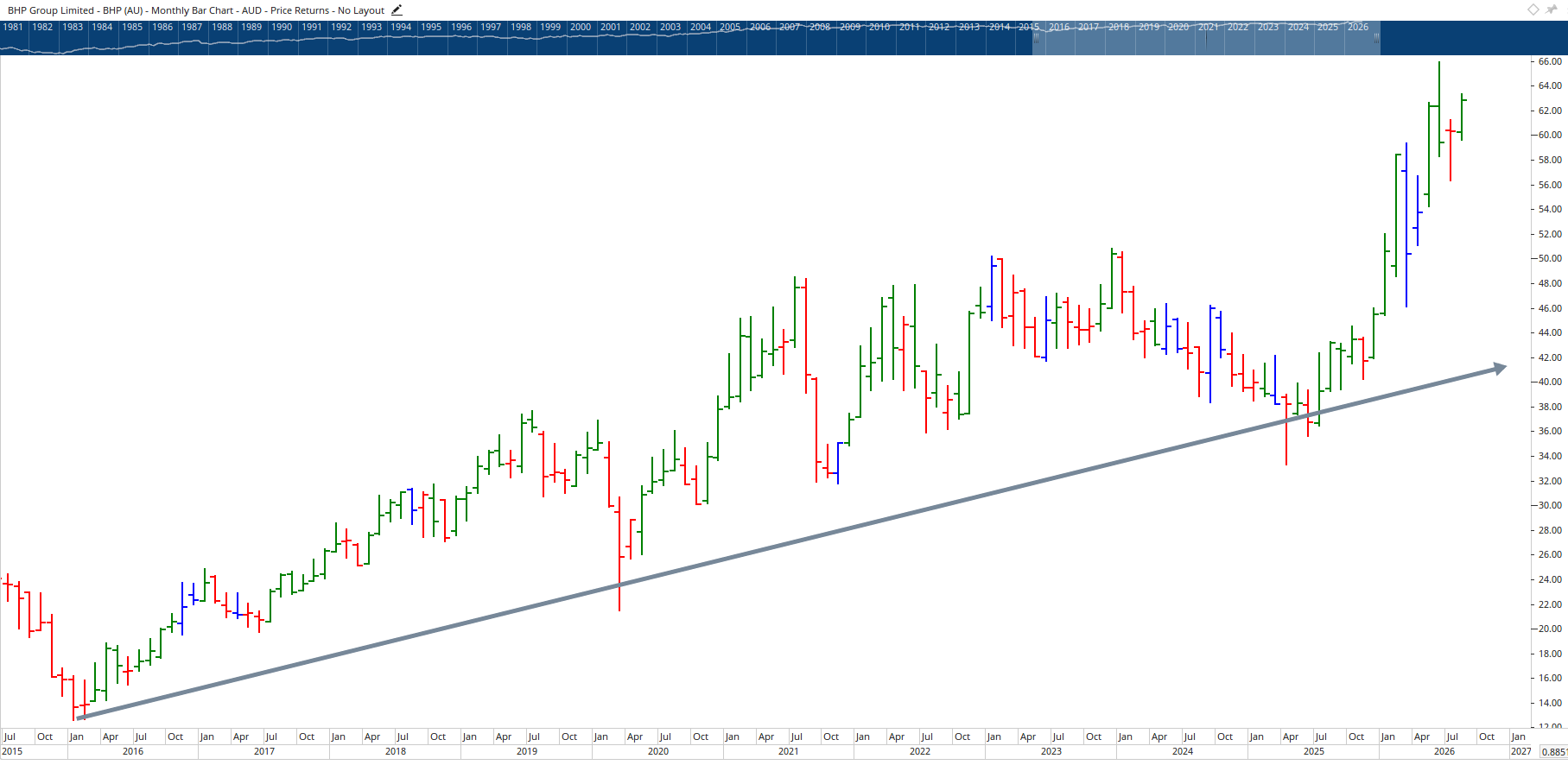
BHP provides a useful example. Looking at the chart from its 2016 low, there were several significant upward moves, including gains of 60%, 45% and 27%. An investor with a proven strategy may have been able to participate in parts of those trends and receive dividends while holding the shares, then bank the capital gain when the trend changed.
The aim is not to buy at the exact bottom and sell at the exact top. That is unrealistic. It's to capture a meaningful portion of the movement while controlling the downside. When that capital gain is realised, it can be used to fund living expenses or held safely until the next opportunity appears. That is still an income strategy. It is simply more flexible than buying a share for the dividend and holding it regardless of what happens to the price.
What CBA Teaches Us About Income and Risk
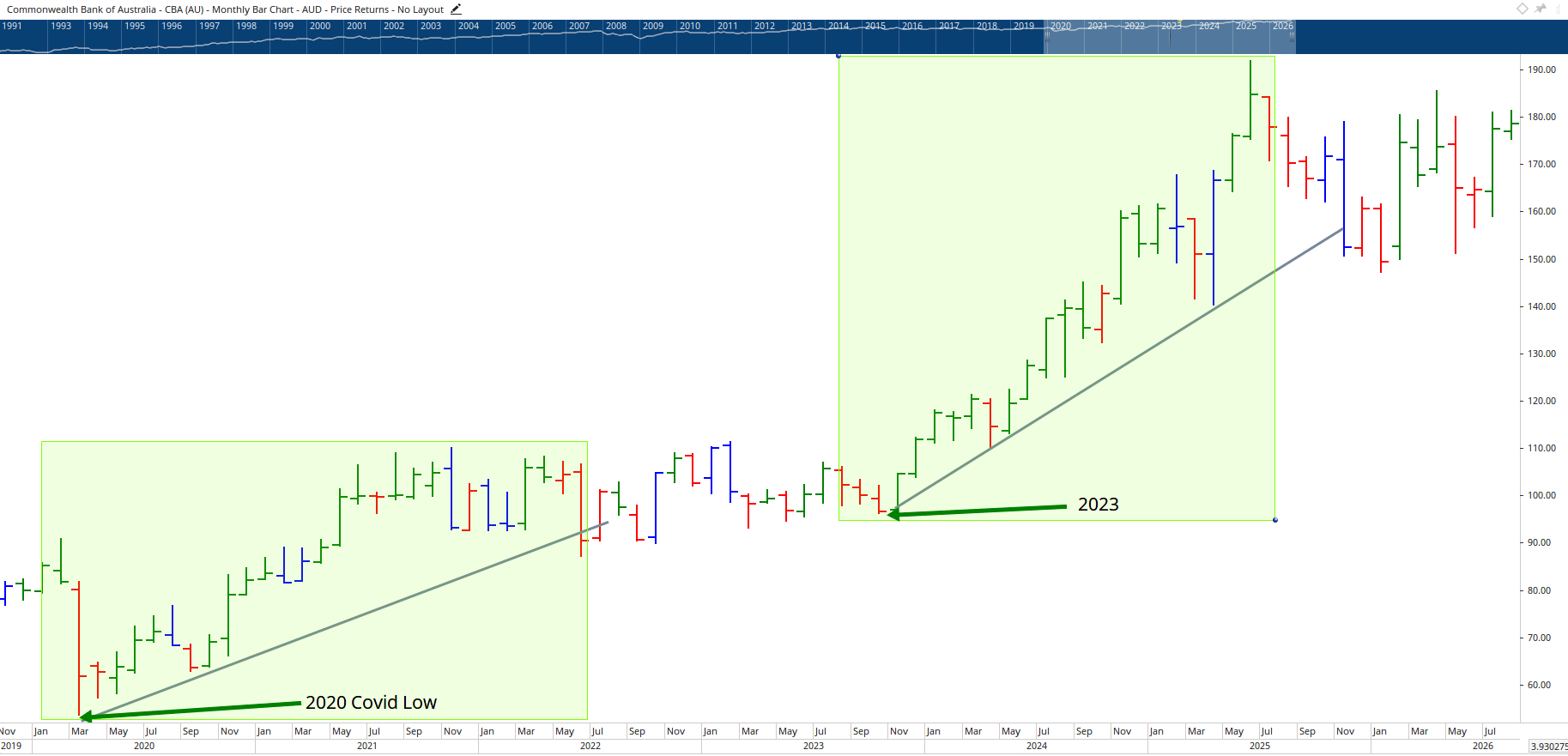
Commonwealth Bank is one of the first companies Australians think about when discussing dividend income. It has also produced some enormous capital-growth opportunities. Following the COVID-related market decline, CBA rose strongly by 60% to 70% over eight to 12 months. An investor holding through that period may also have received dividends of around 4% or 5%, depending on the entry date and holding period. While the dividends were useful, the larger part of the return came from capital gains.
CBA then produced another substantial rise in late 2023 of around 60% to 70%. Go back further and similar opportunities appear. Following the GFC, CBA eventually rose by around 60%.
After the 2011 low, the stock moved sideways for several months before the longer-term trend became clearer. From the point where the trend appeared more likely to continue, the share price eventually rose by approximately 85% over roughly two and a half years.
There were pullbacks, but the point is not that somebody would have captured every percentage point, but that the growth available during those periods was much larger than the dividend alone. And the investor may still have collected dividends along the way.
How a Simple Trend Can Help Manage Risk
You do not need a financial degree to begin examining this for yourself. Bring up a long-term monthly chart of a company such as CBA. Look at the strongest rises and draw a line underneath the trend. Then look at what happened after the share price crossed below that line. It can be a real eye-opener.
As I outline in my bestselling book, How to Beat the Managed Funds by 20%, a trend line is not a perfect prediction tool; it's a momentum indicator that informs you when the trend is changing.
Trading with the Trend
While I always recommend trading with the trend, if you were to wait for the long-term trend to confirm, many low-risk trades would be missed. That's why it's important to understand that trends unfold with the short-term trend confirming first, followed by the medium-term trend, and finally the long-term trend. Therefore, a medium- to long-term investor would look to enter a trade at the earliest possible point before the medium-term trend confirms.
When the stock falls below an uptrend line, you would exit the stock. Later, when the share price establishes another uptrend, you can consider getting back in. That is very different from buying a stock and assuming it will rise forever. Markets do not move that way. They rise, pull back, travel sideways and sometimes experience serious declines before a new opportunity develops.
Stop Losses Still Matter When You Invest for Dividends
Some income investors dislike the idea of stop losses. The problem is that a temporary fall can become a structural decline. A stop loss for a long-term investor does not need to sit close to the current price. It might be based on a longer-term trend line, monthly support or a decline appropriate to the normal volatility of the stock. The objective is not to avoid every small loss; it's to avoid remaining fully exposed during the larger falls.
A longer-term strategy may allow a stock to decline 10% or 15% before the exit occurs. That may feel uncomfortable, but it can still protect an investor from a fall of 20%, 40%, 50% or more. The exit strategy also needs to be defined before you enter the market, so you do not become emotional if a trade does not unfold as expected or to take profits.
Without an exit strategy, investors tend to keep moving the goalposts. They tell themselves the stock will recover. Then they tell themselves they are still receiving the dividend. Eventually, they find themselves trapped in a position they no longer understand.
A Practical Way to Build an Income Strategy
An income strategy becomes dangerous when the investor is focused on the payment and blind to the capital. Before buying anything for income, understand:
- What can cause the dividend to be reduced or suspended?
- What can happen to your capital during an ordinary correction and during a major market decline, and how can you protect it?
- How quickly can the stock be sold, in other words, is it liquid?
- What is your exit rule if the stock declines?
- How often will the position be reviewed?
- A long-term strategy does not need to be checked every day, but still needs to be reviewed at least weekly or monthly.
A good medium- to long-term strategy does not require constant attention. You can analyse a weekly or monthly chart and apply a stop-loss or trend line at the end of the week or the end of the month. The important thing is that the rule exists.
A hands-off approach should mean the process is simple and scheduled. It should not mean nobody is responsible. Even when you use an adviser, you should understand enough to recognise when the risk has changed. Bring up the chart and look at the longer-term trend. Ask whether the investment is still behaving the way your strategy requires. That small amount of knowledge can make an enormous difference.
Property Investors Already Understand This Principle
I recently spoke with somebody who had built substantial knowledge before investing in property. They would not commit a large amount of money until they understood the location, the property, the financing and the risks. That approach felt completely natural to them.
The stock market deserves the same respect. Investors sometimes treat property as something requiring serious research while treating shares as symbols they can buy because a friend, adviser or article mentioned them. The principle is identical.
You are placing your capital at risk in exchange for an expected return. The more you understand, the better placed you are to decide when conditions become uncomfortable. Looking at the stock market through fear will produce a different picture from looking at it with a clear understanding of how risk vs reward can be measured and managed. The answer is not to pretend the risk is not there; it's to know what to do with it.
Learn How to Build and Manage an Income Strategy
Building a successful income strategy is more than just selecting dividend-paying stocks. It's about understanding how to protect your capital, recognising changing market conditions and making confident decisions based on a proven strategy rather than emotion.
Wealth Within has spent over two decades teaching people how to build practical strategies that combine technical and fundamental analysis, as well as risk management through Australia’s only government-accredited course, the Diploma of Share Trading and Investment.
Final Thoughts
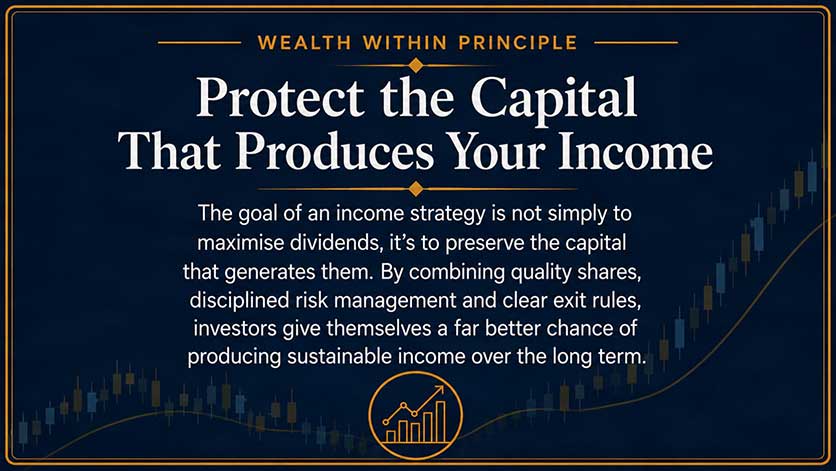
Investing for income isn't just about finding the highest dividend yield. It's about developing a strategy that allows you to generate income while protecting the capital that produces it. Dividends can play an important role, but they should be viewed as one part of the total return, not the entire reason for buying ASX stocks. By focusing on quality companies, managing risk and having a clear exit strategy, you put yourself in a far stronger position to navigate changing market conditions.
Markets will always move through cycles, and no investment is risk-free. Long-term investors who succeed over the long term are not those who simply chase the largest dividend-paying stock, but those who understand when to hold, when to sell and how to preserve their capital for the next opportunity. If you can combine sustainable dividend income with capital growth and a disciplined risk management approach, you can build an income strategy with stocks that is designed not just to survive changing markets but to thrive in them.