Is the VOO ETF at Risk of a Massive Selloff?

By Dale Gillham
Reading Time: 6 minutes
What if one of the world’s safest investments, trusted by millions, is now at the centre of one of the market’s biggest risks?
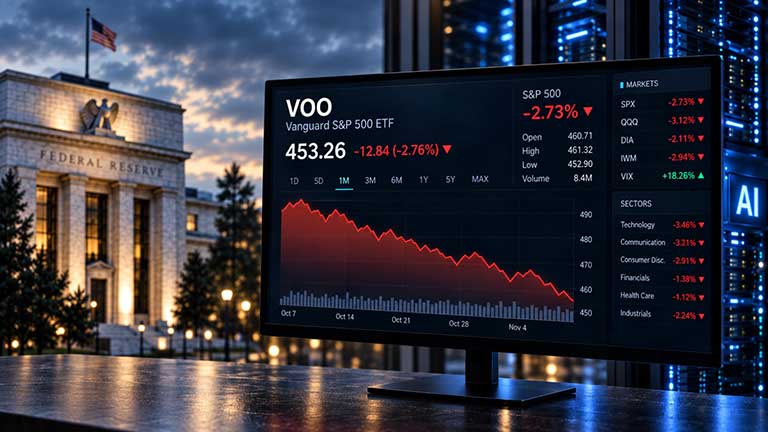
The Vanguard S&P 500 ETF, better known as VOO, has become the world’s largest ETF, with more than US$1 trillion invested in it. Retail investors love it because it’s cheap, simple, and gives them exposure to the US’s largest companies. But that doesn’t make it safe, especially as the conditions that drove the market higher start to change.
Why rising costs could test AI valuations
The Federal Reserve has just raised interest rates for the first time since July 2023. Bond yields are pushing towards 5 per cent, oil is trading near US$100 a barrel, and borrowing money is becoming more expensive.
The AI boom has flourished on cheap money, enormous spending and expectations of extraordinary future growth. But higher bond yields reduce the present value of future earnings, while more expensive credit raises the cost of funding the chips, data centres and energy infrastructure needed to keep the boom going.
Some of the biggest names in AI are calling for development to slow. Whether that leads to lower spending is still unclear, but spending doesn’t need to collapse for these stocks to fall.
When expectations are already high, even slightly weaker growth can trigger a major reassessment. That’s the real risk for VOO investors.
Why VOO may be riskier than investors think
The fund may hold around 500 companies, but a small group of technology giants heavily influences its performance. If the stocks that drove the index higher begin falling together, owning the entire index may offer far less protection than many investors expect.
After the Fed’s rate hike in July 2023, the S&P 500 fell about 11 per cent to its October low. A similar correction would make 7,000 points a real possibility, but history tells us the downside can be much greater.
The S&P 500 lost roughly 40 to 50 per cent during the 1973–74 oil crisis, the technology bust and the Global Financial Crisis. If slowing AI investment becomes the catalyst for another major crash, history suggests the index could fall towards 4,000 points.
The real cost of holding through a market crash
That would be very painful for retail investors who have piled into ETFs near record highs, leaving them exposed to the entire decline. While holding through a 50 per cent fall sounds easy in theory, it rarely feels that way when your money is disappearing.
History shows that many investors eventually crack under the pressure and sell when the damage is already done.
However, holding on presents another challenge: how long can you afford to wait? After peaking in 2000, the S&P 500 didn’t break decisively above that level until 2013. Could you afford to wait another 13 years to get your money back?
The S&P 500 doesn’t have to crash, but with money becoming more expensive, oil pushing costs higher, and AI expectations stretched, blindly buying the index may not be the safe strategy many investors have been led to believe.
Best and worst sectors
Health Care was the best-performing sector last week, rising 3.76 per cent as heavyweight CSL continued its recovery, supported by renewed investor confidence and positive broker sentiment.
Utilities gained 0.5 per cent as investors rotated into defensive stocks, reliable-earnings stocks amid market uncertainty, with easing oil prices also reducing cost pressures.
Communication Services rounded out the top 3, up 0.03 per cent, as investors rotated into defensive stocks, supporting heavyweight Telstra.
At the other end of the market,
Real Estate was the worst sector, falling 1.89 per cent as higher bond yields and expectations of further interest-rate rises reduced the appeal of property stocks.
Energy was the second-worst sector, dropping 1.29 per cent as oil prices retreated on easing supply fears, prompting profit-taking in major producers such as Woodside and Santos after their recent strong run.
Information Technology rounded out the worst performers this week, falling 0.81 per cent as rising bond yields and renewed AI concerns pressured highly valued growth stocks.
Best and worst stocks
Telix Pharmaceuticals led the ASX Top 100 last week, climbing 13.91 per cent after receiving FDA approval for its brain-cancer imaging product, Pixclara.
Dyno Nobel Ltd followed, rising 5.40 per cent as its share buyback and improving explosives earnings outlook attracted buyers.
Resmed Inc rounded out the leading performers, gaining 5.15 per cent after the Royal Bank of Canada upgraded it to Outperform, citing strong sleep-apnoea device demand, market-share gains and its US$1.5 billion share buyback program.
At the other end, Mineral Resources was the weakest performer, falling 11.02 per cent as another decline in lithium prices weighed on producer sentiment.
IGO Limited followed, also falling 9.23 per cent as falling lithium prices renewed concerns about its earnings outlook.
Light & Wonder Inc rounded out the worst performers, falling 8 per cent amid profit-taking and broader weakness in consumer discretionary shares on the back of rising bonds.
All Ordinaries Index update
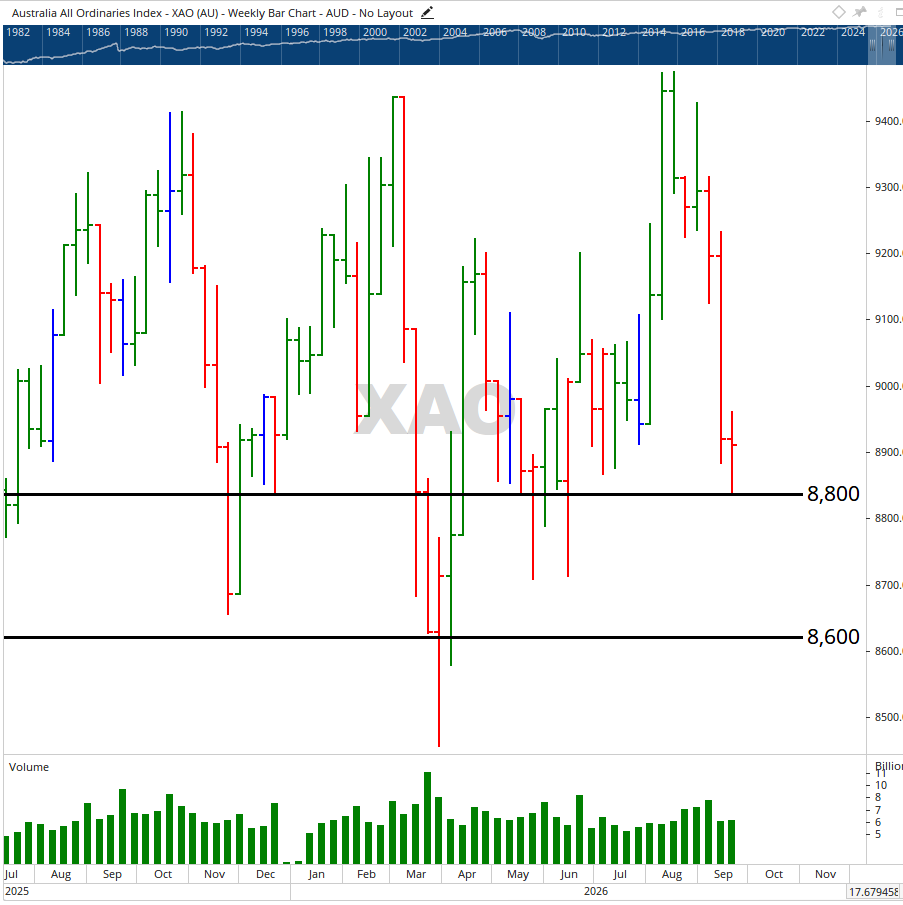
The All Ordinaries Index finished flat last week, slipping just 0.3 per cent as indecision continued to dominate. The recent decline in oil prices may have eased some pressure, but the index remains caught between key levels. Support sits around 8,800, while 8,600 becomes the next major level to watch if sellers regain control.
Healthcare helped offset further weakness in Materials, while Financials finished relatively flat. Materials has now declined for three consecutive weeks and is approaching its longer-term uptrend, making next week particularly important. Strong demand linked to renewable energy and electric vehicles could attract buyers, although uncertainty surrounding the AI investment cycle may create some headwinds.
For now, this remains a stock-picker’s market rather than one that favours passive investors. If the All Ordinaries holds above 8,600, the broader market can still be viewed as moving sideways. However, a decisive break below that level could bring 8,000 into focus and potentially trigger the deepest correction since the tariff-driven sell-off in April last year.
Markets can change quickly, so investors need to stay informed and watch how prices respond around these critical support levels.
Good luck and good trading.
Dale Gillham is the Chief Analyst at Wealth Within and the international bestselling author of How to Beat the Managed Funds by 20%. He is also the author of the award-winning book Accelerate Your Wealth—It’s Your Money, Your Choice, which is available in all good bookshops and online.