Over 40 With Low Super? How to Protect Your Retirement Savings

By Dale Gillham
Reading Time: 7 minutes
General Advice Disclaimer
This article is for general educational purposes only and does not take into account your personal financial circumstances, objectives or needs. Before making any investment decisions, consider your individual circumstances and seek independent financial advice if necessary.
If you're over 40 and feel like you're behind on superannuation, your first instinct might be to think you need to make more money from the market. Find better stocks, take more risk and chase higher returns, but that might be looking at the problem from the wrong angle.

If retirement is potentially less than 20 years away, one of your biggest risks isn't failing to find the next big winners. It's suffering a major loss and spending years trying to recover. The maths explains why.
Why a Major Market Loss Matters More After 40
Imagine you have $100 invested and the market falls 50 per cent; you're left with $50. If the market then rises 50 per cent, you're only back to $75. To turn that $50 back into $100, you need a 100 per cent return. That's why avoiding even part of a major downturn can make such a difference.
Take two hypothetical investors, John and Sally, who both invest $10,000 in the Australian share market 10 years before the Global Financial Crisis in 2007. Using the S&P/ASX 200 price index from November 1997 to November 2017, John remains fully invested, and his $10,000 grew to around $24,600.
Sally invests in the same market but approaches risk differently. Rather than trying to predict the top, she watches the market's long-term trend. Think of it as drawing a line underneath the major lows as the market rises. If price breaks clearly below that line and continues falling, it's a warning that the trend has changed, so she moves to cash.
She doesn't try to pick the exact bottom. She waits until the market stops falling, starts turning, and a new upward trend begins to form before getting back in.
Protect Your Retirement Savings During a Market Downturn
Using the GFC as an ideal example, exiting around the 2007 market peak and re-entering around the 2009 low would have turned Sally’s $10,000 into approximately $53,500 by November 2017. Same starting capital, same market, but she more than doubled John’s return.
The point isn't that Sally picked the top and bottom perfectly; she didn't need to. It's that you don’t need to be a market genius to see that prices had stopped rising and started falling. And in 2009 it became evident that prices had stopped falling and started recovering; that's the real lesson.
Why Time Becomes More Important as Retirement Gets Closer
As you approach retirement, time becomes just as important as return. At 25, you potentially have decades to recover from a major market collapse. At 45, 50 or 55, losing years rebuilding your portfolio can dramatically change your retirement.
So rather than only asking, "How can I make more money?", perhaps there's another question that's just as important: "How do I avoid losing what I have already accumulated?"
If you're over 40 and trying to make the next 20 years count, protecting your capital during major downturns is far more valuable than finding the next hot stock.
Best and Worst Sectors
Materials was the best-performing sector last week gaining 2.5 per cent as stronger commodity prices across iron ore, copper, gold and lithium drove broad buying across the major miners.
Consumer Staples came in second, rising 1.82 per cent driven by better-than-expected results from supermarket giants Coles and Woolworths. Both delivered strong profit growth and improving margins, while renewed interest-rate concerns also encouraged investors back towards more defensive areas of the market.
Healthcare rounded out the top three, gaining 1.11 per cent, helped by a strong result from Ramsay Health Care, which delivered 23 per cent underlying profit growth, which saw its shares surge around 15 per cent.
At the other end of the market, Communication Services was the worst performing sector last week, dropping 2.23 per cent as heavy selling in Telstra and REA Group outweighed strength elsewhere. Telstra is still under pressure following its FY26 result, and REA fell sharply on Thursday
Real Estate was the second-worst sector, dropping 1.94 per cent as investors sold several major property names following reporting season, with Stockland, Mirvac, Charter Hall and Vicinity all falling heavily.
Consumer Discretionary rounded out the worst performers this week, falling 1.7 per cent as hotter inflation lifted expectations for another RBA rate rise. This weighed on retailers, while Wesfarmers also fell after its earnings result.
Best and Worst Stocks
Ansell Limited led the ASX Top 100 this week, climbing more than 17 per cent after a strong FY26 result, with adjusted EPS up 17.8 per cent. Margins also expanded, and management is forecasting further earnings growth in FY27.
Ramsay Health Care followed, gaining more than 14 per cent after a strong FY26 result. Underlying profit rose 22.9 per cent, margins improved, and management forecast further earnings and margin growth in FY27.
Paladin Energy rounded out the top three, rising more than 11 per cent after strong FY26 results showed revenue up 71 per cent. Production was at the top end of guidance and costs at the low end, while the business moved into positive operating cash flow.
At the other end, Stockland was the weakest performer in the top 100 falling 8.3 per cent as investors took profits following its strong post-result rally, while softer housing sales and expectations for fewer residential settlements in FY27 also weighed on sentiment.
Endeavour Group followed, falling 8.26 per cent after a weak FY26 result, with underlying profit down 14.8 per cent. Retail earnings were down 17.6 per cent, and the full-year dividend cut 36 per cent.
Sigma Healthcare Limited rounded out the top 3 losers, falling 7.59 per cent despite a strong FY26 result. Investors focused on cash conversion, integration costs and whether future growth can justify its high valuation.
All Ordinaries Index Update
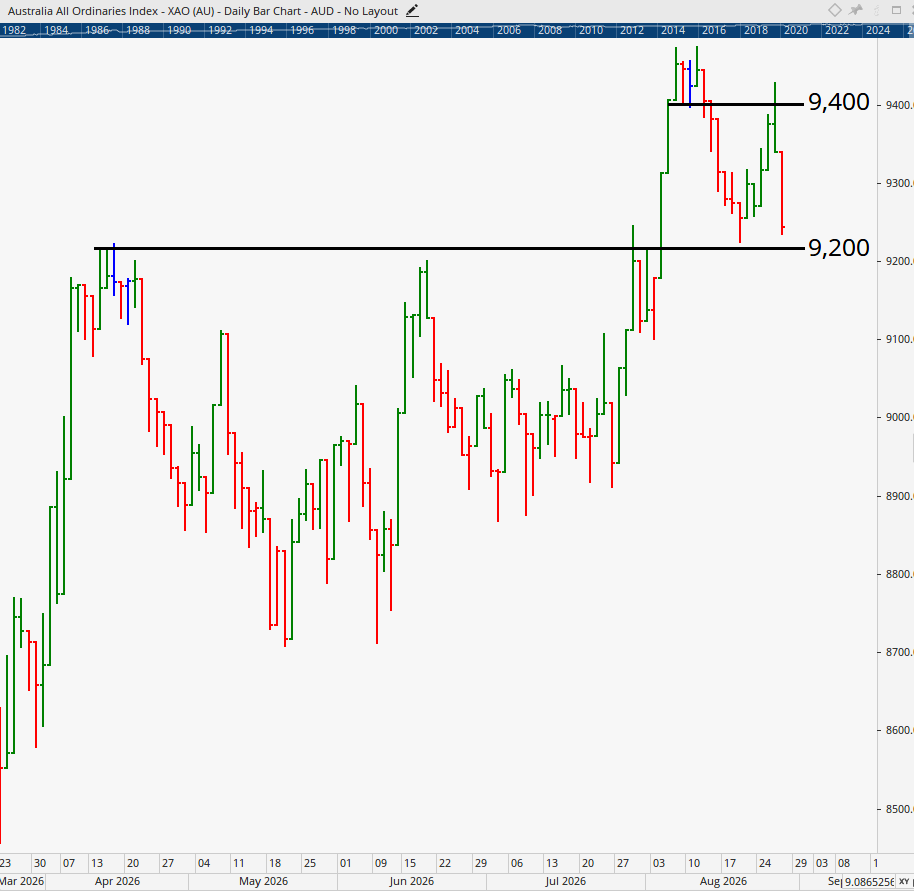
As we close out August, the All-Ordinaries Index finished last week 0.26 per cent higher after another tussle between buyers and sellers.
The week started strongly, with buyers pushing the market towards 9,400. However, Thursday’s selling quickly reversed that momentum and sent the index back towards the previous week’s low and the all-important 9,200 level. The most encouraging sign came on Friday, when buyers returned and once again defended 9,200.
That makes 9,200 the key level to watch. If it continues to hold, sellers will have made two attempts to break below this level and failed. That would strengthen the medium-term bullish picture and, importantly, show that buyers remain willing to step in when the market pulls back.
August is typically an average month for the Australian market, yet this year it has been one of the stronger performers, alongside April, July and November. This suggests reporting season has ultimately delivered enough positives to keep buyers interested despite some significant individual stock falls.
Attention now turns to September, which historically ranks as the second-worst month of the year. That could see volatility increase and some of the stocks that have run hard begin to pull back.
However, that may also create opportunities. Stocks that were heavily sold during reporting season could begin to recover as money rotates out of recent winners and into areas of the market offering better value.
For now, the broader picture remains increasingly bullish, particularly among the larger-cap stocks. The next area I’m watching closely is the mid- and small-cap space. If the broader market continues higher, these stocks could be the next part of the market to catch up.
Good luck and good trading.
Dale Gillham is the Chief Analyst at Wealth Within and the international bestselling author of How to Beat the Managed Funds by 20%. He is also the author of the award-winning book Accelerate Your Wealth—It’s Your Money, Your Choice, which is available in all good bookshops and online.