Australia’s GDP Growth Masks Stalled Living Standards

By Dale Gillham
Reading Time: 7 minutes
Australia’s GDP growth reached 0.4 per cent in the June quarter, slightly above expectations, although annual growth slowed from 2.5 per cent to 2.1 per cent. That’s the number everyone is talking about, but I’m not convinced Australians should be celebrating just yet. When you look beneath the headline, there’s a concerning theme emerging around what is actually driving that growth.
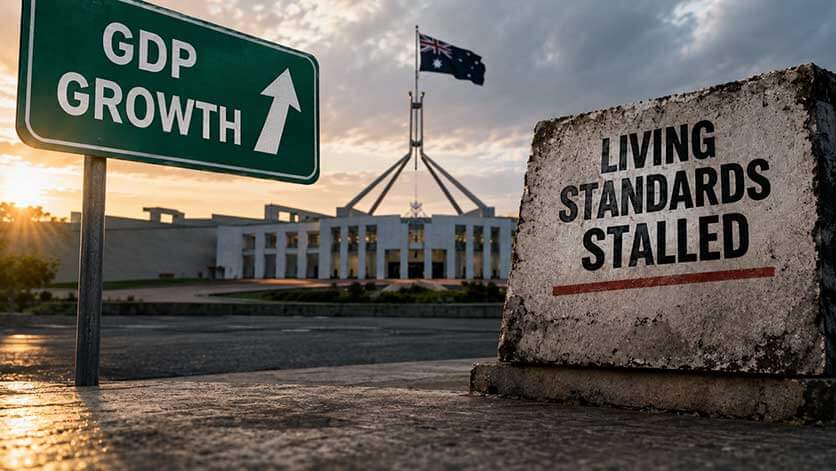
What is really driving Australia’s GDP growth?
Government consumption rose 0.6 per cent, while public demand accounted for around one-quarter of the economy’s quarterly growth. In other words, government spending helped drive the economy, and that’s not necessarily a sign of a strong or healthy economy.
Households also spent more, but much of that increase came from a jump in vehicle purchases, particularly electric and hybrid cars. At the same time, private business investment fell 0.5 per cent. While investment remained higher than a year earlier, the quarterly result hardly points to a broad lift in business expansion.
This is where I think we need to be careful. Government spending can keep the economy moving, but it doesn’t necessarily make the economy more productive or create lasting wealth. GDP per person was flat during the quarter, while labour productivity fell 0.2 per cent over the past year. So, while the economy is technically growing, the average Australian isn’t necessarily getting ahead.
Why government spending matters
And guess who ultimately pays for all this? We do. In the June quarter, government taxation revenue reached $241.3 billion, while total expenses reached $291.5 billion. Despite collecting an enormous amount of revenue, the general government sector still recorded a $2.8 billion net operating deficit.
The more governments spend without generating enough additional economic growth, the greater the pressure on future taxes, government debt and the cost of servicing that debt.
Then there’s the planned Pacific climate meeting, which has faced criticism over more than $19 million in taxpayer-funded event and broadcast costs. At the time of writing, only five non-Pacific leaders had confirmed they would attend. Whether you believe the event is worthwhile or not, Australians are entitled to ask whether every dollar of government spending is producing sufficient value.
What this means for households and investors
This also creates a headache for the RBA. Stronger GDP growth can increase the risk of interest rates remaining higher for longer or rising again. The RBA is already concerned about inflation and says spending across the economy needs to slow while capacity constraints remain.
For households, this means being careful about budgeting for interest rate relief that may not arrive soon. For investors and traders, it means looking beyond the GDP headline and considering whether company earnings, debt levels and price trends support the positive economic story.
So, I wouldn’t get too excited by a 0.4 per cent GDP number. The real question isn’t whether Australia is growing. It’s who is doing the growing, how productive that growth is and how much of the bill is being sent to taxpayers.
Best and worst sectors
Financials were the best-performing sector this week, rising more than 2 per cent as stronger GDP increased expectations of another interest-rate rise. This should support bank margins, while investors returned to the major banks after their sharp falls in August.
Healthcare gained under 0.5 per cent led by CSL, after its agreement with the Trump administration reduced uncertainty surrounding US drug prices and potential pharmaceutical tariffs.
Energy also rose under 0.5 per cent, as escalating tensions between the United States and Iran pushed oil above US$90 a barrel.
At the other end of the market, Information Technology was the weakest sector, falling more than 5 per cent as stronger-than-expected economic growth raised expectations of another interest-rate rise.
Materials was the second-worst sector, dropping just under 4 per cent as weaker gold prices dragged down the major miners and gold producers.
Consumer Discretionary rounded out the worst performers this week, falling more than 2 per cent as rising oil prices and renewed interest-rate concerns threatened to put even more pressure on household budgets. Investors are becoming increasingly cautious about the retail spending outlook.
Best and worst stocks
Challenger Limited led the ASX Top 100 this week, climbing more than 5 per cent as rising bond yields improved the outlook for returns on the assets supporting its annuities.
Insurance Australia Group (ASX: IAG) followed, rising more than 4 per cent as higher bond yields improved the outlook for investment income earned on the premiums it holds before paying claims.
Suncorp Group (ASX: SUN) rounded out the leading performers, also gaining more than 4 per cent as higher bond yields improved the earnings outlook for its large investment portfolio.
Both IAG and SUN remain supported by reports that Japanese insurer Tokio Marine considers these preferred Australian takeover targets. That said, discussions remain uncertain, and no deal has been confirmed.
At the other end, Greatland Resources was the weakest performer, falling more than 9 per cent. This occurred as rising global bond yields pushed gold prices lower and triggered a broad sell-off across Australian gold producers.
With no major negative company announcements, the decline was driven mainly by weaker sentiment towards the gold sector.
NEXTDC Limited followed, also falling more than 9 per cent despite reporting higher revenue and a return to profit. Rising bond yields also weighed heavily on highly valued growth stocks.
Investors also remained cautious about the enormous capital required to expand its data-centre network and the company’s increasing energy and water usage.
SEEK Limited also fell more than 9 per cent as rising interest-rate expectations added to concerns about a slowing employment market and the company’s earnings outlook. The stock also traded without entitlement to its 25-cent dividend this week, which contributed to the fall.
All-Ordinaries Index update
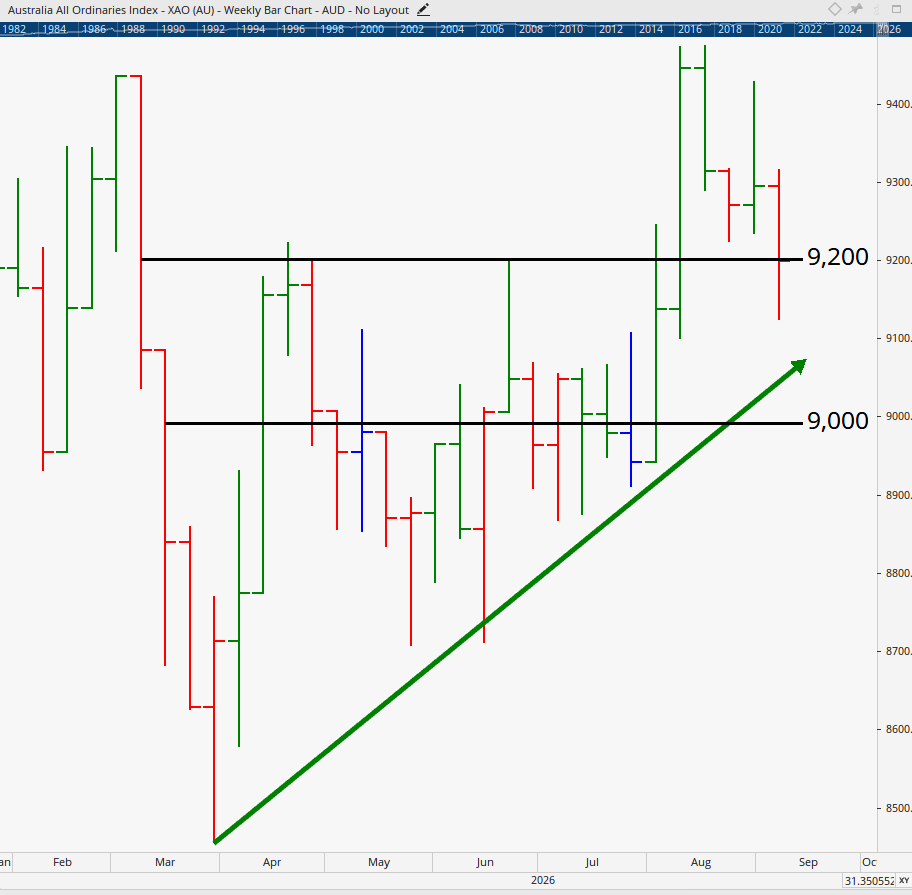
The All-Ordinaries Index fell heavily this week, breaking below the important 9,200 level and recording a loss of around 1 per cent by Thursday’s close. While the decline may look concerning, it is not entirely surprising given the market had recently reached a new all-time high.
Attention now turns to 9,000, which is the next major level to watch. Importantly, this level also aligns with the longer-term uptrend established from the April 2025 low. The market has respected this trend throughout the broader rise, so I would expect buyers to step in again around 9,000.
That makes next week particularly important. If 9,000 holds and the longer-term uptrend remains intact, this decline is likely another healthy correction. However, a decisive break below both would be a much more concerning signal.
Investors got at least some positive news this week, with the Financials sector moving back into positive territory. This may suggest investors are rotating towards more defensive areas of the market as uncertainty increases, making Financials one of the better places to hide over the next few weeks.
For now, it is a waiting game. Next week should reveal whether this is simply a normal pullback after a record high or the beginning of a deeper decline. Either way, further weakness could ultimately create an opportunity to buy quality stocks at lower prices.
Good luck and good trading.
Dale Gillham is the Chief Analyst at Wealth Within and the international bestselling author of How to Beat the Managed Funds by 20%. He is also the author of the award-winning book Accelerate Your Wealth: It’s Your Money, Your Choice, which is available in all good bookshops and online.
Disclaimer
This article contains general information and educational market commentary only. It does not take into account your objectives, financial situation or needs and should not be treated as personal financial advice or as a recommendation to buy, sell or hold any financial product.