Private Credit: The Ticking Time Bomb Inside Your Super

By Dale Gillham
Reading Time: 7 minutes
General Advice Disclaimer
This article is for general educational purposes only and does not take into account your personal financial circumstances, objectives or needs. Before making any investment decisions, consider your individual circumstances and seek independent financial advice if necessary.
Could the next financial crisis already be sitting inside your superannuation account?
It sounds alarmist, but regulators are increasingly questioning the risks building inside Australia’s rapidly growing private credit market, which has expanded to around $250 billion.
What was once a niche area of finance has become one of the country’s fastest-growing sources of funding.

Most Australians have probably never heard of private credit. Yet many may already have exposure through their superannuation. ASIC has repeatedly highlighted the growing connection between private credit and the super sector, warning investors to better understand the risks involved.
Why private credit is becoming a risk to superannuation
The recent collapse of Bathla Group, which entered administration owing approximately $3.4 billion to creditors, has brought those risks into sharper focus.
But Bathla isn't the real story.
The bigger issue is that many of the conditions capable of placing private credit under pressure are already emerging.
Interest rates remain elevated. Inflation has proven more persistent than many expected. Construction costs are significantly higher than before the pandemic, while parts of the property market are beginning to soften.
At the same time, developers who borrowed heavily during years of ultra-low interest rates are being forced to refinance at much higher borrowing costs.
That matters because more than half of Australia’s private credit lending is tied to property development and construction.
When property values are rising and credit remains easy to access, those risks can remain hidden. But when borrowing costs stay high, property values soften and developers struggle to secure fresh funding, pressure can build quickly.
And that is where the risk to superannuation begins.
What happens when private credit comes under pressure
Australia’s private credit market has never been tested through a severe downturn at anything close to its current size.
If several major developers were to fail within a short period, private credit fund managers could be forced to write down the value of their loans. That could lead investors to reduce their exposure and request their money back.
The problem is that private credit assets are not always easy to sell.
What appears liquid during good times can become highly illiquid when markets come under pressure. If investors want their money back, the underlying assets may need to be sold or refinanced.
But if there are few buyers, prices can fall quickly.
That can lead to further write-downs, more redemption requests, and increasing pressure across the sector.
Could private credit trigger another financial crisis?
This is where comparisons with the Global Financial Crisis become relevant, although the two situations are not identical.
The GFC was not simply caused by falling property prices. The crisis intensified when investors discovered that large amounts of property-linked debt were worth far less than expected and that liquidity disappeared when everyone tried to sell at the same time.
The structure of today’s private credit market is different, but the underlying lesson is similar.
Debt problems often appear manageable while asset prices are rising and credit remains available. The real test comes when borrowers struggle to refinance, asset values fall, and investors want their money back at the same time.
That is why recent regulatory warnings deserve attention. ASIC has warned of the sector’s “first significant cracks”, while the Reserve Bank has raised concerns about transparency, leverage and the visibility of risk within private credit markets.
So the real question is not whether Australia is heading for another GFC. It's whether the same types of financial pressure are beginning to emerge in a different part of the system.
Higher interest rates, refinancing stress, weakening property markets, and growing levels of private debt are already putting pressure on borrowers.
If those conditions worsen, the concern is that Bathla may not be remembered as an isolated failure. It could be remembered as an early warning of where the pressure was beginning to build.
Best and worst Sectors
Energy was the best-performing sector this week, rising more than 3 per cent as escalating Middle East conflict pushed Brent crude above US$100 a barrel. Supply disruptions supported oil prices, providing a tailwind for Australian oil producers.
Utilities gained 0.27 per cent as investors sought more defensive businesses while the broader market sold off.
Materials rounded out the top 3, slightly down 0.29 per cent, as the broader sell-off caught major miners, amid inflation and interest-rate concerns. However, record copper prices supported miners earlier in the week, helping cushion the sector’s decline.
At the other end of the market, Information Technology was the weakest sector, falling more than 6 per cent as rising oil prices fuelled inflation and interest-rate fears, weighing on sector heavyweights such as Xero and WiseTech.
Consumer Discretionary was the second-worst sector, dropping just over 4 per cent as higher fuel costs and interest-rate fears threatened household spending. Consumer sentiment also dropped 5.2 per cent, adding to concerns that Australians would cut back on non-essential purchases.
Consumer Staples rounded out the worst performers this week, falling more than 3 per cent as it was caught in the broader sell-off as oil-driven inflation and interest-rate fears weighed on shares.
Best and worst stocks
Whitehaven Coal led the ASX Top 100 this week, climbing more than 5 per cent as Middle East energy disruptions supported the outlook for coal demand. The IEA now forecasts record global coal consumption in 2026, reinforcing that backdrop.
Downer Edi Ltd followed, rising 3.92 per cent as ongoing share buybacks may have helped support its rise this week, with the company reporting further purchases of its own shares.
Santos Limited rounded out the leading performers, gaining 3.9 per cent as escalating Middle East tensions pushed oil prices higher and supported its earnings outlook.
At the other end, XERO Limited was the weakest performer, falling more than 13 per cent as oil-driven inflation and interest-rate fears weighed on technology stocks. Higher rates reduce the value investors place on future earnings, pressuring growth companies such as Xero.
Westgold Resources followed, falling just over 10 per cent despite a strong week for gold stocks. Having outpaced the gold price in recent weeks, its pullback could reflect short-term profit-taking rather than a more serious change in trend.
Wistech Global Limited rounded out the worst performers, falling 9.87 per cent and was caught in this week’s retreat from growth stocks as rising oil prices reignited fears of further rate hikes.
All Ordinaries Index Update
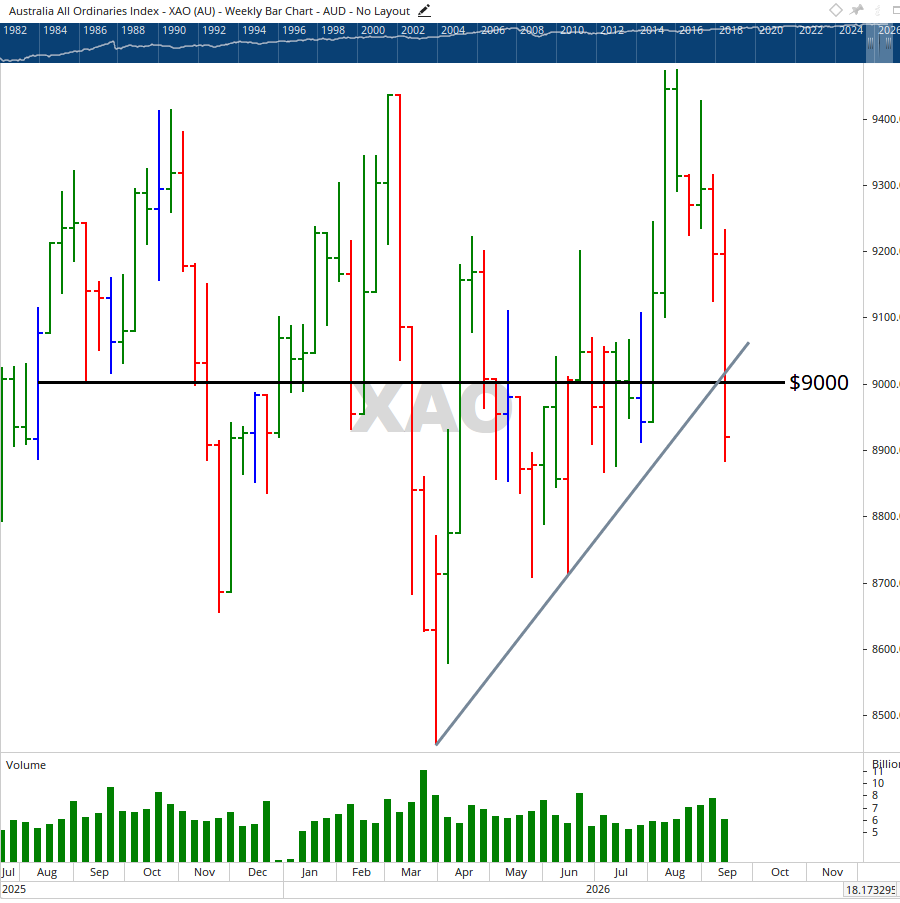
The All-Ordinaries Index sold off again this week, falling more than 2 per cent by Thursday’s close as escalating conflict in the Middle East and rising oil prices weighed on sentiment. The index is now sitting near the critical 9,000 level, making this a genuine make-or-break point for the market.
The significance of 9,000 goes beyond it being a major psychological support level. It also aligns with the longer-term uptrend established from the March 2026 low, which the market has respected ever since. If buyers step in and drive a strong rebound, this decline may ultimately prove to be another healthy correction within the broader uptrend. However, a decisive break below both 9,000 and the uptrend would send a far more concerning signal.
Unsurprisingly, Information Technology led the market lower, falling more than 6 per cent. Technology is one of the market’s more risk-sensitive sectors, making it particularly vulnerable when oil prices rise, uncertainty increases and investors become less willing to hold higher-growth stocks.
Next week should provide greater clarity. The market will either find support and rebound or break lower, with the outcome potentially determined by events unfolding thousands of kilometres away. For Australian investors, 9,000 is now the level that matters most.
Good luck and good trading.
Dale Gillham is the Chief Analyst at Wealth Within and the international bestselling author of How to Beat the Managed Funds by 20%. He is also the author of the award-winning book Accelerate Your Wealth—It’s Your Money, Your Choice, which is available in all good bookstores and online.