How to Navigate ASX Reporting Season Without Losing Control

By Janine Cox
Reading Time: 7 minutes
Reporting season can produce some of the fastest and most confronting moves on the Australian share market. The objective is not to predict every result but to prepare for volatility, protect your capital and manage the risk vs reward before emotions influence your decisions.
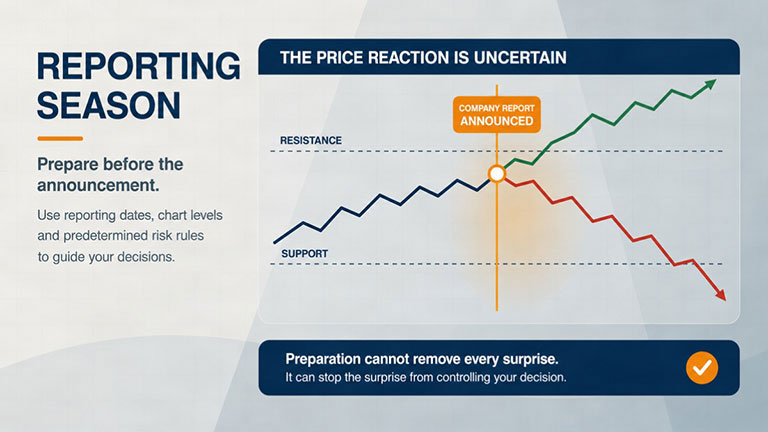
A company may announce higher profit and a larger dividend, yet its share price falls. Another may deliver an unremarkable result and surge. For investors and traders, the lesson is not to predict every surprise. It is to prepare for volatility before it arrives.
To achieve this, I reduce my approach to five key actions, as this helps to separate disciplined traders and investors from emotional ones: know when companies report, define the levels that matter on the chart, understand the capital at risk and decide what you will do before headlines and sharp price moves test your judgement. For further analysis of the companies and sectors in focus, see our recent guide to ASX reporting season stocks and sectors to watch.
Reporting season rewards preparation, not prediction
The first step is knowing the reporting date for every company you hold or are considering buying. The ASX Listed Company Reporting Calendar for 2026 shows the formal reporting windows for companies with June and December balance dates. Individual company investor pages and ASX announcements provide the precise dates as they become available.
It’s recommended marking the company’s reporting date on the chart you use to manage the position, whether that is a weekly or monthly chart. A monthly investor would mark the event on the monthly chart, while someone operating from a weekly chart should place it there. Ex-dividend dates also deserve attention because they can affect price behaviour, which reinforces why these dates belong in an investor’s preparation.
This does not tell you whether a stock will rise or fall. It tells you when the probability of a larger move may increase. That knowledge can change how you manage an existing holding, whether you open a new position immediately before a result, and how much exposure you are prepared to carry through the announcement.
Why good news can still send a share price lower
One of most important observations during reporting season is that a good result does not automatically mean good news for the share price. Markets respond to the gap between what was expected and what was delivered. A strong profit can disappoint if investors anticipated more, the dividend falls short of consensus, the valuation already reflects an exceptional outcome, or management lowers its future guidance.
This is why the headline number rarely tells the whole story. The market is forward-looking. Investors may focus more heavily on revenue quality, costs, margins and management’s outlook than on the profit just reported. ASX Guidance Note 8 on continuous disclosure discusses market-sensitive earnings information and situations in which an entity’s earnings differ materially from market expectations. It supports our point that expectations and guidance can matter as much as the reported result.
Profit-taking can also occur after a strong run. Institutions and other holders may use the announcement as an opportunity to lock in gains, particularly when a stock’s valuation is stretched. Therefore, the useful question is not simply, ‘Was the report good?’ It is, ‘How did the price respond, and what does that response reveal about supply, demand and expectations?’
Let the chart define the risk
Listening to fundamental commentary without looking at the chart is like operating blindfolded. The announcement may explain a move after it occurs, but the chart can help an investor prepare for it. Before the result, mark meaningful support and resistance on the chart, identify where the trend may weaken and consider where profits could be taken if the price accelerates higher.
These levels are not predictions; they are decision points. A small move below a nearby level may require patience and confirmation at the end of the day or week. A 20 per cent fall through an important level is materially different. The response also depends on the broader market and sector environment, because bearish conditions can allow weakness to persist for weeks or months.
Volatility changes the risk environment, so preparation and clear decision-making matter. Wealth Within explores this principle further in its analysis of the ASX reporting season stocks and sectors to watch, emphasising the importance of reading the charts, assessing each sector and following a clear trading plan rather than reacting emotionally.
The same principle applies after a share price surges. Instead of chasing strength because of the fear of missing out, wait for the chart to reveal whether the new trend is sustainable. A pullback followed by confirmation of renewed strength can provide clearer information about direction and risk than buying simply because the stock has appeared in the headlines.
Set the rules before emotions take over
Reporting season can magnify hope, fear, greed and regret. Therefore, investors need to answer a difficult question in advance: how much profit are you prepared to give back? Many people spend their time calculating potential upside while failing to define the downside. When volatility arrives, they have no documented exit strategy and watch a substantial gain disappear.
A trading or investment plan should consider both sides. It should record the relevant timeframe, chart levels, initial risk, the conditions that would confirm further weakness and the rules for taking profits or exiting. The correct response will vary according to the strategy. A short-term trader may reduce exposure ahead of a result, while a longer-term investor may tolerate normal volatility but still act when the underlying trend materially weakens.
Cochlear and CSL offer cautionary examples of why adopting a long-term strategy does not mean ignoring every decline. Review company announcements and management guidance, but rely on the chart and your predetermined rules when deciding how new information affects your position and capital. Dale Gillham, chief analyst of Wealth Within, explains how investors can use trendlines to help manage longer-term market risk in How to Beat the Managed Funds by 20%.
Liquidity, sectors and the wider market
Smaller companies can also be punished more severely because limited liquidity can amplify a rush for the exit. This matters when a portfolio has been accumulated stock by stock without a deliberate structure. Reporting season is an opportunity to review weaker holdings, examine whether each position still fits the intended timeframe and remove ‘dead wood’ according to a tested strategy rather than frustration.
Sector charts add another layer. A result can confirm a new trend, reverse an existing one or send a stock back to test a significant prior low. Healthcare shares, for example, may rebound after heavy falls, but a rebound alone does not guarantee an immediate return to all-time highs. If an important low holds and price confirms a new rise, the opportunity may become more reliable. If that level breaks, the decline may continue.
The same discipline should be applied to the overall Australian market. Company reports collectively reveal information about earnings growth, costs and business confidence. Our latest reporting season outlook for investors examines what these company results could be signalling for 2027.
At the retirement-savings level, the regulatory focus on risk is also real. ASIC’s 2026 report on safeguarding super examines how platform trustees monitor risks to retirement savings. This supports Janine’s broader call for investors to pay attention to how capital is protected, not only how returns are promoted.
A practical reporting season checklist
My approach comes down to following five actions: know the reporting and ex-dividend dates, read the company announcement and management guidance, review the stock and sector charts, mark your support, resistance, and predetermined decision levels, and follow the rules you set before the reporting season event.
Above all, avoid becoming fixed in the belief that a company must rise because its products, expansion plans or previous reports appear strong. A stock that falls 20 per cent is not automatically a bargain. It may become much cheaper if the chart continues to confirm weakness. Likewise, a stock that jumps after its result does not have to be chased immediately. Reporting season always creates further opportunities.
Successful investors do not need to forecast every announcement. They need a repeatable process that protects capital, reduces emotional reactions and leaves them ready to act when price confirms the next opportunity.
Investors who want to develop an in-depth understanding of risk management can explore the Short Course in Share Trading. For comprehensive education in analysing shares, managing risk and applying structured trading rules, explore the Diploma of Share Trading and Investment. My central lesson: preparation cannot remove every surprise, but it can stop surprises from controlling your decisions.